- Animals
- ›Chordates
- ›Vertebrates
- ›Birds
- ›Swifts and Hummingbirds
- ›Hummingbirds
- ›Brilliants, Coquettes, and Allies
- ›Coquettes and Allies
- ›Chalcostigma
On eBird ↗
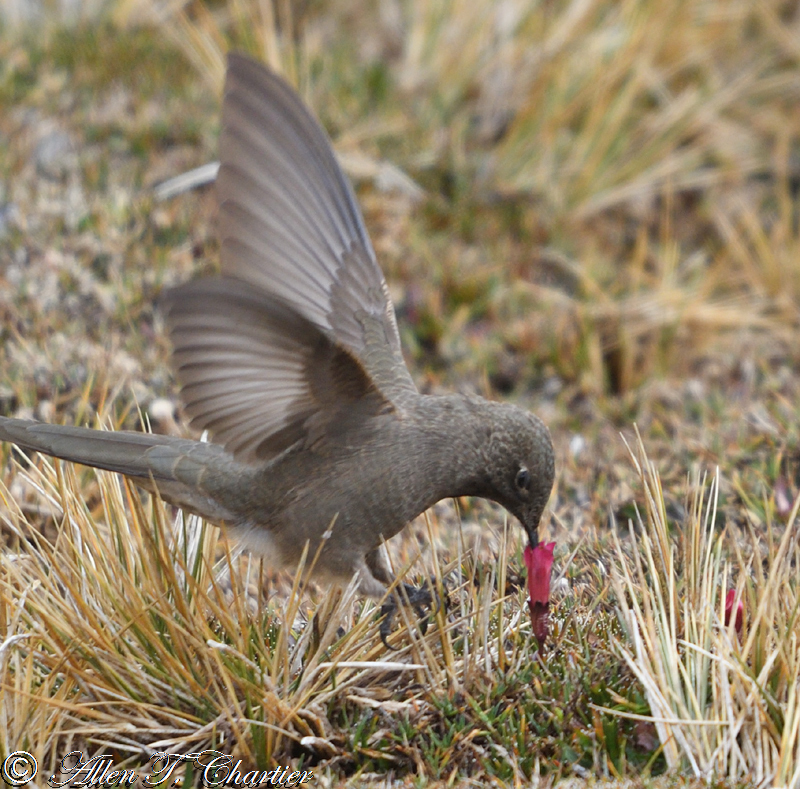
Olivaceous Thornbill
Live sightings near you, the range map, bar charts of when it is seen, and Macaulay Library photos and recordings.
Olivaceous Thornbill
Chalcostigma olivaceum
The olivaceous thornbill (Chalcostigma olivaceum) is a species of hummingbird in the family Trochilidae. It is found in Peru and Bolivia. Its natural habitat is subtropical or tropical high-altitude grassland.
From the article Olivaceous thornbill on Wikipedia (CC BY-SA), quoted section by section
Description
The olivaceous thornbill is 12 to 15 cm (4.7 to 5.9 in) long. One male specimen weighed 8.2 g (0.29 oz) and a female one 6.6 g (0.23 oz). Both sexes have a short black bill. Adult males of the nominate subspecies are mostly dull dark bronzy or olive green, including the tail. The face and throat are dark sooty gray. It has a narrow gorget that is glittering green at the throat and shades through yellow, pink, and purple to blue at its bottom. The adult nominate female is essentially the same but the gorget is much smaller or may be absent. Juveniles have tan margins on some feathers; males' throats are gray brown and females' gray brown with pale margins. C. o. pallens is similar to the nominate but smaller and overall paler. The upperparts have a grayish cast to the bronzy or olive green, the tail is bronzy olive brown, and the underparts are dark sooty brown.
Range & habitat
The nominate subspecies of olivaceous thornbill is found from Apurímac in southeastern Peru to Bolivia's La Paz Department. Its distribution is nearly continuous along this axis. C. o. pallens is found on the western slope of the Peruvian Andes between the departments of Ancash and Junín. Its distribution is more patchy, with records only at scattered sites. In elevation the species ranges between 3,500 and 4,700 m (11,500 and 15,400 ft) in Peru and 3,100 and 4,500 m (10,200 and 14,800 ft) in Bolivia. The species is most often found in somewhat humid puna grasslands but also inhabits low scrub and the edges of dense woods of Polylepis and Gynoxys.
Wikipedia: “Distribution and habitat”
What it does
The olivaceous thornbill feeds on both nectar and insects. Details of its diet are lacking but there is some evidence that insects predominate. It forages near the ground and has even been observed walking on matted grass. It captures small insects by sallying from the ground or by gleaning from low vegetation. Males defend feeding territories.
Wikipedia: “Feeding”
Listen
Looking for field recordings…
Where it lives
Recorded sightings
—
geo-referenced records in GBIF, from museums, herbaria and field observers.
Drag the globe to turn it. Dots are where records exist, not a range map; darker means more records.
In the stacks
Searching the stacks…
Every page naming Chalcostigma olivaceum in the Biodiversity Heritage Library →
This page is assembled live from iNaturalist, GBIF, Wikipedia, the Source Library and the Internet Archive. It is not yet part of the hand-edited codex. iNaturalist taxon 5907.