- Animals
- ›Chordates
- ›Vertebrates
- ›Birds
- ›Swifts and Hummingbirds
- ›Hummingbirds
- ›Bee Hummingbirds, Emeralds, Mountain-gems, and Allies
- ›Emerald Hummingbirds and Allies
- ›Chalybura
On eBird ↗
White-vented Plumeleteer
Live sightings near you, the range map, bar charts of when it is seen, and Macaulay Library photos and recordings.
White-vented Plumeleteer
Chalybura buffonii
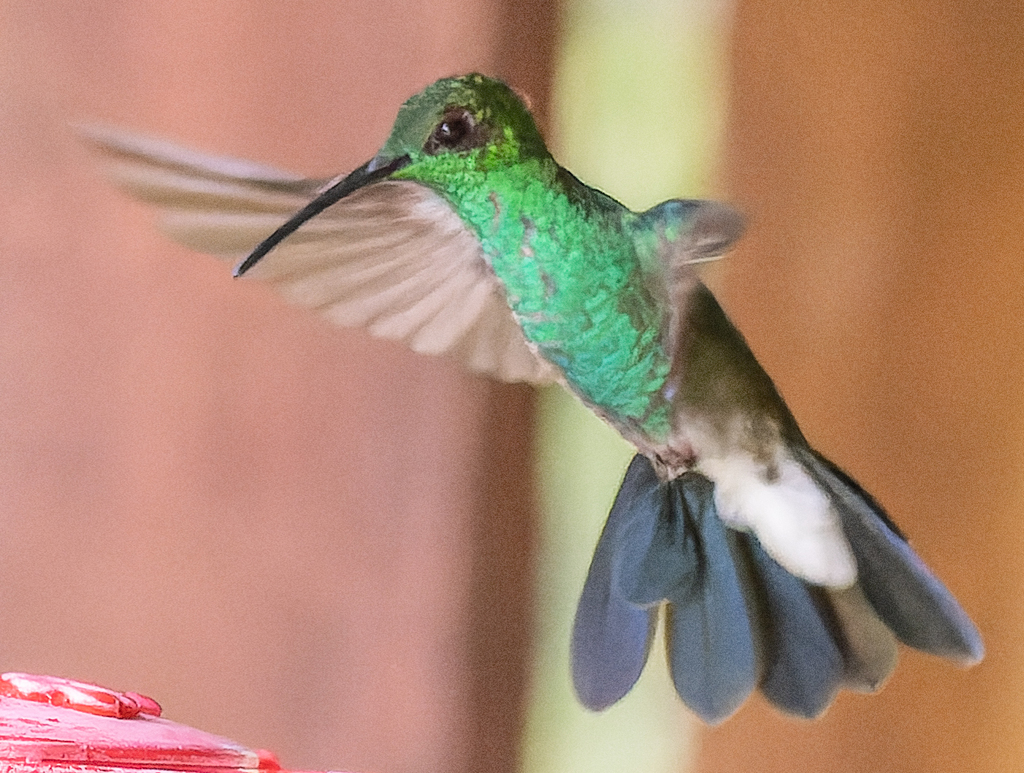
The white-vented plumeleteer (Chalybura buffonii) is a species of hummingbird in the "emeralds", tribe Trochilini of subfamily Trochilinae. It is found in Colombia, Ecuador, Panama, Peru, and Venezuela.
From the article White-vented plumeleteer on Wikipedia (CC BY-SA), quoted section by section
Description
The white-vented plumeleteer is 10.5 to 12 cm (4.1 to 4.7 in) long. Males weigh 6 to 7.3 g (0.21 to 0.26 oz) and females 5.9 to 7.9 g (0.21 to 0.28 oz). All of the subspecies except intermedia have a black bill and black feet; that one has a pinkish base to the mandible and pale pink to red feet. Males of the nominate subspecies C. b. buffonii have mostly dark metallic green upperparts with a bronzy tinge to the crown and coppery bronze uppertail coverts. Their upper breast is bluish, lower breast bright metallic green, the lower belly whitish, and the undertail coverts long and white. Their tail is blue-black with a bronze gloss on the central feathers. Nominate females are paler metallic green above and gray below with green speckles on the side. Their tail is like the males' with the addition of dull gray tips on the outer feathers. Subspecies C. b. micans is larger than the nominate. Males' central tail feathers are a deeper blue and females' undersides are a clearer gray. C. b. aeneicauda males are a more golden-green below than the nominate and their central tail feathers are bright bronze-green to copper-bronze. Females have pale gray underparts with sparse green flecks. C. b. caeruleogaster is the largest subspecies. The male has a bluish green throat and belly and a blue breast. Females have gray underparts with no flecking. C. b. …
Range & habitat
The subspecies of white-vented plumeleteer are distributed thus:
C. b. micans, central and eastern Panama, western Colombia, and Colombia's Cauca River and far upper Magdalena River valleys C. b. buffonii, from central Colombia's upper and middle Magdalena valley east through extreme northeastern Colombia into northwestern Venezuela C. b. aeneicauda, Colombia's lower Magdalena valley and Santa Marta region and east into western and north-central Venezuela C. b. caeruleogaster, eastern slope of Colombia's Eastern Andes C. b. intermedia, southwestern Ecuador and northwestern Peru The white-vented plumeleteer inhabits a variety of landscapes including the edges and interiors of dry, moist, and wet forests, semi-open woodlands, secondary forest, and scrublands. The subspecies differ somewhat in their requirements; only caeruleogaster and sometimes buffonii frequent the interior of wet forest. In elevation the species ranges from sea level to as high as 2,000 m (6,600 ft).
Wikipedia: “Distribution and habitat”
What it does
The white-vented plumeleteer forages for nectar at a wide variety of flowering plants from the understory almost to the canopy. It mostly forages by trap-lining, visiting a circuit of flowers, but also aggressively defends rich patches. In addition to nectar it catches small arthropods by hawking from a perch, hovering, and hover-gleaning from vegetation and spider webs.
Wikipedia: “Feeding”
Listen
Looking for field recordings…
Where it lives
Recorded sightings
—
geo-referenced records in GBIF, from museums, herbaria and field observers.
Drag the globe to turn it. Dots are where records exist, not a range map; darker means more records.
In the stacks
Searching the stacks…
Every page naming Chalybura buffonii in the Biodiversity Heritage Library →
This page is assembled live from iNaturalist, GBIF, Wikipedia, the Source Library and the Internet Archive. It is not yet part of the hand-edited codex. iNaturalist taxon 5810.