- Animals
- ›Chordates
- ›Vertebrates
- ›Birds
- ›Swifts and Hummingbirds
- ›Hummingbirds
- ›Mango Hummingbirds and Allies
- ›Anthracothorax
On eBird ↗
Green Mango
Live sightings near you, the range map, bar charts of when it is seen, and Macaulay Library photos and recordings.
Green Mango
Anthracothorax viridis
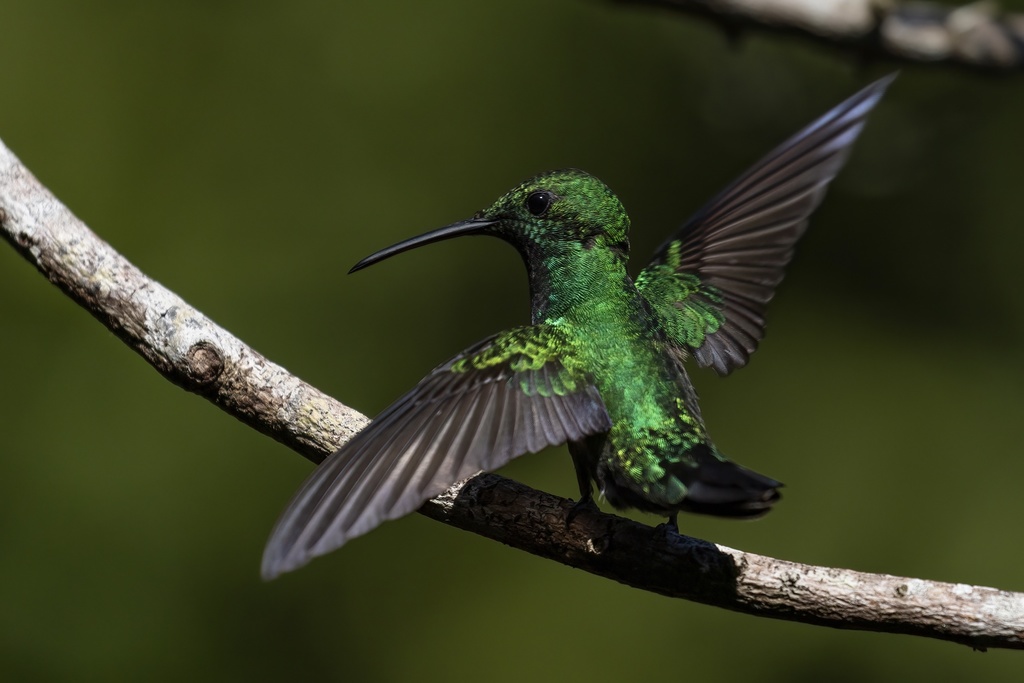
The green mango (Anthracothorax viridis) is a large species of hummingbird endemic to the main island of Puerto Rico. It is usually found in the mountainous regions of the island, often in coffee and other kind of plantations. They usually feed on the nectar found in Heliconia flowers. Their feather coloration is mainly solid dark green with a dark blue and black tail, but solid purple-black birds are common. Females are less glossy and females have...
From the article Green mango on Wikipedia (CC BY-SA), quoted section by section
Description
The green mango is 11 to 14 cm (4.3 to 5.5 in) long and weighs about 7 g (0.25 oz). The sexes are alike except that the female has a tiny white spot behind the eye. Adults' upperparts are emerald green, their underparts metallic blue-green, and their tail metallic blue-black with white tips to its feathers. Immatures have a brownish tinge to the head and back.
Range & habitat
The green mango is found only on Puerto Rico. It primarily inhabits forests and plantations in the central and western mountains and is most common between 800 and 1,200 m (2,600 and 3,900 ft) of elevation. It is rare in coastal areas.
Wikipedia: “Distribution and habitat”
What it does
The green mango feeds on both nectar and arthropods. It takes nectar from a wide variety of flowering trees, shrubs, and vines, and males defend flowering trees. Insects are mostly taken on the wing and spiders from leaves and bark. It forages from the low understory to above tree-top level.
Wikipedia: “Feeding”
Listen
Looking for field recordings…
Where it lives
Recorded sightings
—
geo-referenced records in GBIF, from museums, herbaria and field observers.
Drag the globe to turn it. Dots are where records exist, not a range map; darker means more records.
In the stacks
Searching the stacks…
Every page naming Anthracothorax viridis in the Biodiversity Heritage Library →
This page is assembled live from iNaturalist, GBIF, Wikipedia, the Source Library and the Internet Archive. It is not yet part of the hand-edited codex. iNaturalist taxon 5806.