- Animals
- ›Arthropods
- ›Hexapods
- ›Insects
- ›Winged and Once-winged Insects
- ›Butterflies and Moths
- ›Butterflies
- ›Brush-footed Butterflies
- ›Tropical Brushfoots
- ›Eighty-eights and Allies
- ›Perisama
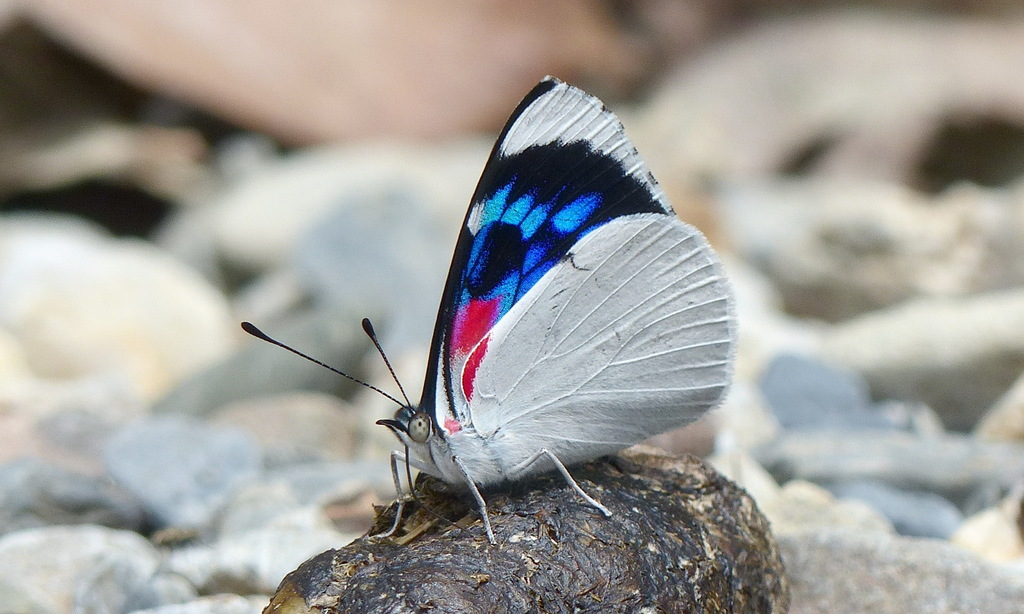
Perisama bomplandii
Perisama bomplandii, or Bomplandi's perisama, is a butterfly belonging to the family Nymphalidae. The species was first described by Félix Édouard Guérin-Méneville in 1844.
From the article Perisama bomplandii on Wikipedia (CC BY-SA), quoted section by section
Description
The wingspan of Perisama bomplandii is about 45–50 millimetres (1.8–2.0 in). These butterflies are the largest of the genus Perisama. Coloration and pattern of these butterflies are quite variable depending on subspecies. Usually the uppersides of the wings are blue black. The forewings are crossed obliquely from the costal margin to the inner margin by wide bands of golden green or blue. Close to the apex sometimes there is a small white spot. On the uppersides of the hindwings the outer margins are bordered with greenish or blueish. At the base there is a brilliant blue. The underside of the anterior wings is black, with a row of five blue spots, a brown inner margin and a gray base followed by light blue. The apex and the outer margin are gray. The undersides of the posterior wings are whitish or grayish, crossed by two black lines. Larvae feed on Serjania species.
Listen
Looking for field recordings…
Where it lives
Recorded sightings
—
geo-referenced records in GBIF, from museums, herbaria and field observers.
Drag the globe to turn it. Dots are where records exist, not a range map; darker means more records.
In the stacks
Searching the stacks…
Every page naming Perisama bomplandii in the Biodiversity Heritage Library →
This page is assembled live from iNaturalist, GBIF, Wikipedia, the Source Library and the Internet Archive. It is not yet part of the hand-edited codex. iNaturalist taxon 565973.