- Animals
- ›Arthropods
- ›Hexapods
- ›Insects
- ›Winged and Once-winged Insects
- ›True Bugs, Hoppers, Aphids, and allies
- ›True Bugs
- ›Cimicomorph Bugs
- ›Reduvioidea
- ›Assassin Bugs
- ›Reduviinae
- ›Reduviini
- ›Reduvius
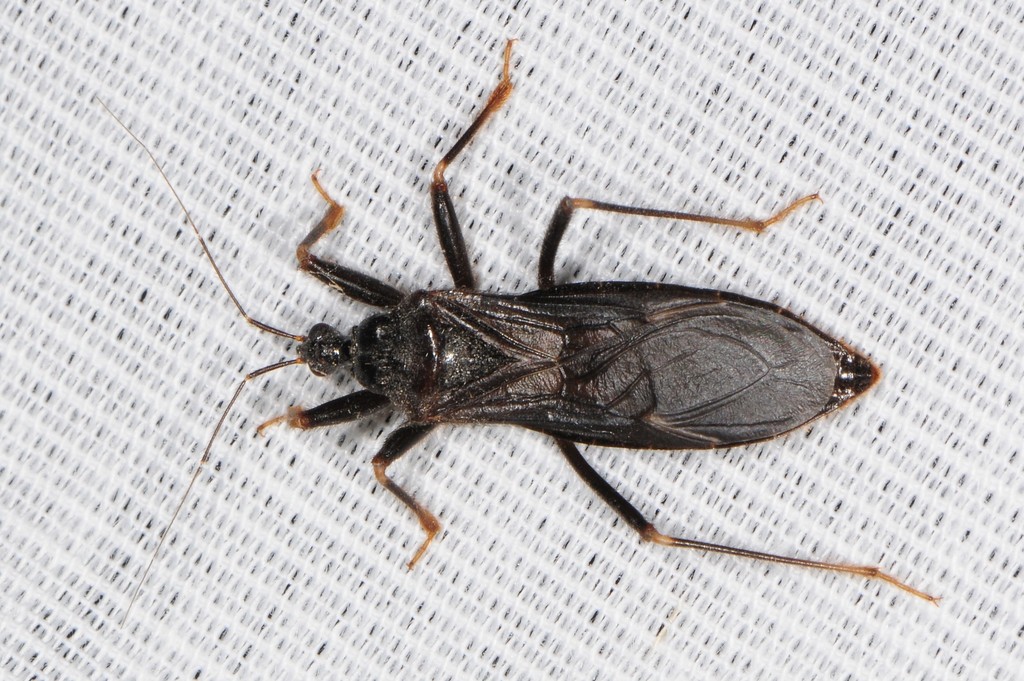
Masked Hunter
Reduvius personatus
Reduvius personatus or the masked hunter is an insect belonging to the assassin bug (Reduviidae) family. The name is because its nymphs camouflage themselves with dust. The masked hunter is a predator of small arthropods, including woodlice, lacewings, earwigs, bed bugs and termites. Masked hunters do not feed on human blood, but can deliver a rostral stab to humans in self-defense when mishandled. The stab can be painful, but masked hunters do not carry Chagas disease, unlike the kissing bug for which they are sometimes mistaken.
From the article Reduvius personatus on Wikipedia (CC BY-SA), quoted section by section
Range & habitat
The masked hunter has a Holarctic distribution. It is native to Europe and western Asia, but has since been introduced to Australia, India, Africa, and North America. Masked hunters were likely introduced into North America accidentally in the late 1800s to early 1900s; they were first found in Canada in 1905 and in the United States in 1917, and are now common in the Central and Eastern United States.
Wikipedia: “Distribution”
What it does
Masked hunters, like other Hemiptera, undergo incomplete metamorphosis. Early stages of the lifecycle look like small adults and are called nymphs. Normally, one generation of masked hunter bugs occurs per year. Adults are common during midsummer, but can also be found in the winter.
Wikipedia: “Life cycle”
Listen
Looking for field recordings…
Where it lives
Recorded sightings
—
geo-referenced records in GBIF, from museums, herbaria and field observers.
Drag the globe to turn it. Dots are where records exist, not a range map; darker means more records.
In the stacks
Searching the stacks…
Every page naming Reduvius personatus in the Biodiversity Heritage Library →
This page is assembled live from iNaturalist, GBIF, Wikipedia, the Source Library and the Internet Archive. It is not yet part of the hand-edited codex. iNaturalist taxon 56521.