On eBird ↗
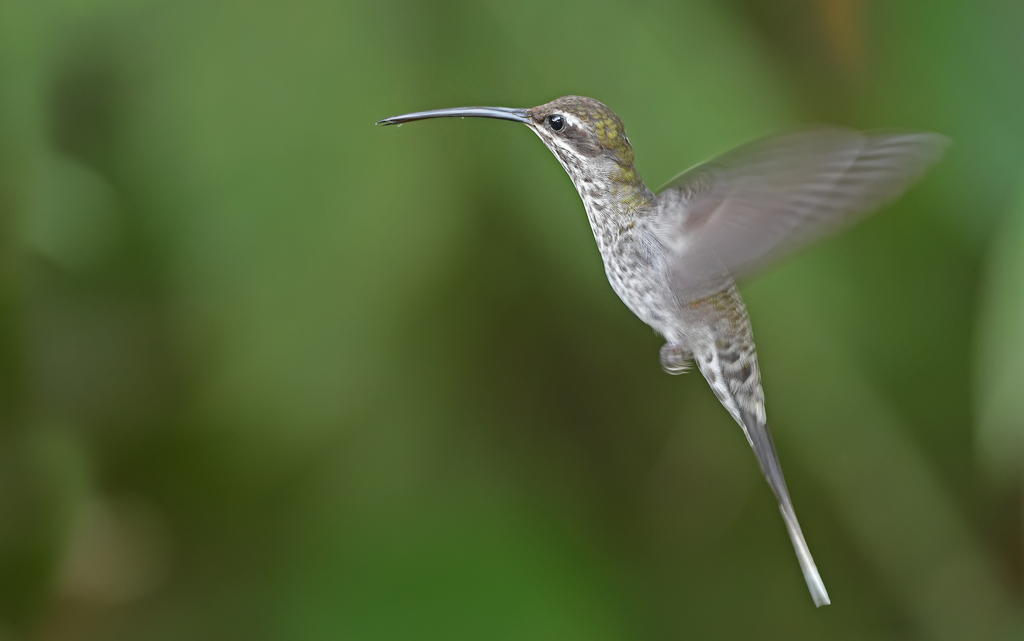
White-bearded Hermit
Live sightings near you, the range map, bar charts of when it is seen, and Macaulay Library photos and recordings.
White-bearded Hermit
Phaethornis hispidus
The white-bearded hermit (Phaethornis hispidus) is a species of hummingbird in the family Trochilidae. It is found in Bolivia, Brazil, Colombia, Ecuador, Peru, and Venezuela.
From the article White-bearded hermit on Wikipedia (CC BY-SA), quoted section by section
Description
The white-bearded hermit is about 13 to 14 cm (5.1 to 5.5 in) long and weighs 4 to 6 g (0.14 to 0.21 oz). This medium-sized hermit has bronzy green upperparts with gray margins on the uppertail coverts. The underparts are gray. The face has a black "mask" with a white supercilium and malar stripe; the center of the throat has a white stripe. The female has identical plumage but shorter wings and a shorter and more decurved bill than the male.
Range & habitat
The white-bearded hermit is found in Amazonia, from the Andean foothills of western and southern Venezuela south through eastern Colombia, Ecuador, and Peru to northeastern Bolivia, and east throughout western Amazonian Brazil. In elevation it usually ranges as high as 850 m (2,800 ft) but has been recorded up to 1,200 m (3,900 ft) in Peru. It is a bird of humid landscapes. In the lowlands it mostly inhabits regularly inundated areas, such as along rivers and in várzea forest. At higher elevations if favors gallery forest in the cerrado and llanos.
Wikipedia: “Distribution and habitat”
What it does
The white-bearded hermit is a "trap-line" feeder like other hermit hummingbirds, visiting a circuit of a wide variety of flowering plants for nectar. It also consumes small arthropods.
Wikipedia: “Feeding”
Listen
Looking for field recordings…
Where it lives
Recorded sightings
—
geo-referenced records in GBIF, from museums, herbaria and field observers.
Drag the globe to turn it. Dots are where records exist, not a range map; darker means more records.
In the stacks
Searching the stacks…
Every page naming Phaethornis hispidus in the Biodiversity Heritage Library →
This page is assembled live from iNaturalist, GBIF, Wikipedia, the Source Library and the Internet Archive. It is not yet part of the hand-edited codex. iNaturalist taxon 5620.