On eBird ↗
Long-tailed Hermit
Live sightings near you, the range map, bar charts of when it is seen, and Macaulay Library photos and recordings.
Long-tailed Hermit
Phaethornis superciliosus
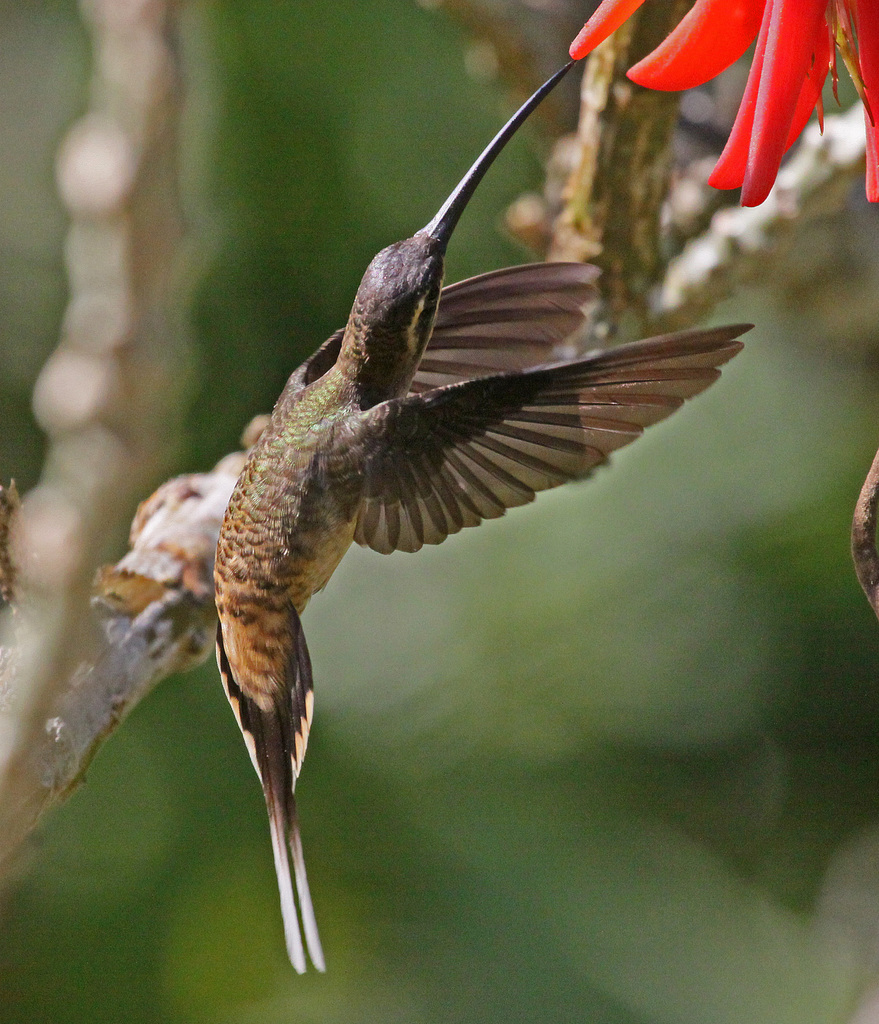
The long-tailed hermit (Phaethornis superciliosus) is a large hummingbird that is a resident breeder in Venezuela, the Guianas, and north-eastern Brazil. This species is commonly referred to as the eastern long-tailed hermit, but it is likely, following recommendations from Gary Stiles in February 2006, that the new name will be adopted by most authorities.
From the article Long-tailed hermit on Wikipedia (CC BY-SA), quoted section by section
Description
The adult long-tailed hermit is mainly dull brownish green above with a buff-tinged rump. It has a dark mask through the eye, bordered above and below with whitish-buff stripes. The underparts are pale greyish-buff in colour. The sexes are similar, although the female is slightly smaller. It is the largest of hermit hummingbirds, with a length of around 15 cm (5.9 in) and a body mass of 6.3 g (0.22 oz). During the breeding season, male long-tailed hermits sing in communal leks of up to several dozen birds, and also wiggle their long tails in display. Competitive lek singing can occupy half of the daylight hours, the purpose of course being to attract females. The female selects the best lek singer to mate with. The song consists of sharp tsuk sounds. The female long-tailed hermit is solely responsible for nest construction, incubation and feeding the young. She lays two white eggs in a conical nest of fibres and cobwebs suspended under a large Heliconia or banana leaf.
Range & habitat
The long-tailed hermit inhabits forest undergrowth, usually near water and its preferred food plants. It is 13.5 cm long and weighs 4-6 g. The bill is very long and decurved (3.6-4.3 cm), with a red tipped black lower mandible, and the central feathers of the tapered tail are long (6.3-6.8 cm) and white-tipped.
Wikipedia: “Distribution and habitat”
What it does
The food of this species is nectar, taken from large flowers, such as Heliconias, gingers and passion flowers, and small insects and spiders taken as an essential source of protein. Hatchlings are fed by the female with regurgitated invertebrates. Long-tailed hermits are trap-line feeders; they do not defend territory, but visit seasonal flowers on routes through the forest up to 1 km long.
Wikipedia: “Behaviour”
Listen
Looking for field recordings…
Where it lives
Recorded sightings
—
geo-referenced records in GBIF, from museums, herbaria and field observers.
Drag the globe to turn it. Dots are where records exist, not a range map; darker means more records.
In the stacks
Searching the stacks…
Every page naming Phaethornis superciliosus in the Biodiversity Heritage Library →
This page is assembled live from iNaturalist, GBIF, Wikipedia, the Source Library and the Internet Archive. It is not yet part of the hand-edited codex. iNaturalist taxon 5617.