On eBird ↗
Reddish Hermit
Live sightings near you, the range map, bar charts of when it is seen, and Macaulay Library photos and recordings.
Reddish Hermit
Phaethornis ruber
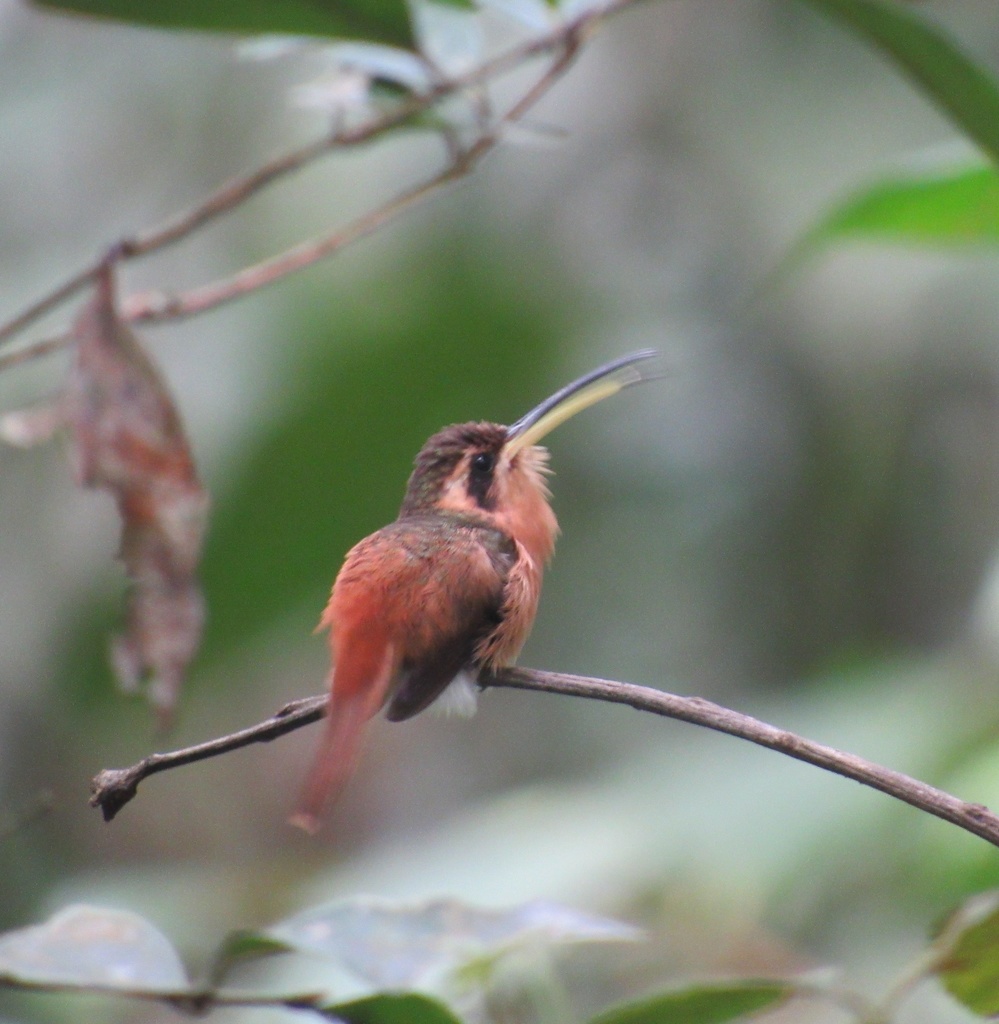
The reddish hermit (Phaethornis ruber) is a species of bird in the Trochilidae family, the hummingbirds. It is found in Bolivia, Brazil, Colombia, Ecuador, Peru, Venezuela, and in the Guianas. At 7.5 cm (3 in) and a weight under 3 grams, it is among the smallest of the hermits and smallest birds overall. Its natural habitats are forest and woodland, primarily humid.
From the article Reddish hermit on Wikipedia (CC BY-SA), quoted section by section
Description
The reddish hermit is 8 to 9 cm (3.1 to 3.5 in) long and weighs 1.8 to 3 g (0.06 to 0.11 oz). All subspecies are generally dark green and rufous on the upperparts and cinnamon rufous on the underparts. Males have a black band on the chest and the tail feather have narrow white or reddish tips. Females have lighter underparts than the males. P. r. episcopus is about the same size as the nominate but has orange-rufous rather than cinnamon-rufous underparts and white tips to the tail. P. r. nigricinctus is the smallest subspecies; it has the richest rufous underparts. P. r. longipennis is the largest subspecies. It has a whitish chin and its central tail feathers have rufous tips.
Range & habitat
The subspecies of reddish hermit are distributed thus:
P. r. episcopus, central and eastern Venezuela, Guyana, and northwestern Brazil's Roraima state P. r. ruber, Suriname and French Guiana through Brazil as far south as northern Paraná state and in the west to southeastern Peru and northern Bolivia. P. r. nigricinctus, eastern and southern Colombia and extreme southwestern Venezuela south through eastern Ecuador into northeastern Peru and northwestern Brazil. P. r. longipennis, southeastern Peru from the department of Pasco to northern Cuzco.
Wikipedia: “Distribution and habitat”
What it does
The reddish hermit is a "trap-line" feeder like other hermit hummingbirds, visiting a circuit of many species of flowering plants for nectar. It also consumes small arthropods. Nectar robbing by piercing the base of a flower has been regularly observed in southeastern Brazil.
Wikipedia: “Feeding”
Listen
Looking for field recordings…
Where it lives
Recorded sightings
—
geo-referenced records in GBIF, from museums, herbaria and field observers.
Drag the globe to turn it. Dots are where records exist, not a range map; darker means more records.
In the stacks
Searching the stacks…
Every page naming Phaethornis ruber in the Biodiversity Heritage Library →
This page is assembled live from iNaturalist, GBIF, Wikipedia, the Source Library and the Internet Archive. It is not yet part of the hand-edited codex. iNaturalist taxon 5612.