- Animals
- ›Chordates
- ›Vertebrates
- ›Reptiles
- ›Snakes and Lizards
- ›Snakes
- ›Madagascar Brook Snakes
- ›Madagascarophis
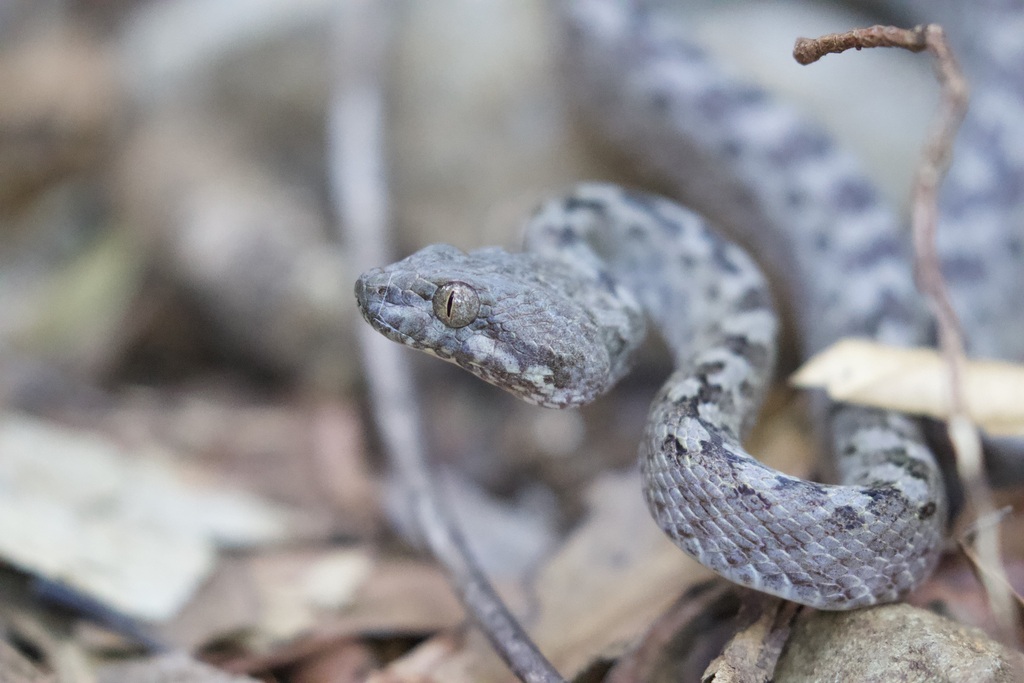
Ghost Snake
Madagascarophis lolo
Madagascarophis lolo is a species of snake endemic to Madagascar. It is colloquially referred to as the ghost snake due to its strikingly pale coloration. It was initially found inside a lime rock formation in 2016.
From the article Madagascarophis lolo on Wikipedia (CC BY-SA), quoted section by section
Description
Madagascarophis lolo can be identified from other species in its genus by its gray overall body color with a black vertebral stripe and dorsal alternating lighter gray splotches. It has 25 midbody scale rows, 189 ventral scales and 56 divided subcaudal scales. With the exception of M. fuchsi, it differs from all other Madagascarophis species by having extended contact of posterior infralabial scales. M. lolo can be distinguished from M. fuchsi by its slightly lower number of infralabial scales, with M. lolo having around 10 infralabial scales, versus approximately 12–13 infralabial scales in M. fuchsi.
Range & habitat
Madagascarophis lolo is terrestrial and semi-arboreal, and is mainly found on karst rock formations. Researchers propose that the rarity of M. lolo sightings could be due to the rough terrain which the species inhabits; the karst rock formations are difficult to navigate, especially in the night, when M. lolo would be active.
Wikipedia: “Habitat”
In human culture
Madagascarophis lolo gets its specific name lolo from the Malagasy word for "ghost". The name refers to both the pale gray color of the ghost snake, and the elusiveness of the species relative to other species in an area of Ankarana that is relatively well explored.
Wikipedia: “Etymology”
Where it lives
Recorded sightings
—
geo-referenced records in GBIF, from museums, herbaria and field observers.
Drag the globe to turn it. Dots are where records exist, not a range map; darker means more records.
In the stacks
Searching the stacks…
Every page naming Madagascarophis lolo in the Biodiversity Heritage Library →
This page is assembled live from iNaturalist, GBIF, Wikipedia, the Source Library and the Internet Archive. It is not yet part of the hand-edited codex. iNaturalist taxon 558920.