- Animals
- ›Chordates
- ›Vertebrates
- ›Birds
- ›Swifts and Hummingbirds
- ›Hummingbirds
- ›Brilliants, Coquettes, and Allies
- ›Coquettes and Allies
- ›Metallura
On eBird ↗
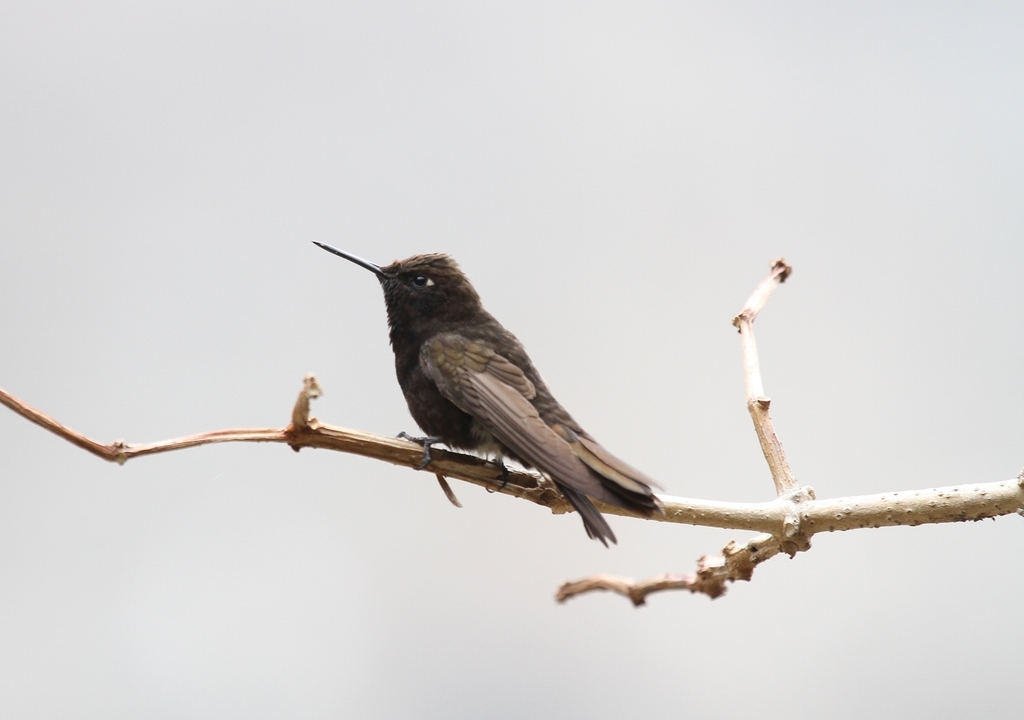
Black Metaltail
Live sightings near you, the range map, bar charts of when it is seen, and Macaulay Library photos and recordings.
Black Metaltail
Metallura phoebe
The black metaltail (Metallura phoebe) is a species of hummingbird in the Trochilidae family. It is found in Peru and far northern Chile. Its natural habitats are subtropical or tropical moist montane forests and subtropical or tropical high-altitude shrubland.
From the article Black metaltail on Wikipedia (CC BY-SA), quoted section by section
Description
The black metaltail is 11.5 to 12.5 cm (4.5 to 4.9 in) long and weighs about 6 g (0.21 oz). It has a medium length, straight, black bill. The adult male is overall black with a purplish or rosy gray sheen. Its slightly forked tail is iridescent bronzy gold and rosy gray on its upper side and glittering golden-orange on its underside. It has a conspicuous white spot behind the eye and its gorget is glittering turquoise green. The adult female is overall dark smoky gray with a smaller gorget than the male. Juveniles are similar to the female but without a gorget.
Range & habitat
The black metaltail is found on the western slope of the Peruvian Andes from southern Cajamarca Department south almost to the Chilean border. It also occurs in some valleys within the Andes. Its range might extend into Chile though as of 2022 there are no records there. It inhabits montane scrublands, woodlands, and canyons, especially those with Polylepis and Puya. In elevation it ranges between 1,500 and 4,500 m (4,900 and 14,800 ft) and is most common above 2,700 m (8,900 ft).
Wikipedia: “Distribution and habitat”
What it does
The black metaltail feeds on nectar from a wide variety of low flowers and flowering bushes, shrubs, and trees. It also eats small insects. It usually takes nectar while hovering but will also cling to flowers and sometimes "rob" nectar by piercing the base of a flower. Males defend feeding territories.
Wikipedia: “Feeding”
Listen
Looking for field recordings…
Where it lives
Recorded sightings
—
geo-referenced records in GBIF, from museums, herbaria and field observers.
Drag the globe to turn it. Dots are where records exist, not a range map; darker means more records.
In the stacks
Searching the stacks…
Every page naming Metallura phoebe in the Biodiversity Heritage Library →
This page is assembled live from iNaturalist, GBIF, Wikipedia, the Source Library and the Internet Archive. It is not yet part of the hand-edited codex. iNaturalist taxon 5587.