On eBird ↗
Malabar Pied-Hornbill
Live sightings near you, the range map, bar charts of when it is seen, and Macaulay Library photos and recordings.
Malabar Pied Hornbill
Anthracoceros coronatus
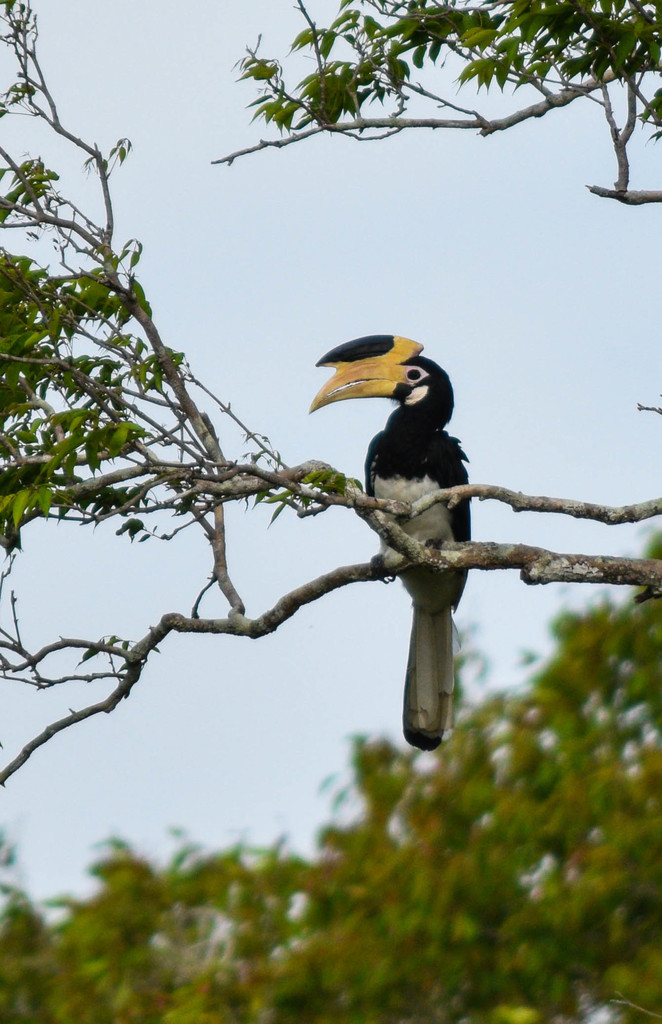
The Malabar pied hornbill (Anthracoceros coronatus), also known as the lesser pied hornbill, is a bird in the hornbill family, a family of tropical birds found in the Old World. The Malabar pied hornbill is a large hornbill, measuring 65 cm (26 in) in length. It has mainly black plumage with a white belly and throat patch, and a yellow bill with a large black casque. The Malabar pied hornbill is a common resident breeder in Sri Lanka and parts of India. It is an omnivore, feeding on fruits, small mammals, birds, small reptiles and insects.
From the article Malabar pied hornbill on Wikipedia (CC BY-SA), quoted section by section
Description
The Malabar pied hornbill is a large hornbill, at 65 cm (26 in) in length. It has mainly black plumage, apart from its white belly, throat patch, tail sides and trailing edge to the wings. The bill is yellow with a large, mainly black casque. Females have white orbital skin, which the males lack. Juveniles have no casque. It might be confused with the oriental pied hornbill. They weigh around 1 kg (2.2 pounds).
Range & habitat
The Malabar pied hornbill is a common resident breeder in Sri Lanka and parts of India, including east-central India and the west coast. It inhabits mainly low-altitude moist evergreen and tall deciduous forests, particularly near rivers, but also occurs in plantations and more open forest. Its habitat is evergreen and moist deciduous forests, often near human settlements. It is distributed across three main regions within the Indian sub-continent: Central and Eastern India, along the Western Ghats, and in Sri Lanka. In Central and Eastern India, it ranges from western West Bengal through parts of Jharkhand, Chhattisgarh, Odisha, Madhya Pradesh, northern and eastern Maharashtra, northern Andhra Pradesh, and north-east tip of Telangana. Along the Western Ghats, the species is distributed in pockets along the eastern slopes and in the Konkan belt and west coast from western Maharashtra through Goa, western Karnataka and Tamil Nadu, and in Kerala. In Sri Lanka, the species occurs mainly in the low country and dry zone forests as well as home gardens.
Wikipedia: “Distribution and habitat”
What it does
This species is omnivorous, taking fruits, small mammals, birds, small reptiles, insects etc. Prey is killed and swallowed whole. Figs are an important food, contributing 60% of their diet from May to February, the non-breeding season; during breeding, in March and April, up to 75% of the fruits delivered at the nest were figs. They also feed on other fruits, including those of the Strychnos nux-vomica, which are toxic to many vertebrates. Great pied hornbills and Malabar pied hornbills are frequently spotted at the township of the Kaiga Atomic Power Station near Karwar in India. The rich biodiversity in the forest around the plant has become a niche for a wide variety of rare bird species. A study comparing populations over a 23-year period at Dandeli found no significant change. In central India, tribal peoples believed that hanging a skull of the hornbill (known as dhanchidiya) brought wealth.
Wikipedia: “Food and feeding”
Listen
Looking for field recordings…
Where it lives
Recorded sightings
—
geo-referenced records in GBIF, from museums, herbaria and field observers.
Drag the globe to turn it. Dots are where records exist, not a range map; darker means more records.
In the stacks
Searching the stacks…
Every page naming Anthracoceros coronatus in the Biodiversity Heritage Library →
This page is assembled live from iNaturalist, GBIF, Wikipedia, the Source Library and the Internet Archive. It is not yet part of the hand-edited codex. iNaturalist taxon 5555.