 NL·0298
Herbarium of the Nature Library
- Name
- Ocyceros birostris
- Family
- Bucerotidae
- Native to
- Indian subcontinent: eastern Pakistan, India and the Nepal terai, south of the Himalaya
- Habitat
- Open woodland, Urban, Dry deciduous forest
On eBird ↗
Indian Gray Hornbill
Live sightings near you, the range map, bar charts of when it is seen, and Macaulay Library photos and recordings.
Indian grey hornbill
Ocyceros birostris
Also calledDhanesh (Hindi/Urdu)
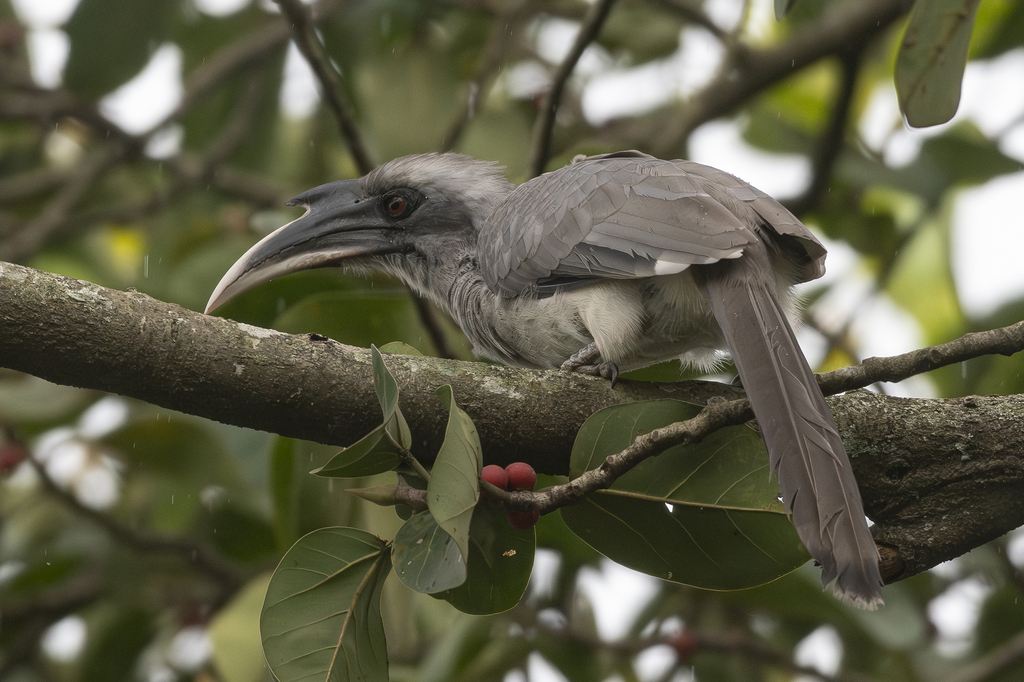
A modest grey hornbill with a black casque on its curved bill, common in groves, temples and city avenues across much of the subcontinent. Like other hornbills, the female walls herself inside a tree-hole nest while the male feeds her through a slit.
The Indian gray hornbill is a common hornbill found on the Indian subcontinent. It is mostly arboreal and is commonly sighted in pairs. It has grey feathers all over the body with a light grey or dull white belly. The horn is black or dark grey with a casque extending to the point of curvature of the horn. It is one of the few hornbill species found in urban areas in many cities where they are able to make use of large trees in avenues. Wikipedia
What it can do
- iFemale seals the nest entrance with mud and droppings, leaving only a narrow slit
- iiDisperses large seeds of figs and other fruit trees
- iiiSurvives in city parks and avenues with old fig trees
In the field
Field marks
- aGrey-brown overall, paler below
- bCurved dark bill with a pointed black casque
- cLong, graduated tail with a dark band and white tip
- dPale eyebrow stripe
- Voice
- A shrill, squealing 'kee-kee-kee' and a kite-like scream
- Not to be confused with
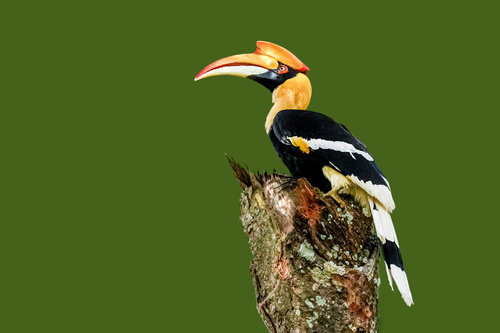
- Malabar grey hornbill (Western Ghats) lacks a casque and has a yellowish bill; Sri Lanka grey hornbill is endemic to Sri Lanka; larger Oriental pied hornbill is black and white.
- Where to see it
- Old park and avenue trees in Lahore (e.g. Bagh-e-Jinnah); Delhi's ridge forests; Ranthambore and Keoladeo
- When
- Resident year-round
Listen
Looking for field recordings…
Life & habits
- Diet
- Mainly fruit, especially figs; also insects, lizards and small birds
- Habitat
- Dry open woodland, groves, gardens and large trees in towns
- Size
- About 50–61 cm long
Pairs and small parties fly between trees with flaps and glides; the female moults her flight feathers while sealed in the nest.
Where it lives
Recorded sightings
—
geo-referenced records in GBIF, from museums, herbaria and field observers.
Native range
Indian subcontinent: eastern Pakistan, India and the Nepal terai, south of the Himalaya
Drag the globe to turn it. Dots are where records exist, not a range map; darker means more records.
In the old herbals & bestiaries
No plate in the Source Library names this exact species, so these show its closest relatives as the old naturalists drew them: same genus, or the same kind of animal. Click a plate to read the page it came from, with translation.

The Malay Archipelago: The Land of the Orang-Utan and the Bird of Paradise
Relative · Alfred Russel Wallace · 1869 · p.167

Ornithology
Relative · Ulisse Aldrovandi · 1599 · p.840

De Indiae utriusque re naturali et medica
Relative · Willem Piso · 1658 · p.464

Ornithology: The History of Birds
Relative · Ulisse Aldrovandi · 1599 · p.837

Ornithology: The History of Birds
Relative · Ulisse Aldrovandi · 1599 · p.818

Ornithologiae: de avibus historiae libri XII
Relative · Ulisse Aldrovandi · 1599 · p.824

De Indiae utriusque re naturali et medica
Relative · Willem Piso · 1658 · p.466
In the stacks
Searching the stacks…
Every page naming Ocyceros birostris in the Biodiversity Heritage Library →
Marginalia
It is one of the few hornbills to live in large South Asian cities, and urban birdwatchers in Delhi and Lahore have tracked nesting pairs in old trees for years.
Curiosity
While she is sealed in, the female moults her flight feathers and depends entirely on the male to bring food.
Kinship

Fact-checked: 2 corrections made to this sheet. Photographs: iNaturalist contributors under the licences shown. Records: GBIF.org. Historical plates: Source Library (CC BY-SA 4.0; originals public domain). Summary text: Nature Library editors and Wikipedia (CC BY-SA). Medicinal and edibility notes are historical and educational, not advice. iNaturalist taxon 5540.