- Animals
- ›Arthropods
- ›Hexapods
- ›Insects
- ›Winged and Once-winged Insects
- ›True Bugs, Hoppers, Aphids, and allies
- ›True Hoppers
- ›Spittlebugs, Cicadas, Leafhoppers and Treehoppers
- ›Cicadas
- ›Typical Cicadas
- ›Largeclasper Cicadas
- ›Widehead Cicadas
- ›Magicicada
- ›Magicicada cassinii
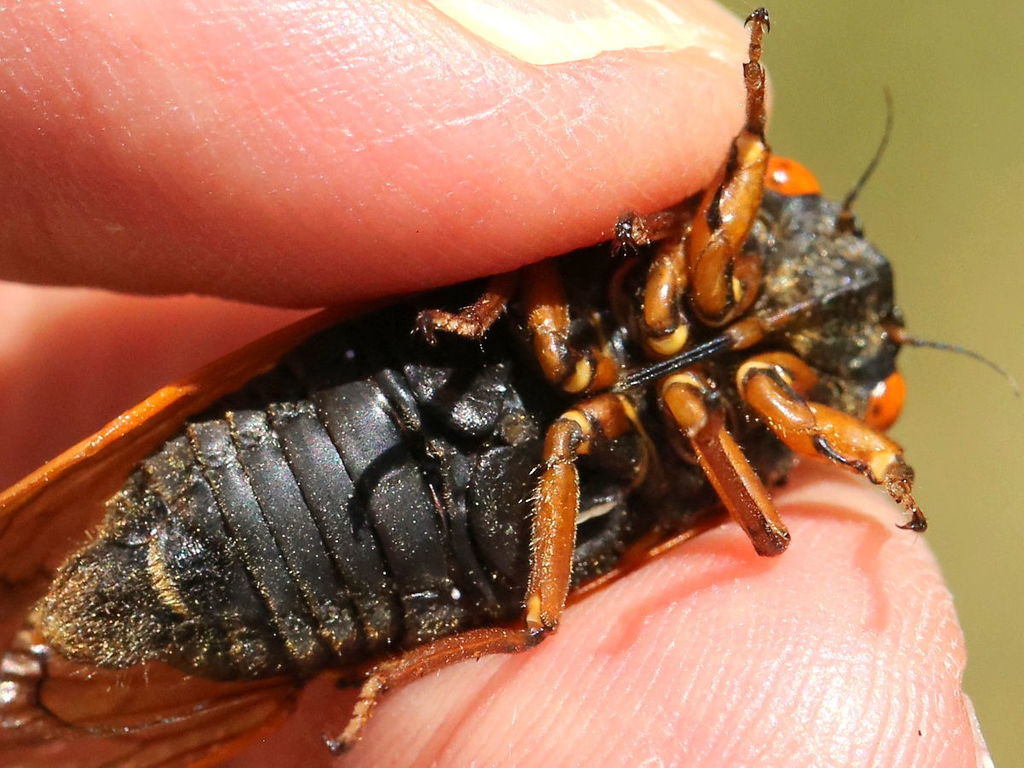
Cassin's 17-year Cicada
Magicicada cassinii
Magicicada cassini (originally spelled cassinii ), known as the 17-year cicada, Cassin's periodical cicada or the dwarf periodical cicada, is a species of periodical cicada. It is endemic to North America. It has a 17-year life cycle but is otherwise indistinguishable from the 13-year periodical cicada Magicicada tredecassini. The two species are usually discussed together as "cassini periodical cicadas" or "cassini-type periodical cicadas." Unlike other periodical cicadas, cassini-type males may synchronize their courting behavior so that tens of thousands of males sing and fly in unison. The species was first reported to the Academy of Natural Sciences of Philadelphia by Margaretta Morris in 1846. In 1852, the species was formally described by J. C. Fisher and given the specific name cassini in honour of John Cassin, an American ornithologist, whose own report was included by Fisher in his publication.
From the article Magicicada cassini on Wikipedia (CC BY-SA), quoted section by section
Description
The adult M. cassini is very similar in appearance to other periodical cicadas. It is between 24 and 27 mm (0.94 and 1.06 in) long, measured from the front of the head to the tip of the wings folded over the abdomen. The head is black, the eyes are large and red, the pronotum is black apart from a narrow orange band at the edge of the sternites, and the abdomen is black. The legs are orange and the wings are translucent, with orange veins and dusky markings near the tips.
Range & habitat
Magicicada cassini is endemic to North America, its range extending across the northern belt of the United States and the southern part of Canada.
Wikipedia: “Distribution and habitat”
What it does
These cicadas are true bugs and after having emerged from underground, the adults feed on sap sucked from trees and shrubs. Males amass in great numbers and sing in unison to attract females. The call lasts for two to four seconds and is a series of ticks followed by a drawn-out buzz which rises and falls in pitch. At the end of a chorus, males move to a new perch before starting the song again. After mating, the females insert their ovipositors into shoots and lay their eggs. These hatch about two months later and the first instar nymphs drop to the ground where they move underground and suck xylem sap from small rootlets. This sap is very low in nutritive value and the nymphs grow very slowly. They will moult five times, moving on to larger roots deep in the soil as they grow over a period of seventeen years. Finally, they all tunnel up through the soil and emerge into the open air, before climbing up the vegetation and shedding their skins for a final time to become adults. Although each population has a seventeen-year life cycle and emerges in synchrony, past environmental events have occasionally disrupted this pattern and there are several different broods in existence in various parts of the insect's range which emerge in different calendar years. …
Wikipedia: “Life cycle”
Listen
Looking for field recordings…
Where it lives
Recorded sightings
—
geo-referenced records in GBIF, from museums, herbaria and field observers.
Drag the globe to turn it. Dots are where records exist, not a range map; darker means more records.
In the stacks
Searching the stacks…
Every page naming Magicicada cassinii in the Biodiversity Heritage Library →
This page is assembled live from iNaturalist, GBIF, Wikipedia, the Source Library and the Internet Archive. It is not yet part of the hand-edited codex. iNaturalist taxon 549305.