- Animals
- ›Chordates
- ›Vertebrates
- ›Reptiles
- ›Snakes and Lizards
- ›Snakes
- ›Colubrid Snakes
- ›Colubrine Snakes
- ›Masticophis
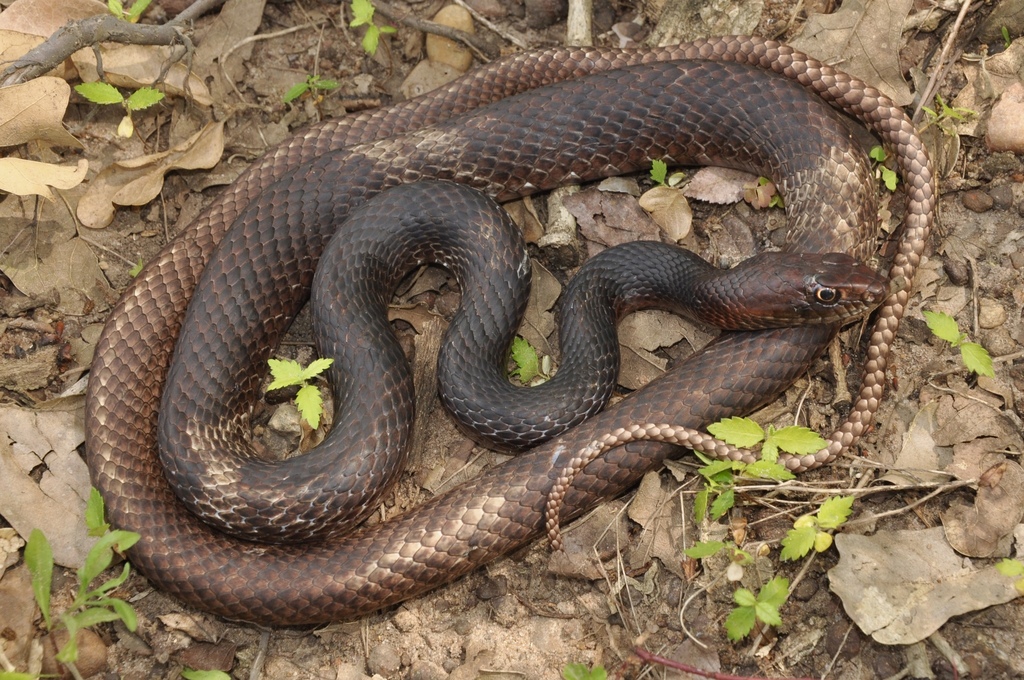
Common Coachwhip
Masticophis flagellum
Masticophis flagellum is a species of nonvenomous colubrid snake, commonly referred to as the coachwhip, whip snake or the red racer. It is endemic to the United States and Mexico. Three subspecies are recognized (including the nominotypical subspecies). It is listed as a species of Least Concern by the IUCN.
From the article Masticophis flagellum on Wikipedia (CC BY-SA), quoted section by section
Description
Coachwhips are thin-bodied snakes with small heads and large eyes with round pupils. They vary greatly in color, but most reflect a proper camouflage for their natural habitat. M. f. testaceus is typically a shade of light brown with darker brown flecking, but in the western area of Texas, where the soil color is a shade of pink, the coachwhips are also pink in color. M. f. piceus was given its common name because specimens frequently, but not always, have some red in their coloration. Coachwhip scales are patterned so at first glance, the snake appears braided. Subspecies can be difficult to distinguish in areas where their ranges overlap. Adult sizes of 127–183 cm (50–72 in) in total length (including tail) are common. The record sized specimen, of the eastern coachwhip race, was 259 cm (102 in) in total length. Young specimens, mostly just over 100 cm (40 in) in length, were found to have weighed 180 to 675 g (6+1⁄2 to 24 oz), whereas good-sized mature adults measuring 163 to 235 cm (64 to 93 in) weighed 1.2 to 1.8 kg (2 lb 10 oz to 3 lb 15 oz).
Range & habitat
Coachwhips range throughout the southern United States from coast to coast. They are also found in the northern half of Mexico. Coachwhips have one of the largest home ranges of any snake, with some being reported to range across and up to 56 hectares. Coachwhips are commonly found in open areas with sandy soil, open pine forests, old fields, and prairies. They thrive in sandhill scrub and coastal dunes. However, they prefer oak savannas in eastern Texas. Coachwhips have been found to tolerate isolated, buffered habitat fragments; however, habitat configuration and edge exposure may be factors which can negatively influence the viability of habitat use by this sensitive species.
Wikipedia: “Distribution and habitat”
What it does
They tend to be sensitive to potential threats, and often bolt at the first sign of one, and will readily strike if cornered. Their bites can be painful, but generally are harmless unless they become infected, as is the case with any wound. They are curious snakes with good eyesight, and are sometimes seen periscoping, raising their heads above the level of the grass or rocks to see what is around them. They are extremely fast-moving snakes, able to move up to 4 miles per hour. Coachwhips have also been found to adjust their space-use behavior with changes in habitat fragment size, tolerating more crowded conditions, reduced home-range sizes, and increased home-range overlap when available habitat area decreased.
Feeding. Coachwhips are diurnal, and actively eat different types of prey including other snakes, lizards, frogs, rodents, birds (including hatchlings and eggs), and insects (cicadas, crickets). These snakes have also been found to ingest carrion and, in rare instances, demonstrated cannibalism. They do not discriminate prey size, as they are opportunistic hunters. They have been described as "sit-and-wait" predators or ambush hunters. They utilize both enhanced vision and sensitive chemoreceptors in order to detect nearby prey. Coachwhips subdue prey by grasping and holding them with their jaws and do not use constriction.
Wikipedia: “Behavior”
In human culture
The generic name Masticophis is derived from the Greek words mastix, meaning "whip", and ophis, meaning "serpent". The specific name flagellum is Latin for "whip". The scientific name was given due to the braided, whip-like appearance of the tail coupled with the length of the snake. Subspecific translations are as follows: lineatulus, (linea) Latin for "line"; testaceus, Latin for "hard covering made of brick or tile", in reference to the scaling pattern of the snake.
Wikipedia: “Etymology”
Where it lives
Recorded sightings
—
geo-referenced records in GBIF, from museums, herbaria and field observers.
Drag the globe to turn it. Dots are where records exist, not a range map; darker means more records.
In the stacks
Searching the stacks…
Every page naming Masticophis flagellum in the Biodiversity Heritage Library →
This page is assembled live from iNaturalist, GBIF, Wikipedia, the Source Library and the Internet Archive. It is not yet part of the hand-edited codex. iNaturalist taxon 547193.