On eBird ↗
Abyssinian Ground-Hornbill
Live sightings near you, the range map, bar charts of when it is seen, and Macaulay Library photos and recordings.
Abyssinian Ground-Hornbill
Bucorvus abyssinicus
The Abyssinian ground hornbill or northern ground hornbill (Bucorvus abyssinicus) is an African bird, found north of the equator, and is one of two species of ground hornbill. The other is the slightly larger southern ground hornbill; the two are the largest species of hornbills found in Africa.
From the article Abyssinian ground hornbill on Wikipedia (CC BY-SA), quoted section by section
Description
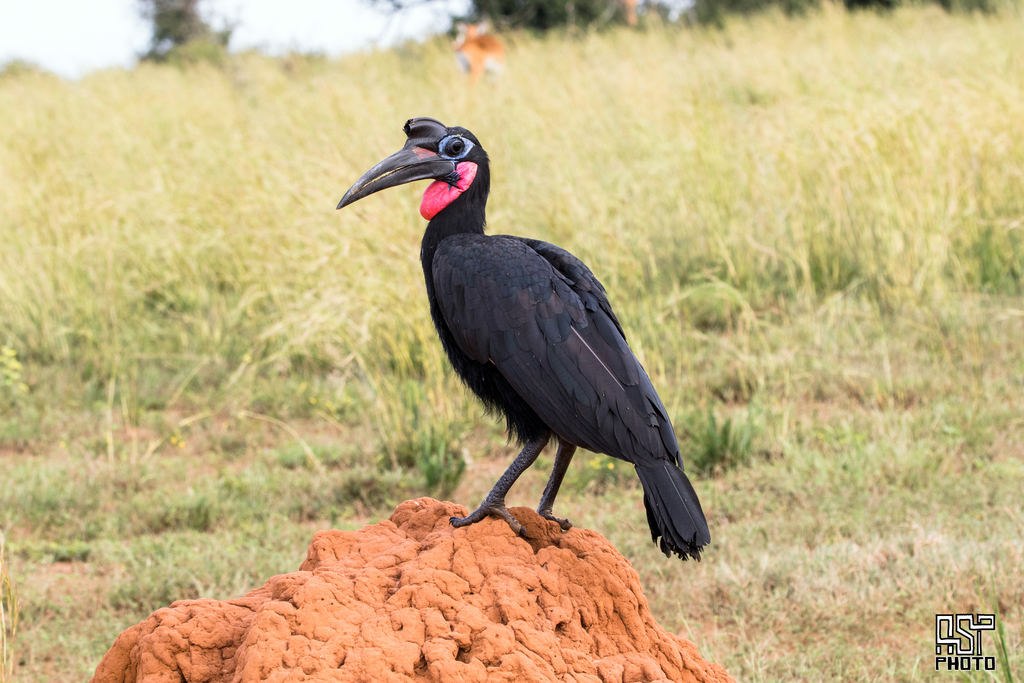
The Abyssinian ground hornbill is a large, terrestrial hornbill with black body feathers and white primary feathers which are visible in flight. The adult male has a patch of bare blue skin around the eye and an inflatable patch of bare skin on the neck and throat which is red, apart from the upper throat which is blue. The bill is long and black except for a reddish patch at the base of the mandible. On top of the bill there is a short open-ended black casque. The female is similar but smaller with any bare skin being wholly dark blue. Juvenile birds are dark sooty-brown with a smaller bill, with an incipient casque. As the juvenile matures, which usually takes 3 years, it gradually develops the plumage, bare skin colour and casque of the adults. The total length is 90 to 110 cm (35 to 43 in). The Abyssinian ground hornbill has long feathers that look like eyelashes that surround its eyes. These protect the eyes from injury. It reportedly averages around 90 to 100 cm (35 to 39 in) tall, around 110 cm (43 in) and weighs approximately 4 kg (8.8 lb). Per Stevenson and Fanshawe, the Abyssinian is a larger species on average than the southern ground hornbill, at 102 cm (40 in), but published weights and standard measurements contrarily indicate the southern species is indeed slightly larger.
Voice. …
Range & habitat
The Abyssinian ground hornbill is found in Northern sub-Saharan Africa from southern Mauritania, Senegal and Guinea east to Eritrea, Ethiopia, north western Somalia, north western Kenya and Uganda. It is found in open habitats such as savanna, sub-desert scrub, and rocky areas, preferring short vegetation which enables its visual foraging technique. The areas inhabited by this species are usually drier areas than the preferred habitat of the Southern ground hornbill. It will tolerate disturbed areas but does require large trees to be used as nest sites. The Abyssinian ground hornbill has escaped or been deliberately released in to Florida, USA, but there is no evidence that the population is breeding and may only persist due to continuing releases or escapes.
Wikipedia: “Distribution and habitat”
What it does
The Abyssinian ground hornbill lives in open grassland, in pairs or small family parties. They patrol their territory by walking and are reluctant fliers, usually only taking to the air when alarmed. In captivity, they can live 35–40 years. Diet in the wild consists of a wide variety of small vertebrates and invertebrates, including tortoises, lizards, snakes, birds, spiders, beetles, and caterpillars; they also take carrion, some fruits, seeds, and groundnuts. Groups of ground hornbills have territories of 2–100 square miles (5.2–259.0 km2). They are diurnal.
Breeding. The breeding season of the Abyssinian ground hornbill varies across its range: the West African populations breed in June through to August, Nigerian and Ugandan populations breed in January, and Kenyan birds breed as late as November. They prefer to nest in large trees, with baobabs and palm stumps being preferred; the nest is constructed in a cavity. They have also been recorded nesting in other types of cavities including holes in rocks and man-made cavities such as bee-hive logs or baskets. In the ground hornbills the females are partially sealed in using a mixture of mud and vegetation. In other hornbills the nesting female moult their all flight feathers at once but this is not the case in the ground hornbills. …
Wikipedia: “Behaviour”
In human culture
Abyssinian ground hornbills are not a normal quarry for commercial hunters, although they are not uncommon in captivity in zoos. In some areas the species has cultural significance and hunters may tie the severed head and neck of these birds around their necks in the belief that it helps them stalk their wild ungulate quarry. In some villages the call is often imitated and there are even entire songs based on the male and female duets of Abyssinian ground hornbills.
Wikipedia: “Cultural importance”
Listen
Looking for field recordings…
Where it lives
Recorded sightings
—
geo-referenced records in GBIF, from museums, herbaria and field observers.
Drag the globe to turn it. Dots are where records exist, not a range map; darker means more records.
In the stacks
Searching the stacks…
Every page naming Bucorvus abyssinicus in the Biodiversity Heritage Library →
This page is assembled live from iNaturalist, GBIF, Wikipedia, the Source Library and the Internet Archive. It is not yet part of the hand-edited codex. iNaturalist taxon 5437.