- Animals
- ›Arthropods
- ›Hexapods
- ›Insects
- ›Winged and Once-winged Insects
- ›Butterflies and Moths
- ›Butterflies
- ›Brush-footed Butterflies
- ›Checkerspots, Anglewings, Peacocks, and Allies
- ›Ladies, Anglewings, and Allies
- ›Polygonia
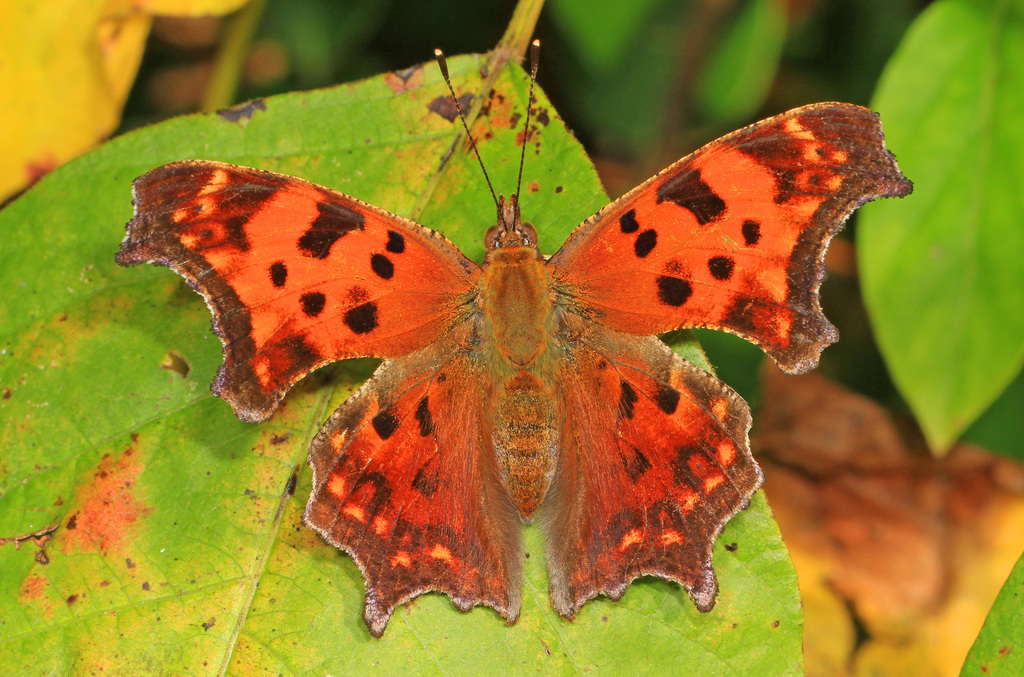
Eastern Comma
Polygonia comma
Polygonia comma, the eastern comma, is a North American butterfly in the family Nymphalidae, subfamily Nymphalinae.
From the article Polygonia comma on Wikipedia (CC BY-SA), quoted section by section
Description
This butterfly is seasonally variable. The upperside of the summer form's hindwings are all black, whereas the winter forms hindwings are reddish orange. The underside of both forms is striped with dark and light brown. There is a silvery comma mark in the middle of the hindwing in both forms. Its wingspan is 4.5–6.4 cm (1.8–2.5 in).
Range & habitat
The eastern comma may be spotted in woods near rivers, ponds, marshes, swamps, and other water sources.
Wikipedia: “Habitat”
What it does
The green eggs are laid singly or in stacks under host plant leaves and stems. The spiny larva varies in color from pale green to yellow to white and to even black. The solitary larva feeds on leaves at night. Older larvae construct daytime leaf shelters by pulling a single leaf together with silk. The chrysalis is brown and covered with spines. Winter-form adults overwinter; some will also migrate south for the winter.
Wikipedia: “Life cycle”
Listen
Looking for field recordings…
Where it lives
Recorded sightings
—
geo-referenced records in GBIF, from museums, herbaria and field observers.
Drag the globe to turn it. Dots are where records exist, not a range map; darker means more records.
In the stacks
Searching the stacks…
Every page naming Polygonia comma in the Biodiversity Heritage Library →
This page is assembled live from iNaturalist, GBIF, Wikipedia, the Source Library and the Internet Archive. It is not yet part of the hand-edited codex. iNaturalist taxon 54064.