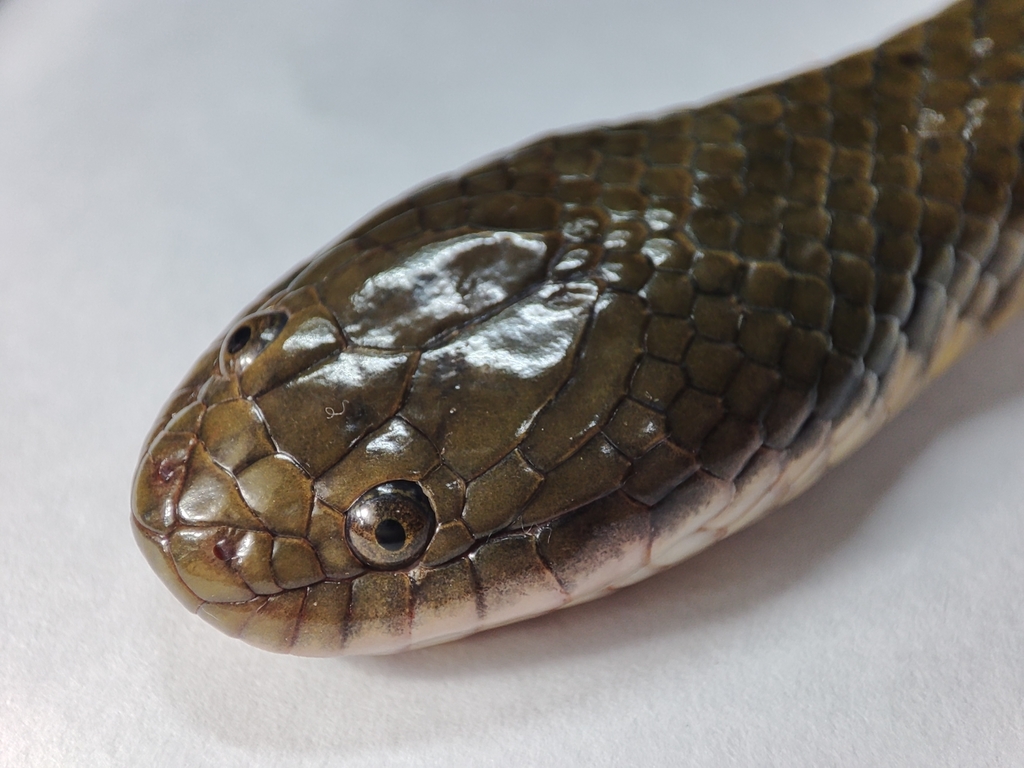
Rice Paddy Snake
Hypsiscopus plumbeus
The rice paddy snake (Hypsiscopus plumbea), also known as grey water snake, Boie's mud snake, yellow or orange bellied water snake, lead water snake or plumbeous water snake is a species of non - venomous, rear-fanged snake endemic to South Asia. It is somewhat common, and is one of the most widespread species of water snake in Asia.
From the article Hypsiscopus plumbea on Wikipedia (CC BY-SA), quoted section by section
Description
The rice paddy snake is a relatively small snake, reaching a total length (including tail) of up to 72 cm (28 in), although sources vary. This snake feeds readily on small fish, frogs, and occasionally small lizards. It has countershading coloration, which is dark brown to grey in the upper part of its body, and light colored white to yellowish color at the bottom of its body. In some populations, the upper part may be greenish, and dark spots along the vertebral line may also occur. It is mainly nocturnal.
Range & habitat
The rice paddy snake is found in the Andaman Islands (India), Myanmar, Thailand, Cambodia, Laos, Malaysia, Indonesia, Vietnam, southern China, and Taiwan. The rice paddy snake is a common and abundant species associated with a variety of wet habitats.
Wikipedia: “Distribution and habitat”
Where it lives
Recorded sightings
—
geo-referenced records in GBIF, from museums, herbaria and field observers.
Drag the globe to turn it. Dots are where records exist, not a range map; darker means more records.
In the stacks
Searching the stacks…
Every page naming Hypsiscopus plumbeus in the Biodiversity Heritage Library →
This page is assembled live from iNaturalist, GBIF, Wikipedia, the Source Library and the Internet Archive. It is not yet part of the hand-edited codex. iNaturalist taxon 539840.