 NL·0221
Herbarium of the Nature Library
- Name
- Gyps indicus
- Family
- Accipitridae
- Native to
- Central and peninsular India and SE Pakistan (Sindh, notably Nagarparkar)
- Habitat
- Dry deciduous forest, Farmland, Rocky hillside
On eBird ↗
Indian Vulture
Live sightings near you, the range map, bar charts of when it is seen, and Macaulay Library photos and recordings.
Indian vulture
Gyps indicus
Also calledGidh (Hindi/Urdu) · Shokun (Bengali) · Long-billed vulture
A large cliff-nesting vulture of India and Pakistan that once swarmed over every carcass. From the 1990s its numbers crashed by more than 95%, poisoned by the veterinary drug diclofenac in the cattle carcasses it ate.
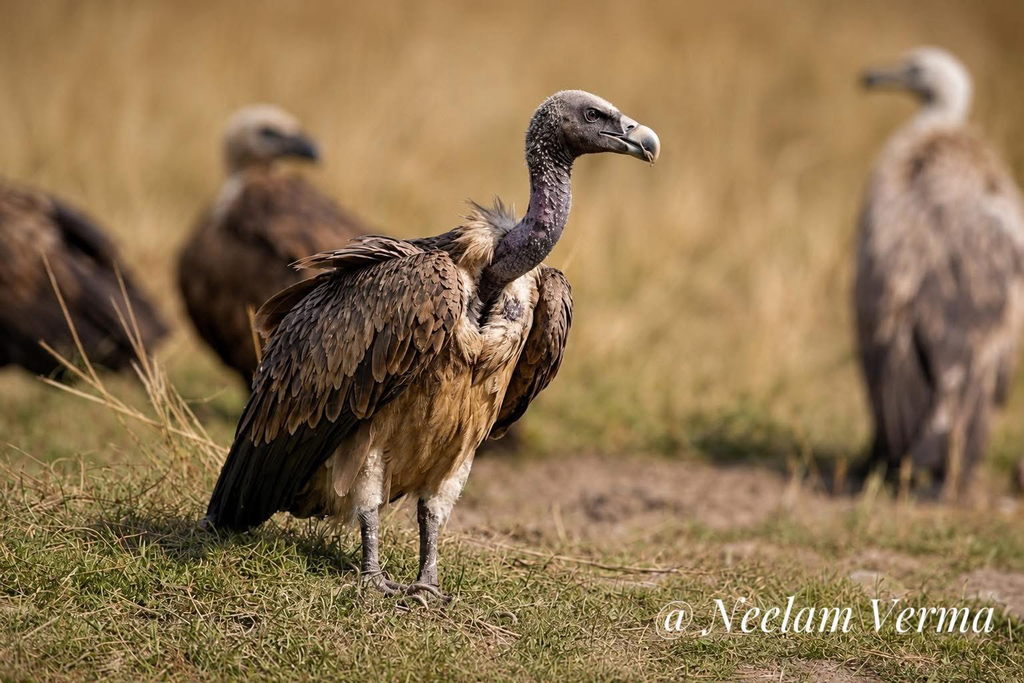
The Indian vulture or long-billed vulture is a bird of prey native to the Indian subcontinent. It is an Old World vulture belonging to the family of Accipitridae. It is a medium-sized vulture with a small, semi-bald head with little feathers, long beak, and wide dark colored wings. It breeds mainly on small cliffs and hilly crags in central India and south India. Wikipedia
What it can do
- iClears carcasses rapidly, reducing disease and feral dog populations
- iiSoars for hours on thermals, scanning for food
- iiiNests on cliffs and old buildings in colonies
In the field
Field marks
- aLarge pale sandy-brown vulture with dark flight feathers
- bBare dark grey head and neck; white neck ruff
- cPale yellowish bill
- dLong, broad wings held flat in soaring
- Voice
- Mostly silent; hisses and grunts at carcasses
- Not to be confused with
- Slender-billed vulture (north India, Nepal) is darker with a thin dark bill and nests in trees; White-rumped vulture is darker with a white back patch; Eurasian griffon is larger and more rufous.
- Where to see it
- Cliffs of Ranthambore, Orchha and Panna in India; Nagarparkar's Karoonjhar hills in Sindh
- When
- Resident year-round
Listen
Looking for field recordings…
Life & habits
- Diet
- Carrion, especially dead cattle
- Habitat
- Open country near villages and cliffs; dry hilly regions
- Size
- About 80–100 cm long; wingspan about 2 m
Groups descend on a carcass and can strip it in under an hour; they nest colonially on cliff ledges.
Where it lives
Recorded sightings
—
geo-referenced records in GBIF, from museums, herbaria and field observers.
Native range
Central and peninsular India and SE Pakistan (Sindh, notably Nagarparkar)
Drag the globe to turn it. Dots are where records exist, not a range map; darker means more records.
In the old herbals & bestiaries
No plate in the Source Library names this exact species, so these show its closest relatives as the old naturalists drew them: same genus, or the same kind of animal. Click a plate to read the page it came from, with translation.

Jan Jonston — Naeukeurige beschryving van de natuur der viervoetige dieren (1660)
Relative · Jan Jonston · 1660 · p.285

Jan Jonston — Naeukeurige beschryving van de natuur der viervoetige dieren (1660)
Relative · Jan Jonston · 1660 · p.31

François Bouchard — Recueil de cent-trente-trois oiseaux des plus belles especes (1775)
Relative · François Bouchard · 1775 · p.26

Garden of Health
Relative · 1507 · p.547

History of Animals, Book I: On Viviparous Quadrupeds
Relative · Conrad Gessner · 1554 · p.934

History of Animals, Book I: On Viviparous Quadrupeds
Relative · Conrad Gessner · 1554 · p.379

Historiae Animalium Liber III: De Avium Natura
Relative · Conrad Gesner · 1555 · p.789

Historiae Animalium Liber III: De Avium Natura
Relative · Conrad Gesner · 1555 · p.790

Florentine Codex, Vol. 3 (Books 10-12)
Relative · Bernardino de Sahagún · 1577 · p.714

Ornithology
Relative · Ulisse Aldrovandi · 1599 · p.252
In the stacks
Searching the stacks…
Every page naming Gyps indicus in the Biodiversity Heritage Library →
Marginalia
Its collapse led India, Pakistan and Nepal to ban veterinary diclofenac in 2006, and the Parsi tradition of exposing the dead at Towers of Silence in Mumbai has been disrupted by the loss of vultures.
Curiosity
Researchers estimate the vulture collapse in India allowed rotting carcasses and feral dogs to increase, with a measurable rise in human deaths.
Kinship




Photographs: iNaturalist contributors under the licences shown. Records: GBIF.org. Historical plates: Source Library (CC BY-SA 4.0; originals public domain). Summary text: Nature Library editors and Wikipedia (CC BY-SA). Medicinal and edibility notes are historical and educational, not advice. iNaturalist taxon 5369.