- Animals
- ›Chordates
- ›Vertebrates
- ›Birds
- ›Hawks, Eagles, Kites, and Allies
- ›Hawks, Eagles, and Kites
- ›Typical Old World Vultures
- ›Gyps
On eBird ↗
White-backed Vulture
Live sightings near you, the range map, bar charts of when it is seen, and Macaulay Library photos and recordings.
White-backed Vulture
Gyps africanus
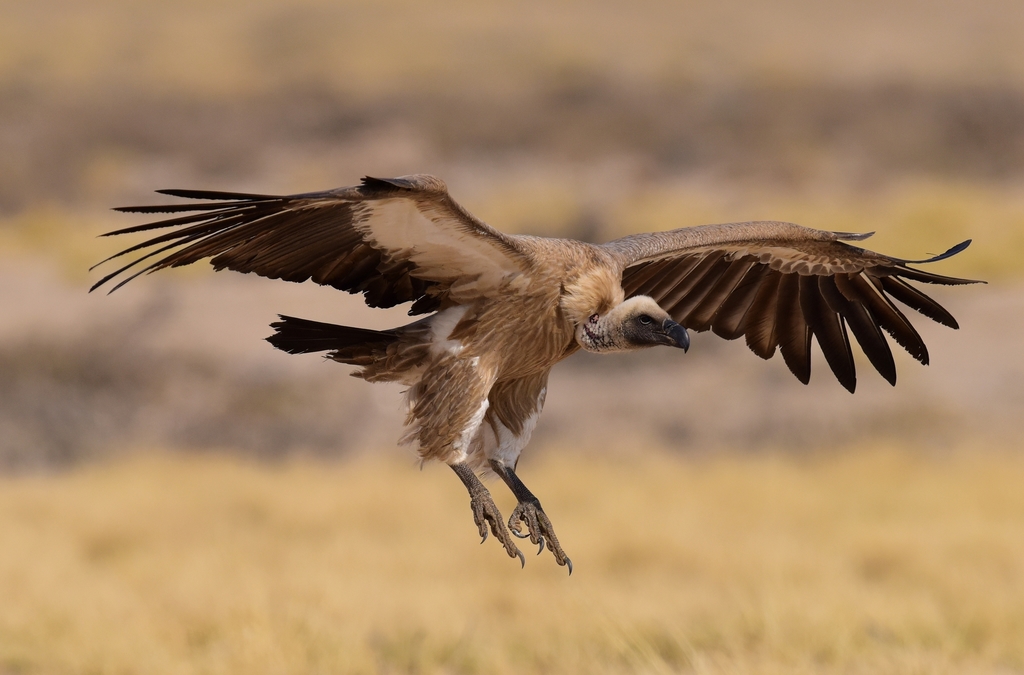
The white-backed vulture (Gyps africanus) is an Old World vulture in the family Accipitridae, which also includes eagles, kites, buzzards and hawks. It is closely related to the European griffon vulture, G. fulvus. Sometimes it is called African white-backed vulture to distinguish it from the Oriental white-backed vulture — nowadays usually called white-rumped vulture — to which it was formerly believed to be closely related.
From the article White-backed vulture on Wikipedia (CC BY-SA), quoted section by section
Description
The white-backed vulture is a typical vulture, with only down feathers on the head and neck, very broad wings and short tail feathers. It has a white neck ruff. The adult's whitish back contrasts with the otherwise dark plumage. Juveniles are largely dark. This is a medium-sized vulture; its body mass is 4.2 to 7.2 kg (9.3–15.9 lb), it is 78 to 98 cm (31 to 39 in) long and has a 1.96 to 2.25 m (6 ft 5 in to 7 ft 5 in) wingspan.
Range & habitat
The white-backed vulture occurs from Senegal, Gambia and Mali in the west, throughout the Sahel region to Ethiopia and Somalia in the east, through East Africa into Mozambique, Zimbabwe, Botswana, Namibia and South Africa in the south. It is the most widespread and common vulture in Africa with an estimated range of 24,300,000 km2 (9,400,000 sq mi), but has undergone rapid population declines in recent years.
Wikipedia: “Distribution and habitat”
What it does
White-backed vultures are obligate scavengers with a high level of specialization on carrion and bone fragments. Their primary food sources are the carcasses of large, grazing animals found in the wooded savannahs where it lives. This includes warthogs, zebras, gazelles, rhinoceroses, buffalos especially African buffalos, ostriches and even livestock. Their beaks are medium-sized, and not adapted for tearing through tough skin, so they are limited to eating soft tissues, such as the viscera, using a pulling feeding tactic. White-backed vultures circle through the sky in search of freshly dead animals, often following other scavenger birds and mammalian carnivores to find it. Gyps vultures are considered social vultures which rely heavily on conspecifics to provide information about the position of food and carcasses. The circling flight pattern of vultures is not a signal to other vultures about food, contrary to popular belief. Such signaling could increase competition around limited resources, so vultures instead rely on both personal and social cues to locate carcasses while balancing the risk of competition through selective use of social information in flight decisions. White-backed vultures feed in groups and are often one of the first vulture species to arrive at a carcass.
Wikipedia: “Diet and feeding”
Listen
Looking for field recordings…
Where it lives
Recorded sightings
—
geo-referenced records in GBIF, from museums, herbaria and field observers.
Drag the globe to turn it. Dots are where records exist, not a range map; darker means more records.
In the stacks
Searching the stacks…
Every page naming Gyps africanus in the Biodiversity Heritage Library →
This page is assembled live from iNaturalist, GBIF, Wikipedia, the Source Library and the Internet Archive. It is not yet part of the hand-edited codex. iNaturalist taxon 5363.