- Animals
- ›Arthropods
- ›Hexapods
- ›Insects
- ›Winged and Once-winged Insects
- ›Beetles
- ›Water, Rove, Scarab, Long-horned, Leaf, and Snout Beetles
- ›Cucujiform Beetles
- ›Lady, Fungus, Scavenger, and Bark Beetles
- ›Lady Beetles
- ›Common Lady Beetles
- ›Black-spotted Lady Beetles
- ›Halyzia
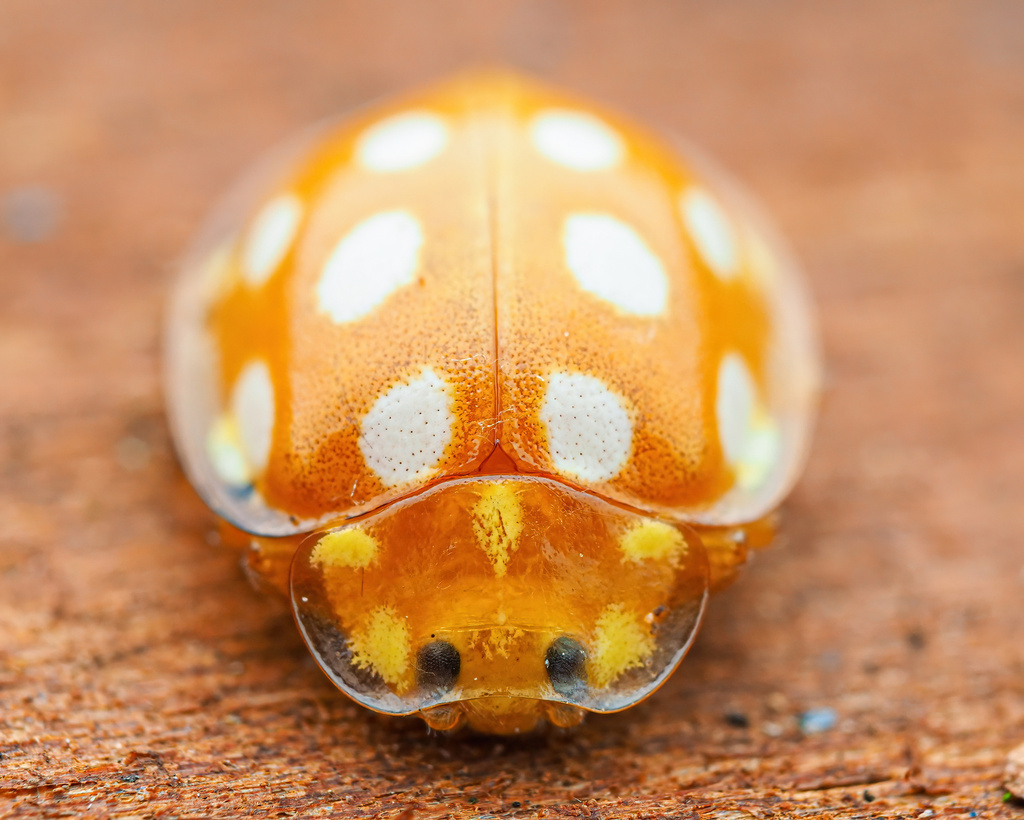
Orange Ladybird
Halyzia sedecimguttata
Halyzia sedecimguttata, or orange ladybird, is a species of Coccinellidae, also known as ladybird.
From the article Halyzia sedecimguttata on Wikipedia (CC BY-SA), quoted section by section
Description
Halyzia sedecimguttata can reach a length of 5–6 millimetres (0.20–0.24 in). These beetles have an oval shaped body, rather round than elongated. Compound eyes are black. The antennae are light-brown, quite long and slightly thickened at the end. Their physical appearance is marked by a striking orange colour and the presence of 16 (sometimes less) creamy white large spots on the elytra (eight spots on each elytron). The neck shield usually covers the head and shows orange colored spots. A typical feature is the slightly transparent edges of the elytra. Transparent parts are also present on either side of the neck shield. This species is rather similar to Calvia decemguttata and Vibidia duodecimguttata.
Range & habitat
Halyzia sedecimguttata is common in Europe, European Russia, the Caucasus, Siberia, the Russian Far East, Belarus, Ukraine, Transcaucasia, Kazakhstan, Asia Minor, Mongolia, Northern China, Japan. It was formerly uncommon in the Ireland and Britain but the species has established itself over the 20th-century and it is now common in many parts.
Wikipedia: “Distribution”
Listen
Looking for field recordings…
Where it lives
Recorded sightings
—
geo-referenced records in GBIF, from museums, herbaria and field observers.
Drag the globe to turn it. Dots are where records exist, not a range map; darker means more records.
In the stacks
Searching the stacks…
Every page naming Halyzia sedecimguttata in the Biodiversity Heritage Library →
This page is assembled live from iNaturalist, GBIF, Wikipedia, the Source Library and the Internet Archive. It is not yet part of the hand-edited codex. iNaturalist taxon 52881.