- Animals
- ›Arthropods
- ›Hexapods
- ›Insects
- ›Winged and Once-winged Insects
- ›Flies
- ›Brachyceran Flies
- ›Cyclorrhaphan Flies
- ›Schizophoran Flies
- ›Calyptrate Flies
- ›Bot Flies, Blow Flies, and Allies
- ›Tachinid Flies
- ›Tachininae
- ›Tachinini
- ›Tachina
- ›Eudoromyia
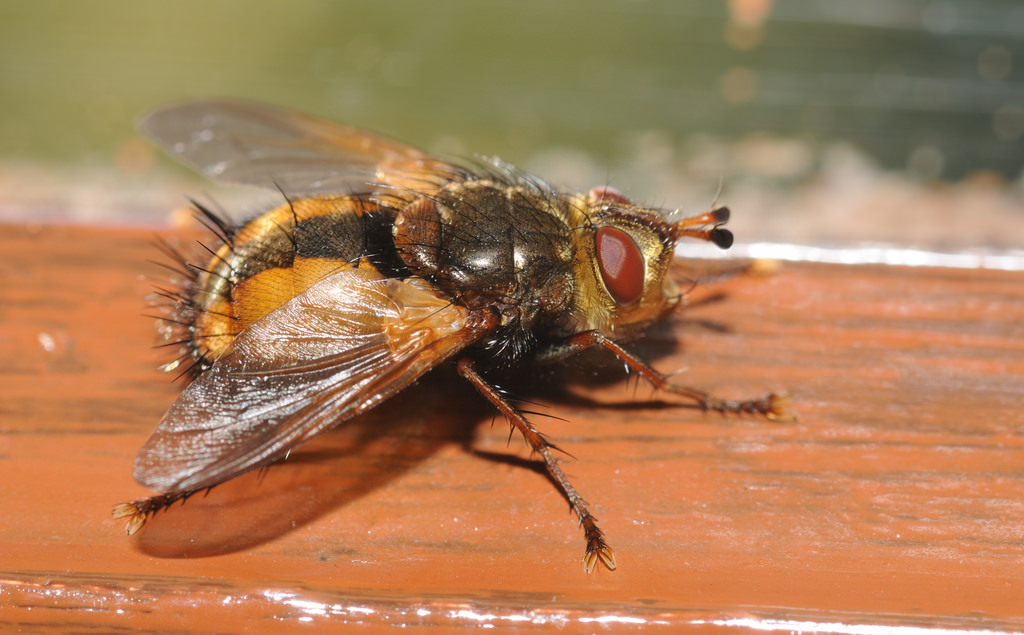
Common Tachinid
Tachina fera
Tachina fera is a species of fly in the genus Tachina of the family Tachinidae. It is found across Europe as far north as Scandinavia. Its larvae are parasitoids of the caterpillars of moths in the family Noctuidae; afflicted species include the Broom Moth Ceramica pisi, the Dun-Bar Cosmia trapezina, Small Quaker Orthosia cruda and Common Quaker Orthosia cerasi.
From the article Tachina fera on Wikipedia (CC BY-SA), quoted section by section
Description
Tachina fera can reach a length of 9–14 millimetres (0.35–0.55 in), with a wingspan of 16–27 mm. These tachinids show a grayish upperside of the thorax, due to dense pollinosity, with regular black stripes. The abdomen is yellow orange with a wide black dorsal stripe ending in a point. They are bristly on the thorax and abdomen, especially towards the tip, where they have long thorn-shaped, protruding black bristles. Close to the thorax there is a striking, orange-red and shiny 'bump' called postscutellum, with a thin black edge. The head is yellowish colored, with long antennae, whose second segment is yellow, while the third, much shorter, is black. The back of the head shows yellowish hairs and the large compound eyes are red in color. The size of the eyes in relation to the head is sex dependent. The palps of the mouthparts are long, thin and thread like. The wings are slightly yellow tinged, show a brownish yellow veining and are yellow brown at the base. Calyptrae are whitish yellow. The legs are predominantly yellowish, but in the male they are usually dark with a yellow tip. This species is very similar to Tachina magnicornis, that is a little smaller, has a medial dorsal band forming lozenges and that does not terminate in a point.
Range & habitat
This species can be found in the entire Palearctic realm, across Europe as far north as Scandinavia and European Russia. It is also present in Israel and North Asia, east to China, Mongolia, Korea, and Japan, and in North Africa.
Wikipedia: “Distribution”
Listen
Looking for field recordings…
Where it lives
Recorded sightings
—
geo-referenced records in GBIF, from museums, herbaria and field observers.
Drag the globe to turn it. Dots are where records exist, not a range map; darker means more records.
In the stacks
Searching the stacks…
Every page naming Tachina fera in the Biodiversity Heritage Library →
This page is assembled live from iNaturalist, GBIF, Wikipedia, the Source Library and the Internet Archive. It is not yet part of the hand-edited codex. iNaturalist taxon 52591.