- Animals
- ›Arthropods
- ›Hexapods
- ›Insects
- ›Winged and Once-winged Insects
- ›Flies
- ›Brachyceran Flies
- ›Cyclorrhaphan Flies
- ›Aschizan Flies
- ›Hover Flies
- ›Typical Hover Flies
- ›Syrphini
- ›Syrphus
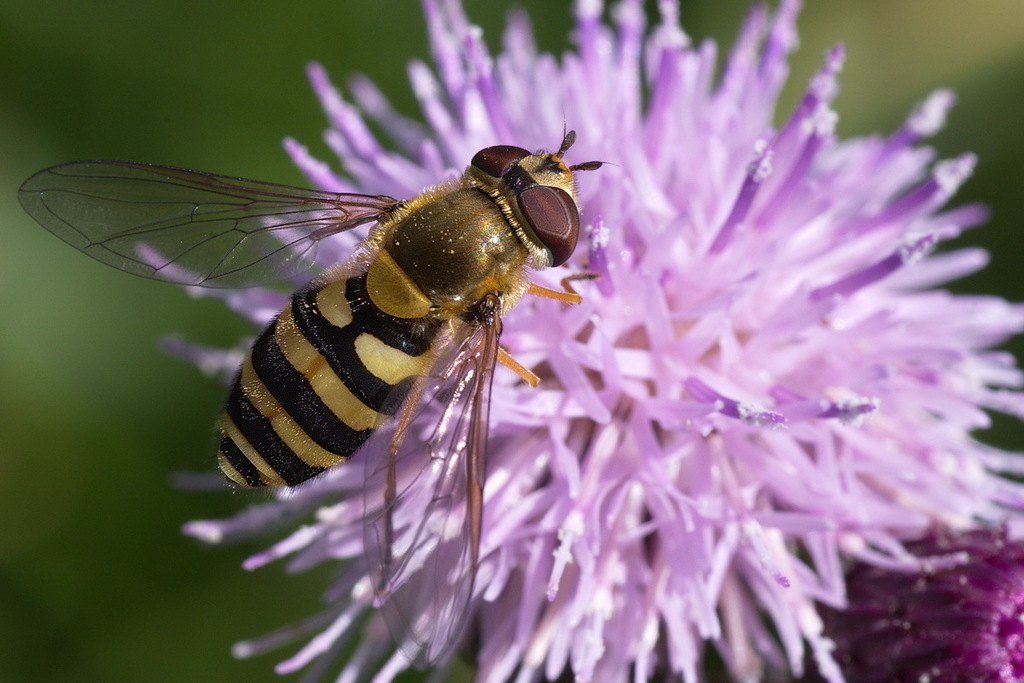
Common Flower Fly
Syrphus ribesii
Syrphus ribesii is a very common Holarctic species of hoverfly. Its larvae feed on aphids. In common with many other species of hoverfly, males have the eyes meeting on the top of the head, whilst females have their eyes widely separated.
From the article Syrphus ribesii on Wikipedia (CC BY-SA), quoted section by section
Description
Adults are very similar in appearance to Syrphus vitripennis and Syrphus torvus. Females are distinguished from both by having entirely yellow hind femora, and from the latter by having no hairs present in their eyes. Males also have bare eyes, unlike S. torvus, but are extremely similar to S. vitripennis, differing only in having some black hairs present on the hind femur and in having the second basal cell of the wing entirely covered by microtrichia. The male genitalia and the larva have been described. Frons is posterior to the lunulae, shiny black. Sternites have lateral and median black marks. Male femora 3 is black for basal 2/3. Femora 3 is yellow. Lateral margins of tergites are black except at the ends of the yellow bands.
Range & habitat
Palearctic: Fennoscandia south to Iberia and the Mediterranean basin, Ireland eastward through Europe into Turkey, European Russia and Afghanistan. Also ranges from Urals to Siberia and Russian Far East to the Pacific coast (Kuril Isles) and Japan. Nearctic: Alaska southward to Central USA. Highly migratory. Nearctic: United States and Canada.
Wikipedia: “Distribution”
Listen
Looking for field recordings…
Where it lives
Recorded sightings
—
geo-referenced records in GBIF, from museums, herbaria and field observers.
Drag the globe to turn it. Dots are where records exist, not a range map; darker means more records.
In the stacks
Searching the stacks…
Every page naming Syrphus ribesii in the Biodiversity Heritage Library →
This page is assembled live from iNaturalist, GBIF, Wikipedia, the Source Library and the Internet Archive. It is not yet part of the hand-edited codex. iNaturalist taxon 52488.