- Animals
- ›Arthropods
- ›Hexapods
- ›Insects
- ›Winged and Once-winged Insects
- ›Flies
- ›Brachyceran Flies
- ›Cyclorrhaphan Flies
- ›Schizophoran Flies
- ›Calyptrate Flies
- ›Muscoid Flies
- ›House Flies and Allies
- ›Muscinae
- ›Muscini
- ›Musca
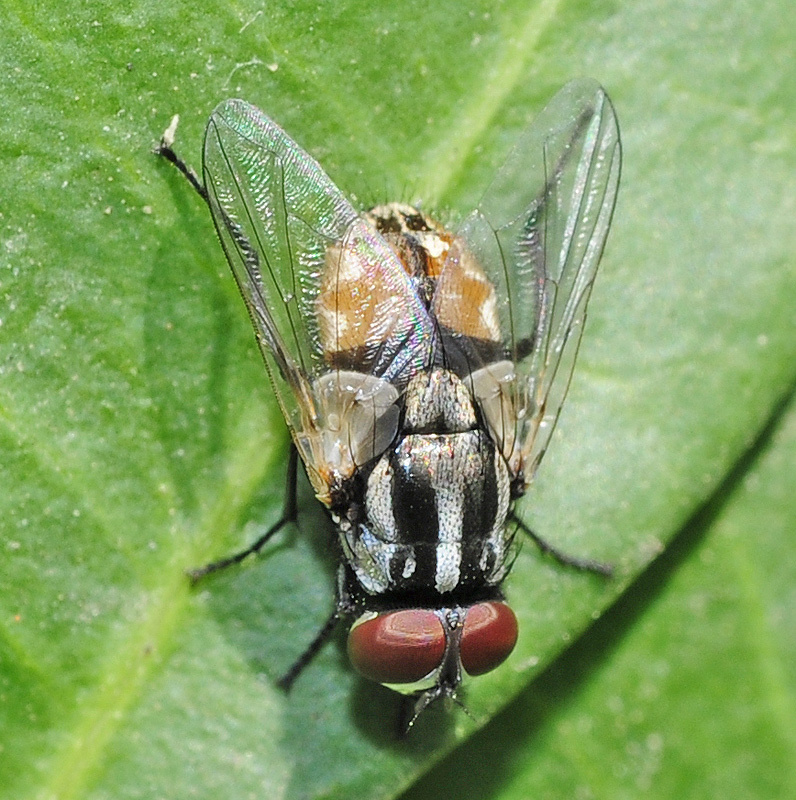
Dog Dung Fly
Musca sorbens
Musca sorbens, the bazaar fly or eye-seeking fly, is a close relative of, and very similar in appearance to, the housefly (Musca domestica). It is found in tropical and subtropical Africa, Asia and the Pacific Ocean region. It breeds in excreta, especially human faeces, and is the main insect vector of trachoma, a major cause of blindness.
From the article Musca sorbens on Wikipedia (CC BY-SA), quoted section by section
Range & habitat
Bazaar flies are found in parts of Africa, Asia and the Pacific Ocean region. The flies need temperatures between about 16 to 40 °C (61 to 104 °F), with 28 °C (82 °F) being optimal, and a humidity level of over 85%. Bazaar flies are more abundant at low and medium altitudes. They may be more abundant in winter, spring and autumn, or summer depending on rainfall patterns, competition for dung, and predation.
Wikipedia: “Distribution”
What it does
After mating, female bazaar flies seek out suitable places to lay their eggs. Bazaar flies are most attracted to human faeces on the ground (they will not breed in covered pit latrines). If no human faeces are available, the excreta of other animals will suffice. The larvae develop in the faeces and die if the excreta dries out or becomes too hot. When developed, the larvae pupate, undergo metamorphosis and emerge as adult flies. The time from egg-laying to adult emergence averages nine days. The bazaar fly is a prolific species: theoretically, if all its progeny survived, a single female bazaar fly kept at 28 °C (82 °F) could produce 17.8 million offspring within 11 weeks. The quality of the emerging adult flies (as measured by head breadth) is better from human faeces than from those of any other animal; these larger flies are likely to be more fecund and have longer lives, thus producing more offspring.
Wikipedia: “Life cycle”
Listen
Looking for field recordings…
Where it lives
Recorded sightings
—
geo-referenced records in GBIF, from museums, herbaria and field observers.
Drag the globe to turn it. Dots are where records exist, not a range map; darker means more records.
In the stacks
Searching the stacks…
Every page naming Musca sorbens in the Biodiversity Heritage Library →
This page is assembled live from iNaturalist, GBIF, Wikipedia, the Source Library and the Internet Archive. It is not yet part of the hand-edited codex. iNaturalist taxon 524419.