- Animals
- ›Arthropods
- ›Hexapods
- ›Insects
- ›Winged and Once-winged Insects
- ›Ants, Bees, Wasps, and Sawflies
- ›Narrow-waisted Wasps, Ants, and Bees
- ›Ants, Bees, and Stinging Wasps
- ›Bees and Apoid Wasps
- ›Bees
- ›Honey Bees, Bumble Bees, and Allies
- ›Apine Bees
- ›Bombini
- ›Bombus
- ›Thoracobombus
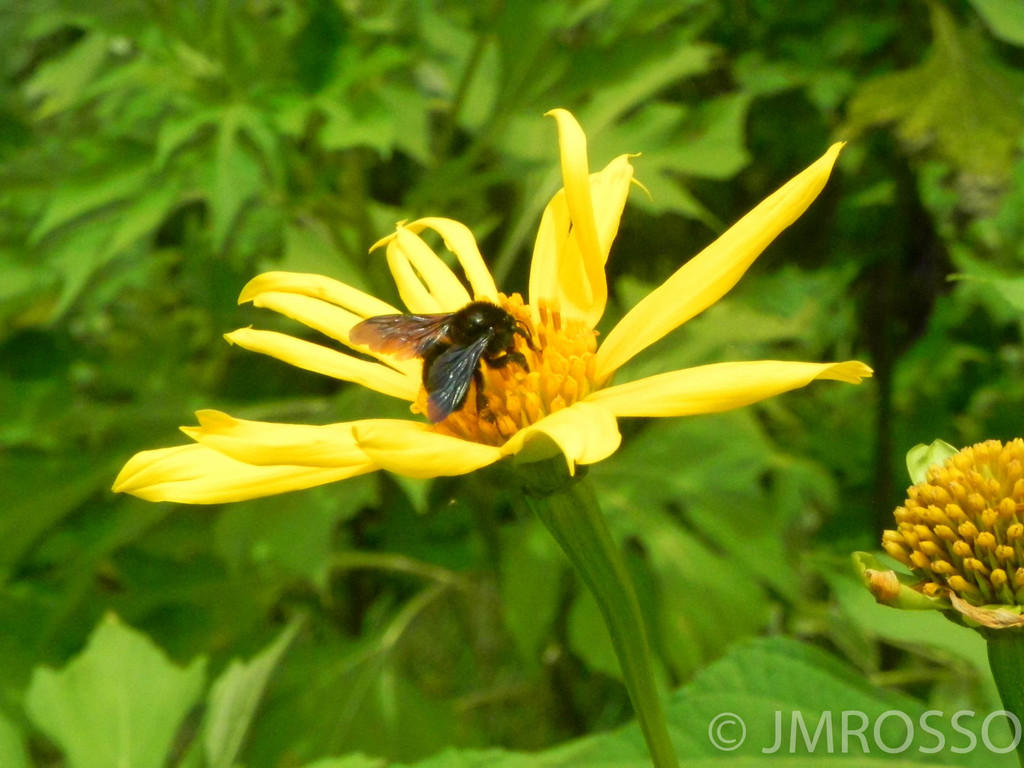
Black-clothed Bumble Bee
Bombus pullatus
Bombus pullatus is a tropical, eusocial species of bumblebee native to Mexico and Central America. Unlike many bumblebee species, they live in colonies with multiple queens.
From the article Bombus pullatus on Wikipedia (CC BY-SA), quoted section by section
Range & habitat
The majority of this species occurs in the lowlands of Central America, with approximately 90% of colonies being found in Costa Rica. However they have been found at elevations higher than 3 km above sea level. Colonies have been confirmed in Guatemala, Honduras, Nicaragua, Panama and the south of Mexico. Bombus pullatus is considered a more basal member of the genus Bombus compared to Bombus pauloensis and Bombus transversalis. Historically, Bombus pullatus has commonly been misidentified as Bombus pauloensis and vice versa in many collections. Molecular analyses (such as DNA profiling) of these specimens are required to accurately identify both species. This issue is why the IUCN has agreed to reject data on this species that is more southern than Panama.
Wikipedia: “Distribution & Taxonomy”
What it does
This species is known to be quite aggressive, stinging humans within approximately 6 m of the nest if it is disturbed. Unlike most bumblebees, Bombus pullatus colonies contain multiple queens (a form of polygyny) like their close relative Bombus pauloensis (who rotate between polygyny and monogyny). However Bombus pullatus colonies have a comparatively higher number of queens. In one nest a total of 36 queens were sampled in a colony with a total of 343 individuals. Workers of this species are significantly smaller than males. This bee forages on many kinds of plants, including Miconia sp., Monochaetum sp., Solanum sp. Mimosa sp., and Spermacoce sp. Individual worker bees have displayed preferences for particular plant species. Foraging rate was calculated in one study to be 2.6-9.5 bees per minute. Pollen collectors had the highest activity in the early morning, however nectar collectors had a relatively constant rate during the day. Foraging trips lasted approximately 50 minutes.
Nesting. Their nests are mostly found on the ground, anchored to sturdy plants. This is thought to protect them from tropical storms. Much like their close relative Bombus pauloensis, their colonies display a degree of perenniality. …
Wikipedia: “Behaviour”
Listen
Looking for field recordings…
Where it lives
Recorded sightings
—
geo-referenced records in GBIF, from museums, herbaria and field observers.
Drag the globe to turn it. Dots are where records exist, not a range map; darker means more records.
In the stacks
Searching the stacks…
Every page naming Bombus pullatus in the Biodiversity Heritage Library →
This page is assembled live from iNaturalist, GBIF, Wikipedia, the Source Library and the Internet Archive. It is not yet part of the hand-edited codex. iNaturalist taxon 522589.