- Animals
- ›Arthropods
- ›Hexapods
- ›Insects
- ›Winged and Once-winged Insects
- ›Butterflies and Moths
- ›Butterflies
- ›Brush-footed Butterflies
- ›Checkerspots, Anglewings, Peacocks, and Allies
- ›Buckeyes, Commodores, and Allies
- ›Hypolimnas
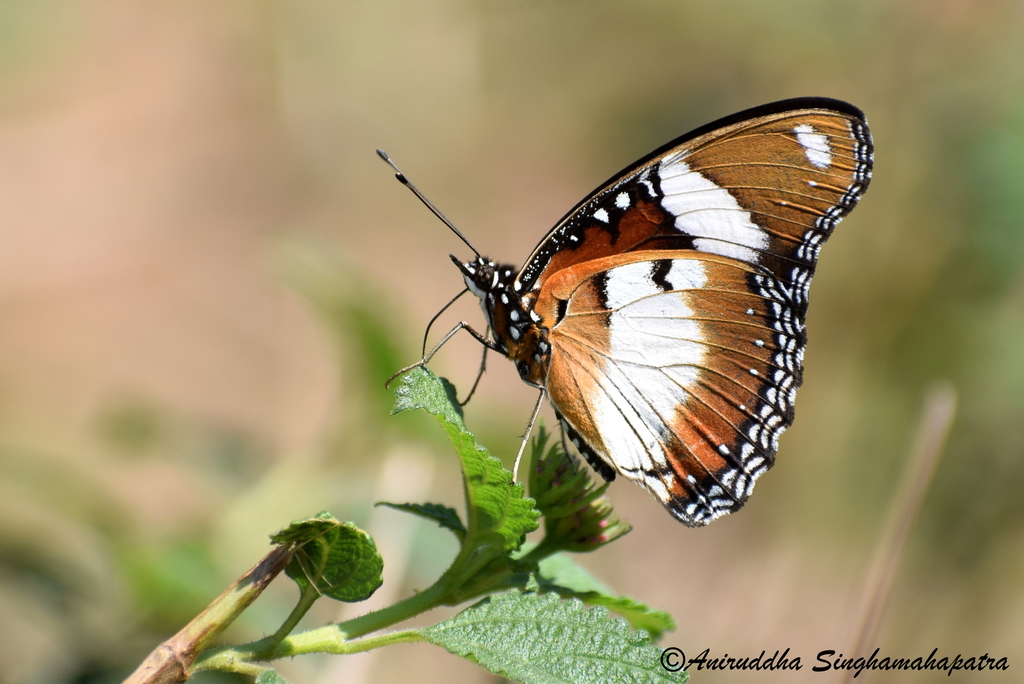
Danaid Eggfly
Hypolimnas misippus
Hypolimnas misippus, the Danaid eggfly, mimic, or diadem, is a widespread species of nymphalid butterfly. It is well known for polymorphism and mimicry. Males are blackish with distinctive white spots that are fringed in blue. Females are in multiple forms that include male-like forms while others closely resemble the toxic butterflies Danaus chrysippus and Danaus plexippus. They are found across Africa, Asia, and Australia.
From the article Hypolimnas misippus on Wikipedia (CC BY-SA), quoted section by section
Description
The adults are on wing during late summer, between March and April. The wing periods are associated with rainfall patterns, as peak abundances occur shortly after rainfall. They are rarely seen during dry weathers. This correlation is due food plants growth rates and suitable conditions for larval growth.
Male. The male is monomorphic, with the upperwings dark velvety brownish black. Forewing: The forewing has a broad white oval spot between veins 3 and 7. A smaller spot near the apex is also present. These spots are crossed by the black veins and bordered in iridescent blue that is visible only at certain angles. The hindwing has a larger white spot but the veins crossing it are yellowish and not as prominent as on the forewing. There are some white specks along the tornus and the margin is edged with white and black. The underside of forewing is colored rich light chestnut at the bases of interspaces 1 and 2, and the cell. The discal area, however, shows fuscous brown hue. The apical half is golden brown, with the basal half of costal margin is flecked with white. There are three white spots on th cell, which is black anteriorly. Beyond the apex of the cell, there is a narrow, short, transverse white mark. A broad, oval, white discal patch extends from costa to the middle of interspace 2, edged with a diffused dusky black border. …
Range & habitat
They are found across Africa, Asia, and Australia. In the Americas, they are found in the West Indies, with strays in Central and North America. It is widely distributed across the Indian Ocean islands, including Maldives,Seychelles, and has recorded on multiple islands such as Mahé, Praslin, Aldabra and Cousine.
Wikipedia: “Distribution”
What it does
Larva: According to de la Chaumette (as noted by Moore), the larva of H. misippus has a cylindrical shape and is predominantly black, having an even darker black dorsal line that runs along its back. It is banded transversely with small, pale brown transverse tuberculated spots, contrasting against the dark body. The ventral surface has a dark olive-brown hue, while the legs and head are brick-red in color. The head is equipped with two long, thick branched black spines thats serve as defensive adaptations. The rest of the segments, with the exception of the anal segment, possess a total of ten branched spines that are dirty, transparent white in colour and are disposed in longitudinal rows. The anal segment, notable for its function, also has two similar spines. Food plant: The larvae primarily feed on the leaves of Portulaca oleracea (common purslane, also known as little hogweed, or pursley), and Asystasia lawiana. Pupa: The pupa is pendulous in nature, characterized as short and thick, with its overall structure contributing to its camouflage. Its coloration is light brown, lacking any metallic spots, which aids in its concealment among foliage. It is variegated and streaked with bistre, particularly around the head and tail regions, providing further adaptations to the environment. (de la Chaumette.)
Wikipedia: “Life cycle”
Listen
Looking for field recordings…
Where it lives
Recorded sightings
—
geo-referenced records in GBIF, from museums, herbaria and field observers.
Drag the globe to turn it. Dots are where records exist, not a range map; darker means more records.
In the stacks
Searching the stacks…
Every page naming Hypolimnas misippus in the Biodiversity Heritage Library →
This page is assembled live from iNaturalist, GBIF, Wikipedia, the Source Library and the Internet Archive. It is not yet part of the hand-edited codex. iNaturalist taxon 51578.