- Animals
- ›Chordates
- ›Vertebrates
- ›Reptiles
- ›Snakes and Lizards
- ›Snakes
- ›Colubrid Snakes
- ›Colubrine Snakes
- ›Lampropeltis
- ›Lampropeltis triangulum
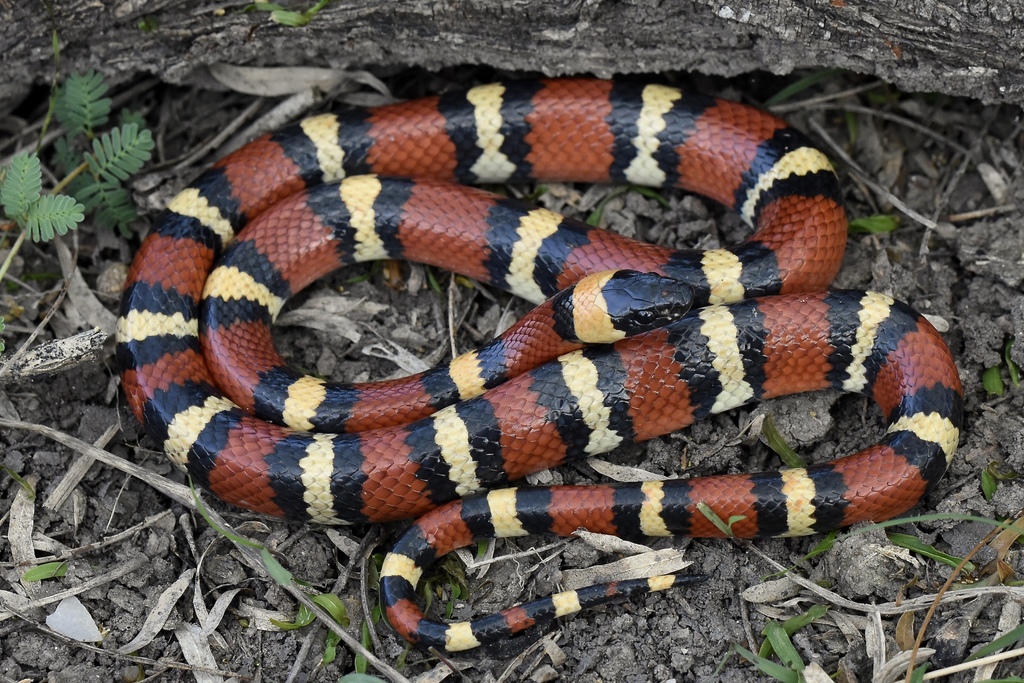
Tamaulipan Milksnake
Lampropeltis annulata
Lampropeltis annulata, commonly known as the Mexican or Tamaulipan milksnake, is a non-venomous species of milksnake (family Colubridae). It is native to northwestern Mexico and some adjacent Mexico–United States border regions.
From the article Mexican milk snake on Wikipedia (CC BY-SA), quoted section by section
Description
The Mexican milksnake has distinct red, black and cream or yellow-colored banding, wrapping around the body. This coloration is likely an evolutionary survival tactic to ward off potential predators by mimicking the venomous coral snake (Elapidae), which shares much of the same habitat, leading to the species sometimes being called a coral snake-"mimic." Localities indicate "whiter", brighter creams to the west, "dirtier" creams to the east and north, and often yellow or orange further south. The underside of the species is checkered black and white, in correlation to the overhead banding, with southern localities having higher concentrations of black, and northern localities having more white. The subspecies can be differentiated from other milksnakes due to the darker light bands, which display at the very lightest—a creamy yellow color at the first light band following the black head (darker cream than other subspecies), with the rest of the light banding being solid cream. The darkest light bands will display: a bright yellow or orange-yellow color following the first light band adjacent to the black head, with the rest of the light banding being a lighter hue of either yellow, cream-yellow, or orange-yellow. …
Range & habitat
This milksnake species is native to the dry, semi-arid regions of northeastern and north-central Mexico, predominantly the states of Coahuila, Tamaulipas and Nuevo León, and may additionally be found as far south as Guanajuato, Hidalgo, San Luis Potosí and Querétaro, and as far east as the coast of Veracruz. It may also be found as far north as southwestern Texas, United States, where it has been observed near cities as far north as Kerrville, Ozona, San Angelo and San Antonio, among others.
Wikipedia: “Geographic range and habitat”
What it does
Like many snakes, L. annulata tend to be nocturnal or crepuscular in lifestyle, mostly preferring to hide when the daytime temperatures are at their highest and becoming most active in the cooler periods of the day, especially from the spring to the fall. They eat primarily rodents and lizards; additionally, they will occasionally eat other snakes, including venomous rattlesnakes and coral snakes (albeit not nearly as often as the related kingsnakes), whose venom the genus Lampropeltis has (seemingly) evolved an innate resistance to. As with all lampropeltid snakes, they will eat most or all animals they can comfortably swallow, if hungry or voracious enough, including desert toads, frogs, young rabbits, and various ground-nesting birds and their chicks. Their choice of habitat is semi-arid brush areas with sandy soils. While these snakes are primarily nocturnal and crepuscular, as previously stated, they will also bask for short periods during the day to raise their internal temperature. …
Wikipedia: “Behavior and adaptations”
Where it lives
Recorded sightings
—
geo-referenced records in GBIF, from museums, herbaria and field observers.
Drag the globe to turn it. Dots are where records exist, not a range map; darker means more records.
In the stacks
Searching the stacks…
Every page naming Lampropeltis annulata in the Biodiversity Heritage Library →
This page is assembled live from iNaturalist, GBIF, Wikipedia, the Source Library and the Internet Archive. It is not yet part of the hand-edited codex. iNaturalist taxon 515417.