On eBird ↗
Wreathed Hornbill
Live sightings near you, the range map, bar charts of when it is seen, and Macaulay Library photos and recordings.
Wreathed Hornbill
Rhyticeros undulatus
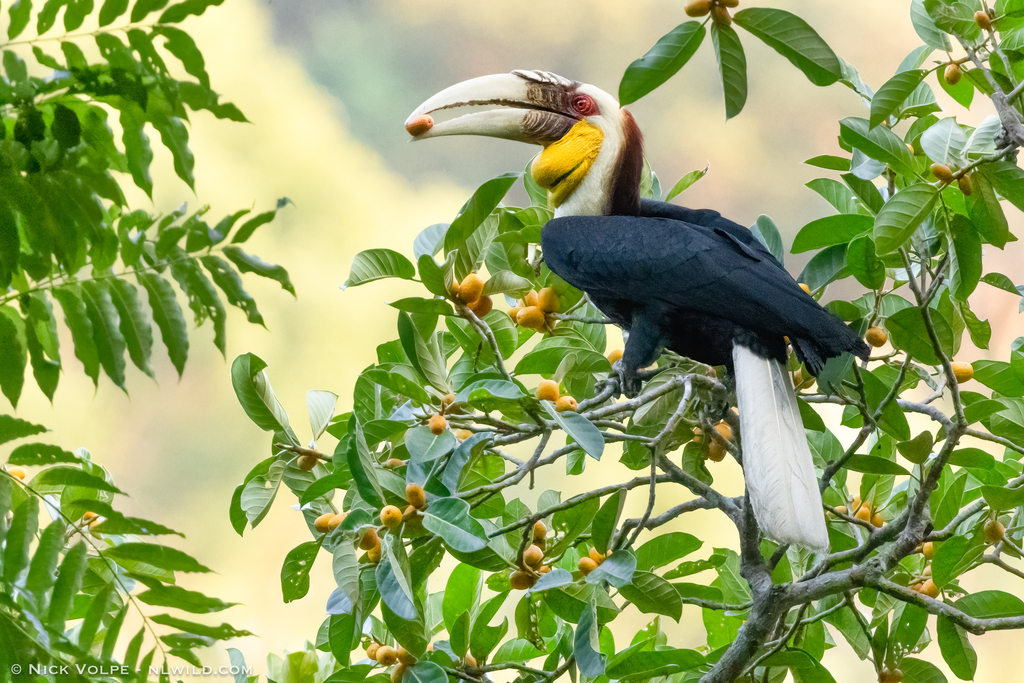
The wreathed hornbill (Rhyticeros undulatus) is an Old World tropical bird of the hornbill family Bucerotidae, also called bar-pouched wreathed hornbill due to its distinctive blue-black band on its lower throat sac. It is named after its characteristic long, curved bill that develops ridges, or wreaths, on the casque of the upper mandible in adults. Males are black with a rufous crown, a white upper breast and face, and a yellow featherless throat. Females are uniformly black with a blue throat and are slightly smaller than males.
The wreathed hornbill ranges across the foothills and evergreen forests of Northeast India and Bhutan to Bangladesh, Southeast Asia and the Greater Sunda Islands.
From the article Wreathed hornbill on Wikipedia (CC BY-SA), quoted section by section
Description
The wreathed hornbill is black with black legs and feet, but has a pale yellow bill, bare reddish skin around the eyes, a black band around the gular skin and a white tail. The female's gular skin is blue, whereas the male's is bright yellow; his neck is white and his nape dark reddish passing into black. Sexual dimorphism in the colouration of plumage and inflatable gular skin is less pronounced in young wreathed hornbills, but becomes more apparent as both sexes mature. It is a medium-sized bird with a body length of 75 to 90 cm (30 to 35 in); adult males weigh from 1.68 to 3.65 kg (3.7 to 8.0 lb), and females weigh from 1.36 to 2.69 kg (3.0 to 5.9 lb).
Bill morphology. All members of the hornbill family have large, heavy bills with characteristic casques that distinguish them from other avian taxa. Hornbill casques contain foamy air-filled cavities surrounded by multiple layers of keratin tiles that act as an external shell. The extra weight of the casque is supported by the fusion of the first two vertebrae. The bill has distinctive serrated casques near the base of the upper mandible, which are particularly unique because of its ridges. As the birds mature, forward growth causes the foremost ridge to break off. …
Range & habitat
The wreathed hornbill inhabits tropical evergreen forests in the region from southern Bhutan, Northeast India, Bangladesh and through mainland Southeast Asia to Indonesia, where it is restricted to Sumatra, Java, Borneo and a few smaller islands. It has been recorded up to an elevation of 2,560 m (8,400 ft). In Bhutan, two individuals were sighted in Sarpang district in spring 1986. In Northeast India, it inhabits unlogged primary forests and selectively logged forests in the foothills of the Eastern Himalayas from Nameri National Park in Assam to Namdapha National Park in Arunachal Pradesh. During the breeding season, it lives in lowland areas, but migrates to higher elevations in the non-breeding season. In Myanmar, 62 wreathed hornbills were sighted in the Mali River valley at elevations of 800–2,500 m (2,600–8,200 ft) in winter 1999. A flock of about 50 individuals was sighted in Hponkanrazi Wildlife Sanctuary in September 2004.
Wikipedia: “Distribution and habitat”
What it does
The wreathed hornbill is a social bird and most active in the early mornings when foraging for fruits; 21 individuals studied in Pakke Tiger Reserve during the non-breeding season rested at midday and resumed activity in the early afternoons. It lives in larger flocks than other hornbill species and remains in groups during both breeding and non-breeding seasons. Flock size observed in Namdapha National Park ranged from a mean of 4.7 to 6.6 individuals with a density of 1.3 birds/km2 (3.4 birds/sq mi) in March and April to 68 birds/km2 (180 birds/sq mi) in December. In Arunachal Pradesh, the wreathed hornbill density is much lower in habitats where local people hunt, ranging from 2.9 to 9.02 birds/km2 (7.5 to 23.4 birds/sq mi). It travels long distances to forage for fruit, sometimes flying between islands, but it does not migrate. A male wreathed hornbill was fitted with a GPS tracking unit in Pakke Tiger Reserve during the breeding season; it moved a mean minimum daily distance of 24.8 km (15.4 mi) and dispersed seeds for up to 10.8 km (6.7 mi) from its nesting site. Home ranges of the wreathed hornbill and other hornbill species overlap in several range countries.
Vocalizations. The main call of the wreathed hornbill is a loud double yelp that has been described to sound like "coo-cuk" or "wuff-wurff". …
Wikipedia: “Behaviour and ecology”
Listen
Looking for field recordings…
Where it lives
Recorded sightings
—
geo-referenced records in GBIF, from museums, herbaria and field observers.
Drag the globe to turn it. Dots are where records exist, not a range map; darker means more records.
In the stacks
Searching the stacks…
Every page naming Rhyticeros undulatus in the Biodiversity Heritage Library →
This page is assembled live from iNaturalist, GBIF, Wikipedia, the Source Library and the Internet Archive. It is not yet part of the hand-edited codex. iNaturalist taxon 514339.