On eBird ↗
Sumba Hornbill
Live sightings near you, the range map, bar charts of when it is seen, and Macaulay Library photos and recordings.
Sumba Hornbill
Rhyticeros everetti
Sumba hornbill (Latin: Rhyticeros everetti), or known natively as Julang (in Sumba languages) is a large bird belonging to the family of Bucerotidae, endemic and native to the Indonesian island of Sumba. The scientific name commemorates British colonial administrator and zoological collector Alfred Hart Everett.
From the article Sumba hornbill on Wikipedia (CC BY-SA), quoted section by section
Description
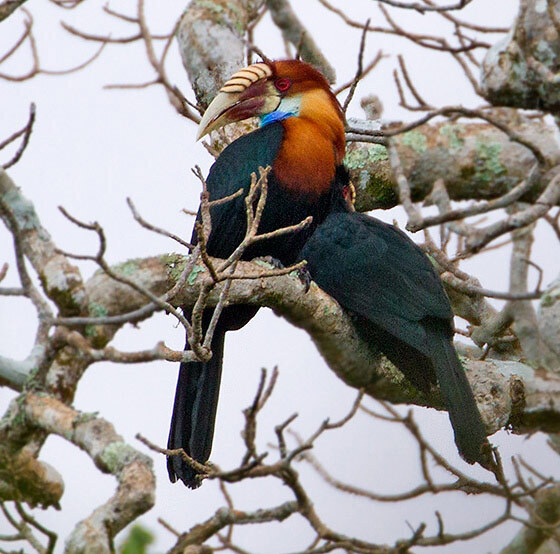
It is a medium-sized, blackish hornbill, approximately 70 cm long. The male is dark reddish-brown on the crown and nape, with a paler neck. The female has entirely black plumage. Both sexes have a large, dull, yellowish bill with a maroon patch at the base, a serrated casque, and an inflatable blue throat.
Range & habitat
An Indonesian endemic, the Sumba hornbill inhabits semi-evergreen forests of Sumba in the Lesser Sunda Islands. It is uncommon and found in the lowlands at altitudes of up to 950 m (3,120 ft).
Wikipedia: “Distribution and habitat”
Listen
Looking for field recordings…
Where it lives
Recorded sightings
—
geo-referenced records in GBIF, from museums, herbaria and field observers.
Drag the globe to turn it. Dots are where records exist, not a range map; darker means more records.
In the stacks
Searching the stacks…
Every page naming Rhyticeros everetti in the Biodiversity Heritage Library →
This page is assembled live from iNaturalist, GBIF, Wikipedia, the Source Library and the Internet Archive. It is not yet part of the hand-edited codex. iNaturalist taxon 514335.