On eBird ↗
Crowned Hornbill
Live sightings near you, the range map, bar charts of when it is seen, and Macaulay Library photos and recordings.
Crowned Hornbill
Lophoceros alboterminatus
The crowned hornbill (Lophoceros alboterminatus) is an African hornbill.
From the article Crowned hornbill on Wikipedia (CC BY-SA), quoted section by section
Description
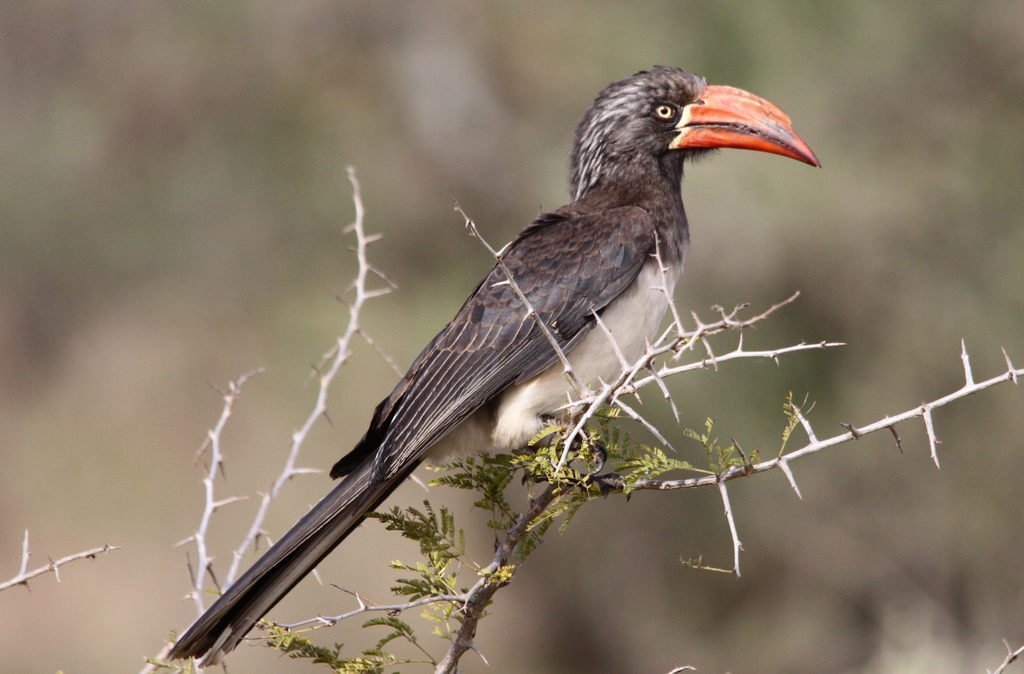
It is a medium-sized bird, 50–54 centimetres (20–21 in) in length, and is characterized by its white belly and black back and wings. The tips of the long tail feathers are white. The eyes are yellow; the beak is red and presents a stocky casque on the upper mandible. In females, the casque is smaller. The crowned hornbill can be distinguished from the similar Bradfield's hornbill by its shorter beak.
Range & habitat
The crowned hornbill is a common resident of the coastal and riverine forests of southern (only the eastern coast) to northeastern Africa.
Wikipedia: “Habitat”
What it does
It forages mainly in trees, where it feeds on insects (often caught in flight), small rodents, small reptiles, eggs, seeds and fruits. This hornbill species can be seen in flocks, usually in the dry season. Four to five white eggs are incubated for 25 to 30 days; the juveniles remain with both parents for about 8 weeks.
Wikipedia: “Diet”
Listen
Looking for field recordings…
Where it lives
Recorded sightings
—
geo-referenced records in GBIF, from museums, herbaria and field observers.
Drag the globe to turn it. Dots are where records exist, not a range map; darker means more records.
In the stacks
Searching the stacks…
Every page naming Lophoceros alboterminatus in the Biodiversity Heritage Library →
This page is assembled live from iNaturalist, GBIF, Wikipedia, the Source Library and the Internet Archive. It is not yet part of the hand-edited codex. iNaturalist taxon 512160.