On eBird ↗
White-plumed Honeyeater
Live sightings near you, the range map, bar charts of when it is seen, and Macaulay Library photos and recordings.
White-plumed Honeyeater
Ptilotula penicillata
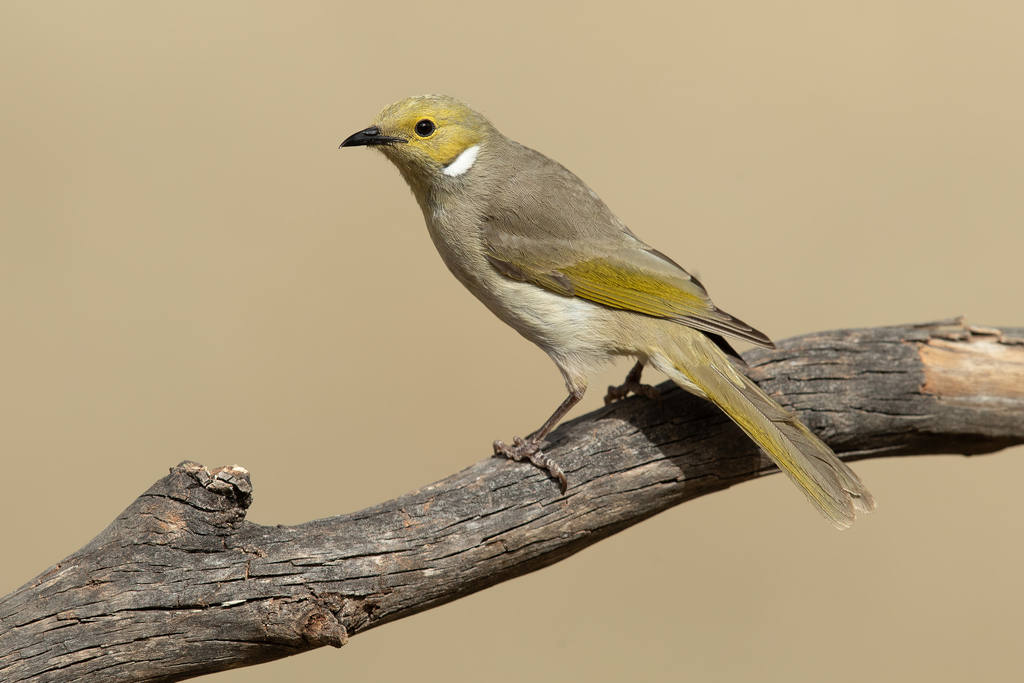
The white-plumed honeyeater (Ptilotula penicillata, formerly Lichenostomus penicillatus) is a medium-sized passerine of the family Meliphagidae (honeyeaters) endemic to mainland Australia. Its key identifying characteristics are a primarily olive-grey body and yellow face, a slightly down-curved bill and its white distal neck-plumes from which it takes its name. White-Plumed Honeyeaters exhibit a preference for woodlands and riparian areas and have a very strong association with River Red Gums. They exhibit a small seasonal migration from ranges to lower areas in winter. Today the species is most commonly seen through Victoria, South Australia and New South Wales, but is also found in regions of Western Australia and the Northern Territory. They are often seen in gardens and backyards with vegetation cover.
Honeyeaters are most diverse group of passerine birds on continental Australia and the White-plumed honeyeater is one of the most common honeyeaters of urban areas throughout much of Australia.
From the article White-plumed honeyeater on Wikipedia (CC BY-SA), quoted section by section
Description
Similar in appearance to the Yellow-plumed, Yellow-tinted, Fuscous and Grey-fronted Honeyeaters, the distinguishing feature of the White-plumed honeyeater is the distil white bands at its neck called neck-plumes. This is where its name is derived from with the species epithet penicillata deriving from the Modern Latin penicillatus meaning tufted or with brush-like tufts originating from the Latin word penicillus meaning a painter's brush. It is a medium-sized honeyeater with a yellowish head, pale grey-brown plumage below and yellowish-olive feathers on its back. Males and Females appear similarly with males only slightly larger than females.
There is some variation in appearance seasonally and with breeding individuals. All adults are mostly uniform olive-grey with a yellowish tinge on upperparts. The wings are mostly brown with olive to yellow-olive edges or accents. The underwing coverts are white, and remiges are brownish grey and undertail is typically brownish-grey. the nape, crown, forehead and lores are olive and the eye-ring is yellow. Breeding and non-breeding adults are differentiated in appearance by the colour of bare parts. Breeding adults possess a black bill, nares, tomia and gape, whereas non-breeding adults possess a lighter or yellower tomia, yellow gape and browner leaning to yellow or orange bill. …
Range & habitat
The White-Plumed Honeyeater is endemic to mainland Australia. The species is widely distributed throughout south-eastern Australia (excluding Tasmania), up towards central Australia and in areas of central and western Queensland, Northern Territory and Western Australia. In Queensland White-plumed Honeyeaters are widespread in the Gulf Country, in all areas West of the Great Dividing Range and South of 20°. They are reportedly rare East of the Great Divide. White-Plumed Honeyeaters are widespread West of the Great Dividing Range in New South Wales, including within the Australian Capital Territory, but have a much patchier distribution East of the Great Divide, with larger populations near Sydney and in the Hunter Region. In Victoria White-Plumed Honeyeaters are widespread West of the Great Dividing Range in the North, Northeast and North-central. They are far rarer at higher elevations of the Great Dividing Range, in Gippsland and in arid regions of the West, Southwest and Central Victoria. In South Australia, the species is found most commonly in the East and Southeast with more arid areas of the North, Central, West and Southwest being mostly absent. In Western Australia the species is most widespread in the northern areas of the Wheatbelt, Pilbara and Gascoyne Regions. …
Wikipedia: “Distribution”
What it does
The white-plumed honeyeater's diet consists mainly of nectar, insects and their products (e.g., honeydew and lerp), manna, fruit, and very occasionally seeds. They may also peck at berries to feed on juice. Information on diet comes from scats, stomach contents, and foraging observations. Stomach contents are heavily biased toward strong tissues from plants and arthropods. In 1980, it was found that manna, honeydew, and lerp were extremely important food resources. Other research indicated that insects were only a small part of the diet, when they were previously thought to be major components. However, this is debated with many sources reporting the prominence of insects in the diet with some studies reporting a ratio of approximately 2:1 insects to nectar in the diet. Insects are sometimes taken on the wing, but probably only provide a protein and mineral source, as a surplus of energy is available in nectar, lerp, and manna. The lower proportion of insects in the diet is a consequence of the fact that more energy is spent hawking prey than can be redeemed from the prey. Where sufficient standing water occurs, P. penicillata can be observed drinking at least twice per day. In xeric habitats, additional moisture is obtained from food. A study in the Pilbara region of Western Australia found that white-plumed honeyeaters must eat around 100 berries to obtain 1mL of water. …
Wikipedia: “Diet”
In human culture
Females are relatively more ready to breed from late winter through to summer; however, males maintain enlarged testes throughout the year. Breeding occurs throughout their range with records in all months, and clutches typically produced 2–3 times per year. Breeding events usually coincide with outbreaks of herbivorous insects.
Courting Behaviour. Males undertake a song flight display, with a slight climbing and undulating flight above treetops while singing. At the song's completion, the male dives quickly into a nearby tree. This is performed throughout the day during breeding season, but less commonly in the early morning. Playback of this song does not induce territorial responses, suggesting the display is sexual in function. Other songs heard commonly after the breeding period begins may also have courtship functions.
Breeding. Breeding behaviours are reportedly relatively well known, however, no detailed studies have occurred. Females are relatively more ready to breed from late winter through to summer; however, males maintain enlarged testes throughout the year. Breeding occurs throughout their range with records in all months, and clutches typically produced 2–3 times per year. In Queensland breeding mainly occurs in February through to September, in NSW, Victoria and SA mostly in the Spring. …
Wikipedia: “Life History”
Listen
Looking for field recordings…
Where it lives
Recorded sightings
—
geo-referenced records in GBIF, from museums, herbaria and field observers.
Drag the globe to turn it. Dots are where records exist, not a range map; darker means more records.
In the stacks
Searching the stacks…
Every page naming Ptilotula penicillata in the Biodiversity Heritage Library →
This page is assembled live from iNaturalist, GBIF, Wikipedia, the Source Library and the Internet Archive. It is not yet part of the hand-edited codex. iNaturalist taxon 508976.