- Animals
- ›Chordates
- ›Vertebrates
- ›Birds
- ›Swifts and Hummingbirds
- ›Hummingbirds
- ›Mango Hummingbirds and Allies
- ›Colibri
On eBird ↗
Mexican Violetear
Live sightings near you, the range map, bar charts of when it is seen, and Macaulay Library photos and recordings.
Mexican Violetear
Colibri thalassinus
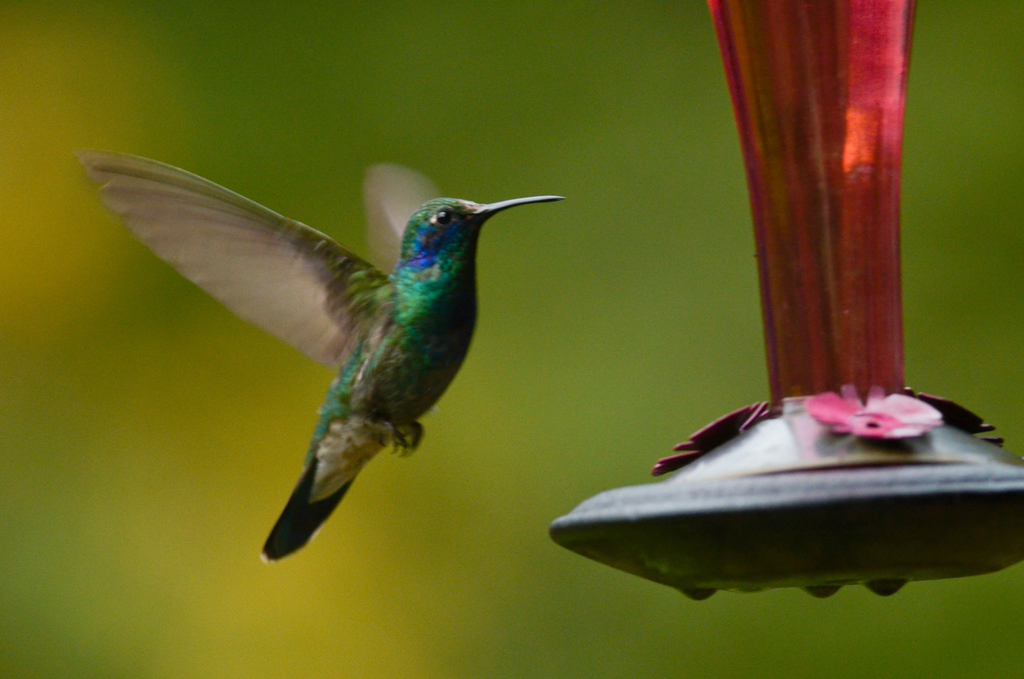
The Mexican violetear (Colibri thalassinus) is a medium-sized, metallic green hummingbird species commonly found in forested areas from Mexico to Nicaragua. This species, together with the lesser violetear were previously considered conspecific, and together called the green violetear.
From the article Mexican violetear on Wikipedia (CC BY-SA), quoted section by section
Description
The Mexican violetear is roughly medium-sized by hummingbird standards. It averages around 9.7 to 12 cm (3.8 to 4.7 in) in total length. Its bill is black and mostly straight with only a slight downward curve and measures from 1.8 to 2.5 cm (0.71 to 0.98 in). The body mass can vary from 4.8 to 5.6 g (0.17 to 0.20 oz). Among standard measurements, the wing chord is 5.8 to 6.8 cm (2.3 to 2.7 in) and the tail is 3.5 to 4.3 cm (1.4 to 1.7 in). The bird has a wingspan of 12 cm. It is shining green above with a glittering violet ear-patch on the sides of its neck. Its throat and chest are a glittering green with a shining green belly. The tail is a metallic blue-green with more bronzy central feathers and a prominent black subterminal band.
Vocalizations. Solitary males sing from above, exposed twigs in their territory every day. Their song is a monotonously repeated sharp and dry "tsu-tzeek" at a rate of about one call per second.
Range & habitat
The Mexican violetear breeds from the highlands of southern Mexico south to Nicaragua. It is a rare but annual nonbreeding visitor to the United States, primarily southern and central Texas, with scattered records as far north as extreme southern Canada. According to IUCN C. thalissinus can be found in much of montane areas of the northern Andes, stretching from Bolivia to Venezuela.
Wikipedia: “Distribution”
What it does
The Mexican violetear forages alone but tends to gather at flowering trees, especially coffee-shade Inga. They feed at mid-level to canopy and often hold and defend a feeding territory. They primarily feed on nectar and small insects. They are a fairly common species that thrives in deforested areas.
Wikipedia: “Diet”
Listen
Looking for field recordings…
Where it lives
Recorded sightings
—
geo-referenced records in GBIF, from museums, herbaria and field observers.
Drag the globe to turn it. Dots are where records exist, not a range map; darker means more records.
In the stacks
Searching the stacks…
Every page naming Colibri thalassinus in the Biodiversity Heritage Library →
This page is assembled live from iNaturalist, GBIF, Wikipedia, the Source Library and the Internet Archive. It is not yet part of the hand-edited codex. iNaturalist taxon 508366.