- Animals
- ›Arthropods
- ›Hexapods
- ›Insects
- ›Winged and Once-winged Insects
- ›Butterflies and Moths
- ›Butterflies
- ›Brush-footed Butterflies
- ›Satyrs, Morphos, and Allies
- ›Alpines, Arctics, Nymphs and Satyrs
- ›Coenonymphina
- ›Heteronympha
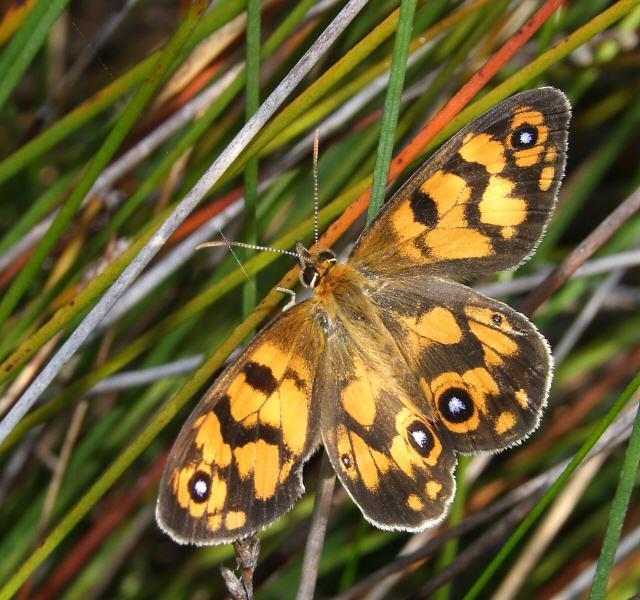
Bright-eyed Brown
Heteronympha cordace
Heteronympha cordace, the bright-eyed brown, is a brown colored butterfly endemic to Australia. It was described by Carl Geyer in 1832.
From the article Heteronympha cordace on Wikipedia (CC BY-SA), quoted section by section
Description
Heteronympha cordace has a wingspan ranging from 38–42 mm (1.5–1.7 in), with females generally larger than males and with stouter abdomens. The uppersides of the wings are black to dark brown with orange to brownish-orange markings. The markings contain a blue-centered black subapical eyespot and a larger blue-centered black subtornal eyespot. The underside of the wings are lighter in hue and have more extensive orange areas.
Range & habitat
The Heteronympha cordace butterfly occurs in disjunct populations across Australia, in New South Wales, southern Victoria, south eastern South Australia, and Tasmania. Populations of the butterfly are known from swampy areas in the alpine of the Great Divide to coastal areas in both the east and west. It is not common in any areas and colonies tend to be static, and many populations have become extinct as a result of habitat loss.
Wikipedia: “Range”
What it does
Adult butterflies have a slow, meandering flight pattern close to the ground among the larval host plants, and near food plants Melaleuca and Leptospermum that grow near the breeding habitat. One generation is completed annually, with adults occurring mainly from late December to February. It is fond of sedgeland and low shrubland in swamps and along creeks, often with dense stands of the larval food plant. It occurs mostly at altitudes from 600–1,800 m (2,000–5,900 ft) but can occur as low as sea level in Tasmania. The larval food plant of Heteronympha cordace is Carex appressa. The female butterfly lays a single egg or very few on the underside of the lower leaves of Carex appressa. The eggs are .8 mm (0.031 in) in diameter, green, nearly spherical, and have thin longitudinal ribs. The larva is green to greenish brown and generally 25 mm (0.98 in) long. The larva has a darker middorsal line with paler dorsolateral and lateral lines. The head of the larva is slightly concave and reddish brown to mottled brown. The pupa of the butterfly is green with greenish-yellow wings, and about 14 mm (0.55 in) long. Pupation occurs either on a low leaf of a host plant or nearby a host plant, and the pupa is suspended with its head downwards by the cremaster.
Wikipedia: “Ecology”
Listen
Looking for field recordings…
Where it lives
Recorded sightings
—
geo-referenced records in GBIF, from museums, herbaria and field observers.
Drag the globe to turn it. Dots are where records exist, not a range map; darker means more records.
In the stacks
Searching the stacks…
Every page naming Heteronympha cordace in the Biodiversity Heritage Library →
This page is assembled live from iNaturalist, GBIF, Wikipedia, the Source Library and the Internet Archive. It is not yet part of the hand-edited codex. iNaturalist taxon 501281.