On eBird ↗
Gilbert's Honeyeater
Live sightings near you, the range map, bar charts of when it is seen, and Macaulay Library photos and recordings.
Gilbert's Honeyeater
Melithreptus chloropsis
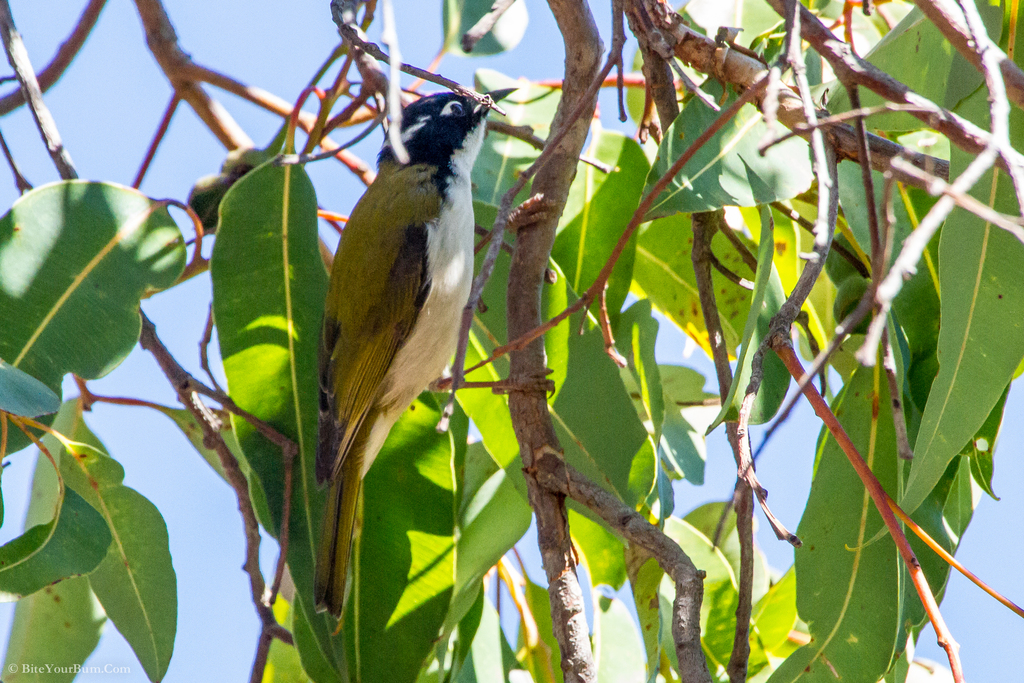
Gilbert's honeyeater (Melithreptus chloropsis), also known as the Swan River honeyeater or western white-naped honeyeater, is a passerine bird of the honeyeater family Meliphagidae native to south-western Australia. A mid-sized honeyeater, it is olive green above and white below, with a black head, nape and throat and a white patch over the eye and a white crescent-shaped patch on the nape. The bill is brownish-black and the eyes a dull red. The sexes have similar plumage.
From the article Gilbert's honeyeater on Wikipedia (CC BY-SA), quoted section by section
Description
A mid-sized honeyeater, Gilbert's honeyeater has olive-green upperparts and white underparts to the undertail. Both olive and white feathers have grey bases, which can be seen if the plumage is ruffled. White feathers on the flanks have dusky tips. It has a black head, nape and throat, a white patch over the eye, and a white crescent-shaped patch on the nape, which is thinner than that of other species. The bill is brownish-black and the eyes a dull red. Within its range, its plumage is distinctive, rendering it unlikely to be confused with other species, apart from the related white-throated honeyeater (though this species are found much further north) or the Brown-headed honeyeater. Gilbert's honeyeater closely resembles the white-naped honeyeater; the plumage of the two is identical, except for the bare parts around the eye, which is pale-green to off-white in the former species, and red in the latter. Gilbert's honeyeater also has a longer bill and tarsus, and is slightly larger overall.
Range & habitat
Gilbert's honeyeater is found in the southwest corner of Western Australia, where it ranges from Moora in the north, through the jarrah forest belt to Broomehill, the Stirling Range and along the coast to Stokes Inlet. It inhabits dry sclerophyll forests dominated by jarrah (Eucalyptus marginata), karri (E. diversicolor) or marri (Corymbia calophylla) inland, tuart (E. gomphocephala), flooded gum (E. rudis) or narrow-leaved paperbark (Melaleuca laxiflora) on the coastal plain, or wandoo (E. wandoo) woodland. Gilbert's honeyeater is generally sedentary or locally nomadic; birds on the Swan Coastal Plain generally move little. The species has become less common on the Swan Coastal Plain, and has vanished from Kellerberrin.
Wikipedia: “Distribution and habitat”
What it does
Gilbert's honeyeater mainly forages in the foliage and flowers in the canopy of tall eucalypts, though at times it ventures into understory plants and on the bark of treetrunks. Fieldwork in Dryandra Woodland revealed that they foraged at an average height of 7.7 m above the ground. It mainly hunts arthropods, particularly insects, as well as nectar, manna, honeydew and lerp.
Wikipedia: “Feeding”
Listen
Looking for field recordings…
Where it lives
Recorded sightings
—
geo-referenced records in GBIF, from museums, herbaria and field observers.
Drag the globe to turn it. Dots are where records exist, not a range map; darker means more records.
In the stacks
Searching the stacks…
Every page naming Melithreptus chloropsis in the Biodiversity Heritage Library →
This page is assembled live from iNaturalist, GBIF, Wikipedia, the Source Library and the Internet Archive. It is not yet part of the hand-edited codex. iNaturalist taxon 501225.