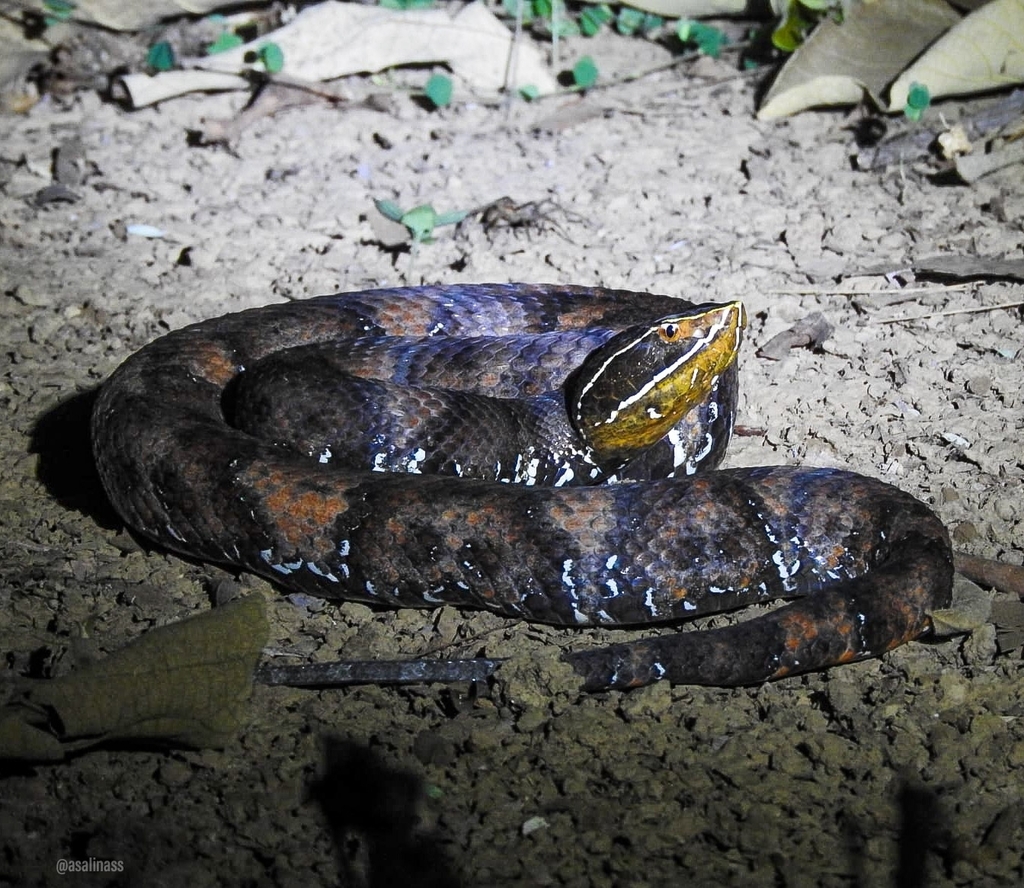
Southern Cantil
Agkistrodon howardgloydi
Agkistrodon howardgloydi is a species of venomous snake, a pit viper in the subfamily Crotalinae of the family Viperidae. The species is endemic to Central America. It is most commonly called castellana, but it has also been called the southern cantil, Gloyd's moccasin, and a number of other colloquial names. It is a rare species with a relatively small geographic distribution in the tropical dry forest on the Pacific coast of Honduras, Nicaragua, and extreme northwest Costa Rica. A. howardgloydi is a stout, medium-sized snake with a maximum total length (including tail) of 96 cm (38 in). It is a viviparous species, with females giving birth in the rainy season from May to August. No clinical reports on envenomation had been published (as of 1999), but laboratory tests and analysis indicate the venom is highly toxic and similar to its close relative Agkistrodon bilineatus, and potentially lethal.
From the article Agkistrodon howardgloydi on Wikipedia (CC BY-SA), quoted section by section
Description
Of the ten specimens of A. howardgloydi available to Gloyd and Conant (1990) from Nicaragua and Costa Rica, the largest male was 96 cm (37+3⁄4 in) and the largest female 82 cm (32+1⁄4 in) in total length (including tail). According to Villa (1984), adults in Nicaragua almost never exceed 135 cm (53+1⁄4 in) in length. In both sexes, the tail length is 19% of the total body length. Scalation includes 23 rows of keeled dorsal scales at midbody; 128-135 ventral scales; and 54-61 subcaudal scales, roughly half of which are paired, especially towards the tail tip. The dorsal color pattern consists of light to medium reddish brown ground color overlaid with 10-14/13-17 broad brown or brownish crossbands in males/females. Large adult males tend to be melanistic. Juveniles are more lightly colored, even to the point of being bright red. The head is clearly marked on either side with two longitudinal light lines: the upper one is narrow and broken or even absent posterior to the supraocular scale; while the lower one is wider and split into two parts which may or may not meet at the suture of the third supralabial scale. Agkistrodon howardgloydi can be distinguish from other members of the genus Agkistrodon by the presence of a loreal scale (absent in cottonmouths A. piscivorus and A. conanti), and two distinctive white or light stripes on each side of the face (absent in copperheads A. …
Range & habitat
Agkistrodon howardgloydi is found on the Pacific coast of Nicaragua, ranging north into the Gulf of Fonseca area in extreme southwest Honduras, and south into the Guanacaste Province of extreme northwest Costa Rica. It occurs on a relatively narrow strip of lowlands less than 400 km. north to south. The elevational range is from near sea level to no more than 600 m. In Costa Rica it has been reported from 20 to 285 m., and sea level to 300 m. elevation. The type locality given is "0.8 km north Mirador el Cañon del Tigre, Parque Nacional Santa Rosa, Provincia Guanacaste, Costa Rica".
Wikipedia: “Distribution”
What it does
Fish, frogs, lizards, birds, eggs, and rodents were identified in the diet of A. howardgloydi in one Nicaraguan publication. A study conducted early in the rainy season of 1994 in Costa Rica found some age related variation in the diet: neonates (<38 cm.) contained frogs (Hypopachus) and lizards (Marisora, Holcosus); juveniles (38–50 cm.) contained frogs (Leptodactylus), lizards (Ctenosaura), and mice (Liomys); adults (>50 cm.) contained lizards (Ctenosaura), mice (Liomys), and rats (Sigmodon), suggesting an ontogenetic shift in diet from ectotherm prey in juveniles, to endotherm prey in adults.
Wikipedia: “Diet”
In human culture
Roger Conant's original description states: "This subspecies is named for the late Howard K. Gloyd, my close friend, colleague, and expert on pit vipers, especially the rattlesnakes. Gloyd worked for decades on the genus Agkistrodon (sensu lato), and he had predicted that a new race of A. bilineatus would eventually be described from lower Central America." The common name castellana is the feminine form of the Spanish adjective castellano, translating to Castilian or Spaniard, but it is not entirely clear how this name came to be applied to A. howardgloydi. It has been speculated that it is something of an analogy, with the snake and the conquistadores being equally feared, or the snake and the conquistadores both being alert and ready to strike in a confrontation.
Wikipedia: “Etymology”
Where it lives
Recorded sightings
—
geo-referenced records in GBIF, from museums, herbaria and field observers.
Drag the globe to turn it. Dots are where records exist, not a range map; darker means more records.
In the stacks
Searching the stacks…
Every page naming Agkistrodon howardgloydi in the Biodiversity Heritage Library →
This page is assembled live from iNaturalist, GBIF, Wikipedia, the Source Library and the Internet Archive. It is not yet part of the hand-edited codex. iNaturalist taxon 497678.