- Animals
- ›Arthropods
- ›Hexapods
- ›Insects
- ›Winged and Once-winged Insects
- ›Ants, Bees, Wasps, and Sawflies
- ›Narrow-waisted Wasps, Ants, and Bees
- ›Ants, Bees, and Stinging Wasps
- ›Bees and Apoid Wasps
- ›Bees
- ›Honey Bees, Bumble Bees, and Allies
- ›Apine Bees
- ›Bombini
- ›Bombus
- ›Thoracobombus
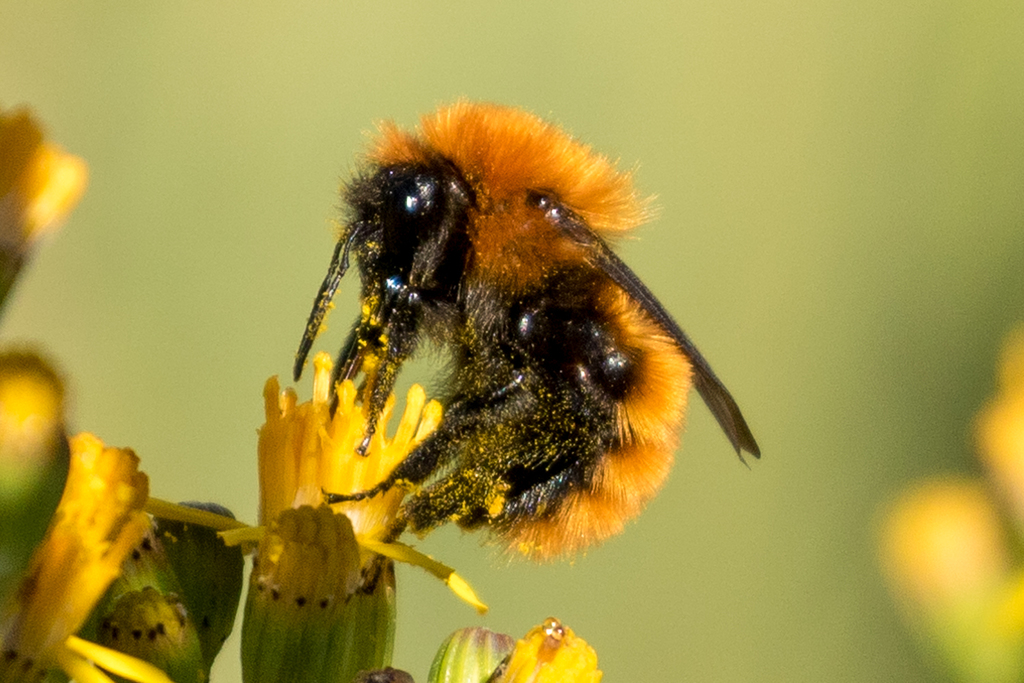
Giant Bumble Bee
Bombus dahlbomii
Bombus dahlbomii, also known as the moscardón (or mangangá, from Guarani: mamanga), is a species of bumblebee endemic to southern South American temperate forests. B. dahlbomii is one of the largest bee species in the world, with matured queens growing up to 40 mm (1.6 in) long. Because of its size and furry appearance, the species has been described as "flying mice" colloquially, and "a monstrous fluffy ginger beast" by British ecologist David Goulson.
B. dahlbomii is native to southern Chile and southern Argentina, including Patagonia. The decline of its populations started with the introduction of Bombus terrestris and B. ruderatus into Chile to serve as commercial pollinators. B. dahlbomii population decline can also be attributed to the pathogen spillover of the parasitic protozoan Apicystis bombi, which was co-introduced with B. terrestris.
From the article Bombus dahlbomii on Wikipedia (CC BY-SA), quoted section by section
Description
B. dahlbomii is predominantly red-orange in color. The thorax of the bee is completely red-orange while the abdomen is generally a lighter shade of orange with a small amount of lightening/discoloration towards the end. Like most bumblebees, the abdomen of the bee has a rounded tip. The head, wing and leg region of B. dahlbomii are distinctly black in color. B. dahlbomii has relatively short antennae and a distinct forewing and smaller hindwing that are usually tucked in above the main thorax area (they lie almost flat). Relatively long bristles cover almost the whole thorax and abdomen of B. dahlbomii, giving the bumblebee an extremely furry appearance. The leg and head regions are covered by shorter bristles than the thorax and abdomen. B. dahlbomii queens usually have relatively heavy body masses of around 0.5-1.5 grams and large head-to-tail lengths of up to 4 cm. These measurements make B. dahlbomii one of the largest bumblebees in the world and give it the nickname the "flying mouse".
Wikipedia: “Description and identification”
Range & habitat
B. dahlbomii is the only native bumblebee species in southern South America. Its range extends from 30 degrees southwards to the southern tip of mainland South America. It is endemic to temperate forest regions in central/southern Patagonia. B. dahlbomii is distributed throughout Patagonia, where it coexists with two non-native species that belong to the same genus, Bombus terrestris and Bombus ruderatus. In its distribution in Chile and Argentina, including Patagonia, B. dahlbomii occupies forest environments that have both continuous and fragmented (scattered) distribution of plants, flowers and other resources. Individuals in these two environments have slightly different morphological and behavioral features. Although some reports cite B. dahlbomii outside of southern South America, they fail to substantiate their findings; when compared to other South American bumblebees, B. dahlbomii's range is relatively confined.
Wikipedia: “Distribution and habitat”
What it does
B. dahlbomii queens initiate colonies. Queens forage for nectar and pollen that are used to feed the initial brood of a new colony nest site. The foraging activity of queens usually stops once the first brood develops into fully mature workers that can forage to feed immature siblings and alleviate the queen's need to perform such duties. After this happens, the queen assumes her main role of laying and incubating the brood eggs to further propagate the colony and produce new workers. Once workers begin foraging activities, B. dahlbomii queens seem to venture out of nests less frequently, but are still found in the outside of nests quite often.
Wikipedia: “Queen behavior”
Listen
Looking for field recordings…
Where it lives
Recorded sightings
—
geo-referenced records in GBIF, from museums, herbaria and field observers.
Drag the globe to turn it. Dots are where records exist, not a range map; darker means more records.
In the stacks
Searching the stacks…
Every page naming Bombus dahlbomii in the Biodiversity Heritage Library →
This page is assembled live from iNaturalist, GBIF, Wikipedia, the Source Library and the Internet Archive. It is not yet part of the hand-edited codex. iNaturalist taxon 497142.