- Animals
- ›Arthropods
- ›Hexapods
- ›Insects
- ›Winged and Once-winged Insects
- ›Flies
- ›Brachyceran Flies
- ›Cyclorrhaphan Flies
- ›Schizophoran Flies
- ›Calyptrate Flies
- ›Bot Flies, Blow Flies, and Allies
- ›Blow Flies
- ›Luciliinae
- ›Luciliini
- ›Lucilia
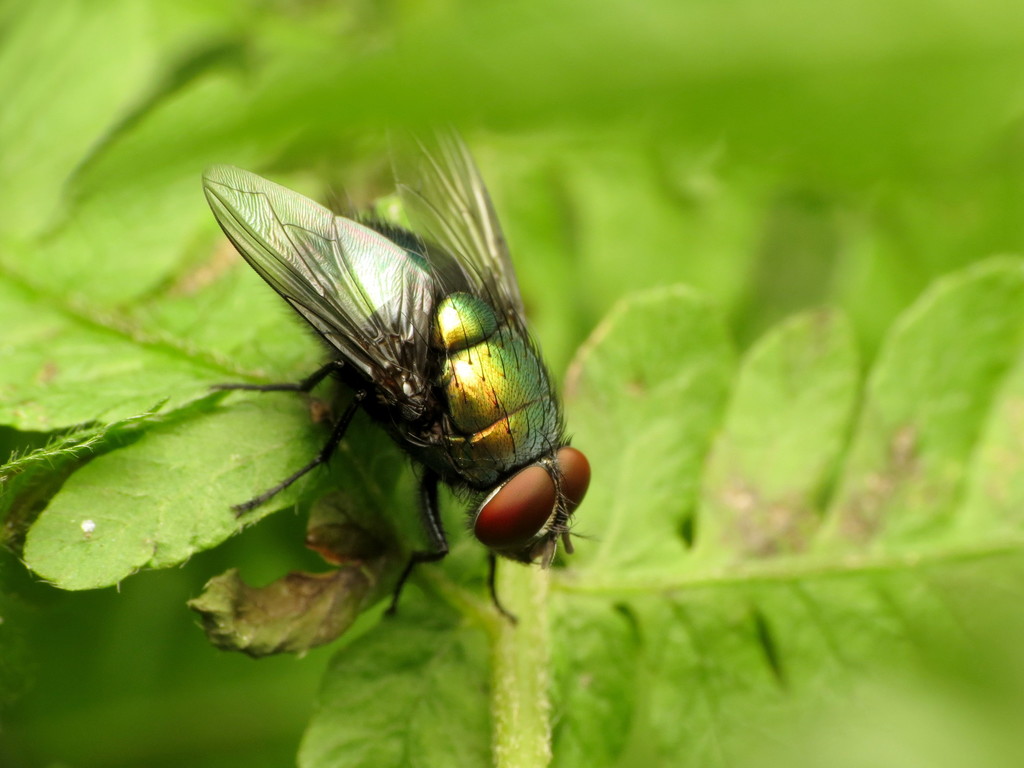
Illustrious Greenbottle Fly
Lucilia illustris
Lucilia illustris is a member of the fly family Calliphoridae, commonly known as a blow fly. Along with several other species, L. illustris is commonly referred to as a green bottle fly. Lucilia illustris is typically 6–9 mm in length and has a metallic blue-green thorax. The larvae develop in three instars, each with unique developmental properties. The adult fly typically will feed on flowers, but the females need some sort of carrion protein in order to breed and lay eggs.
Due to the predictable nature of development, L. illustris is often used by forensic entomologists to determine time and place of death. Medically, L. illustris is often used for maggot debridement therapy because it only causes myiasis in necrotic tissue. Lucilia illustris was first described by the German entomologist Johann Wilhelm Meigen in 1826. Its specific epithet is derived from the Latin word "illustris", meaning "brilliant".
From the article Lucilia illustris on Wikipedia (CC BY-SA), quoted section by section
Description
Lucilia illustris is 6–9 mm in length. Its bucca (cheeks) are colored black with slightly gray pollinose and black hairs. The first segment of the antenna is black; the second generally orange-tipped, and the third segment is about three times the length of the second segment and colored a dark brown or black. The arista (a bristle on the antenna) is dark brown or black, and has cilia that are dark and long. The back of its head is black and there are three to four rows of black cilia behind the eyes. A metallic blue-green thorax reflects bronze and purple. In some lights, silvery pollen appears on its back, as well as a dark line that extends along the back. Black setae can be found on both the propleuron and the hypopleuron, with brown setae on the prosternum. There are dark brown or black sclerites located at the wing-base, as well as dark brown or black found on the spiracle. Lucilia illustris has black legs, translucent wings, and does not have a costal spine. The abdomen has similar coloring to the thorax, but looks slightly white in certain lights. The first segment of the abdomen has metallic and dark brown coloring. The second segment has a slight indication of a spot in the middle of the back on the front margin, as well as a row of hardly apparent bristles along the margin. …
What it does
Adults of L. illustris feed on flowering plants. However, the female also needs a protein source to mature her eggs and become sexually responsive. Mating will commonly take place in close range of where the eggs will be deposited. The species' sex ratio is generally equal, but around an egg laying vector, the females can be found in masses. Approximately 200 eggs will be laid in a single batch of an adult female, and each individual female can lay up to 10 batches in her three-week life span. Eggs will primarily be found on a carcass, but can also occasionally be in open wounds or excrement. Temperature is a crucial factor in the development time of the blow fly and this particular species. At 25 degrees Celsius, the eggs will take about 24 hours to hatch. Upon hatching, L. illustris enters its larval stages of development, commonly called a maggot. As in other green bottle fly species, their larvae are carrion feeders and will generally infest any decomposing corpse. Larvae go through three separate developmental stages called instars. Lucilia illustris typically prefers cooler weather, and when ambient temperatures are around 7.7 degrees Celsius, L. illustris will usually be the largest group of maggots on a corpse. Between each instar, the L. illustris larvae will molt. The current instar of the larvae can be determined by examining the respiratory organs, called spiracles. …
Wikipedia: “Behavior”
Listen
Looking for field recordings…
Where it lives
Recorded sightings
—
geo-referenced records in GBIF, from museums, herbaria and field observers.
Drag the globe to turn it. Dots are where records exist, not a range map; darker means more records.
In the stacks
Searching the stacks…
Every page naming Lucilia illustris in the Biodiversity Heritage Library →
This page is assembled live from iNaturalist, GBIF, Wikipedia, the Source Library and the Internet Archive. It is not yet part of the hand-edited codex. iNaturalist taxon 494868.