- Animals
- ›Arthropods
- ›Hexapods
- ›Insects
- ›Winged and Once-winged Insects
- ›Beetles
- ›Water, Rove, Scarab, Long-horned, Leaf, and Snout Beetles
- ›Cucujiform Beetles
- ›Lady, Fungus, Scavenger, and Bark Beetles
- ›Lady Beetles
- ›Common Lady Beetles
- ›Black-spotted Lady Beetles
- ›Hippodamia
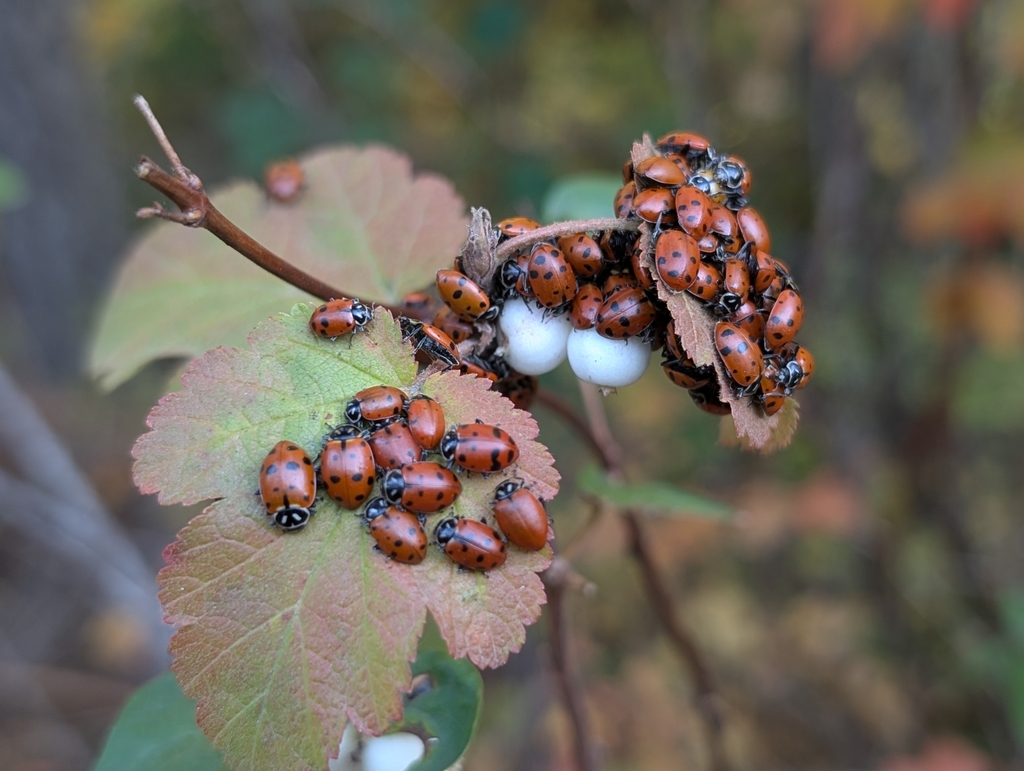
Convergent Lady Beetle
Hippodamia convergens
Hippodamia convergens, commonly known as the convergent lady beetle, is one of the most common lady beetles in North America and is found throughout the continent. They tend to live a variety of habitats, including grasslands and forests.
Female H. convergens can lay over 1000 eggs over the span of a few months during the spring or early summer. In some populations, the beetles may undergo diapause if there are limited food resources to delay reproduction.
From the article Hippodamia convergens on Wikipedia (CC BY-SA), quoted section by section
Range & habitat
Convergent lady beetles are native to North America, but have also been found in South America after they were imported from California.
Wikipedia: “Range”
What it does
The female lady beetle lays 200 to 1000 eggs over several months during spring and early summer. The eggs are small and spindle-shaped and are laid near the prey in upright batches of fifteen to thirty eggs. The larvae are dark and somewhat alligator-shaped. Once the larvae begin feeding, they grow quickly and molt four times over a period of up to a month. Larvae generally move between plants by traveling across leaves. However, they are able to travel via soil if the leaves cannot be crossed. The pupal stage lasts about a week and mating takes place soon after adult eclosion. If the food supply is abundant, the female may start laying within about a week of mating, but if it is scarce, she may wait for up to nine months. Upon reaching the adult stage, females feed on fats and proteins for a week. This increases the production of juvenile hormone, helping the ovaries mature. This hormone also causes a behavior that results in long distance migration. In the western United States, these beetles may spend up to nine months in diapause in large groups in mountain valleys. Some populations have been shown to undergo diapause when nutrients are scarce, using limited food resources to develop fat bodies and postpone the onset of reproduction until they can find a consistent and sufficient food source. During diapause, adult females are known to actively engage in flight.
Wikipedia: “Life cycle”
Listen
Looking for field recordings…
Where it lives
Recorded sightings
—
geo-referenced records in GBIF, from museums, herbaria and field observers.
Drag the globe to turn it. Dots are where records exist, not a range map; darker means more records.
In the stacks
Searching the stacks…
Every page naming Hippodamia convergens in the Biodiversity Heritage Library →
This page is assembled live from iNaturalist, GBIF, Wikipedia, the Source Library and the Internet Archive. It is not yet part of the hand-edited codex. iNaturalist taxon 48987.