 NL·0566
Herbarium of the Nature Library
- Name
- Vanessa cardui
- Family
- Nymphalidae
- Native to
- Nearly worldwide: Europe, Africa, Asia, North America and Australia (absent as a resident from South America and Antarctica)
- Habitat
- Temperate grassland, Desert edge, Farmland, Disturbed ground, Savanna
Painted lady
Vanessa cardui
Also calledDistelfalter (German) · Vanesa de los cardos (Spanish) · Belle-Dame (French) · Hime-akatateha (Japanese) · Xiǎo hóng jiādié (Chinese)
The most widespread butterfly on Earth, found on every continent except Antarctica and South America. Successive generations relay a round trip of up to 12,000 km a year between tropical Africa and northern Europe, much of it flown at high altitude out of sight.
Vanessa cardui is the most widespread of all butterfly species. It is commonly called the painted lady, or formerly in North America the cosmopolitan butterfly. Wikipedia
What it can do
- iCompletes a multigenerational Africa–Europe round trip of up to about 12,000 km, the longest known insect migration cycle
- iiCrosses the Sahara and the Mediterranean, often flying hundreds of metres above the ground on favourable winds
- iiiCaterpillars eat hundreds of host plants, especially thistles, mallows and nettles
- ivBreeds continuously with no winter diapause, so it follows the seasons rather than waiting them out
In the field
Field marks
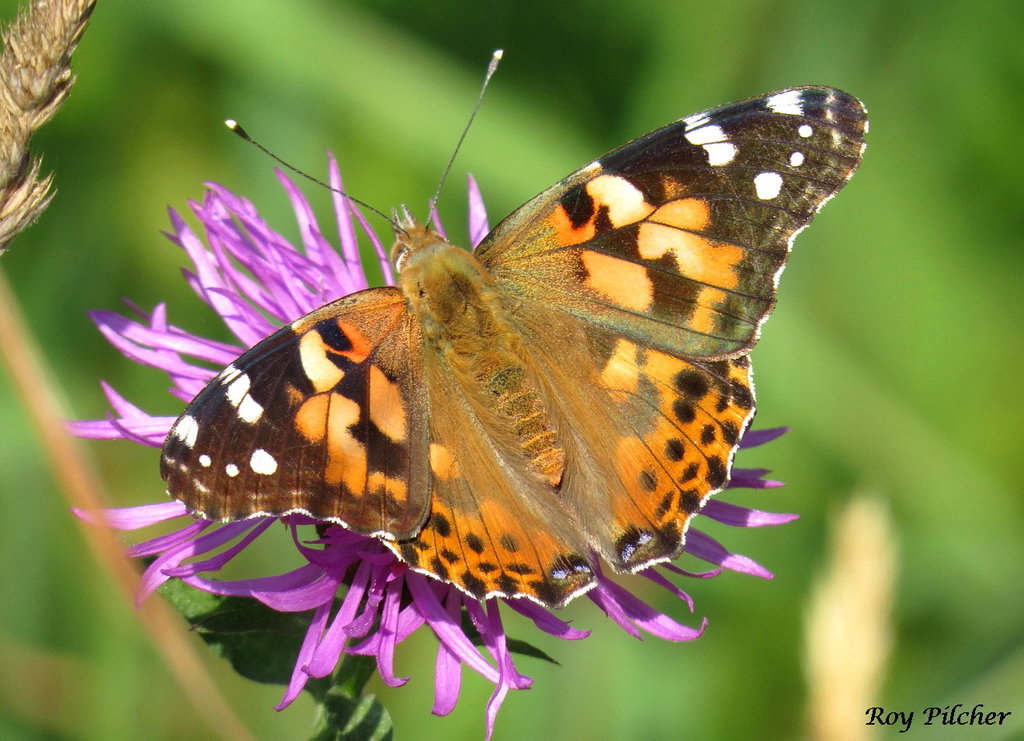
- aUpperside salmon-orange with black blotches
- bForewing tips black with a band of white spots
- cHindwing underside marbled grey, buff and olive with a row of four or five small blue-centred eyespots
- dStrong, fast flight; often basks with wings open on bare ground
- Not to be confused with
- American lady (Vanessa virginiensis) has two large eyespots on the hindwing underside instead of a row of four or five small ones. West Coast lady (V. annabella) has an orange, not white, bar near the forewing tip. Red admiral (V. atalanta) is black with red bands.
- Where to see it
- Thistle-rich meadows, coastal headlands and gardens with buddleia; spectacular mass arrivals occur in irruption years (e.g. Europe 2009, California 2019).
- When
- Europe: spring immigrants Apr–Jun, local brood and southward return Aug–Oct; in tropical Africa and the Middle East during the northern winter
Listen
Looking for field recordings…
Life & habits
- Diet
- Adults sip nectar from thistles, knapweeds, buddleia and many other flowers; caterpillars eat thistles (Cirsium, Carduus), mallows, nettles and legumes
- Habitat
- Open sunny places of almost any kind: meadows, deserts after rain, farmland, gardens, dunes
- Size
- Wingspan about 5–7.5 cm
- Lifespan
- Adults about 2–4 weeks; the full life cycle takes roughly 4–6 weeks in warm weather
Spring generations push north from North Africa into Europe and as far as Scandinavia and Iceland; their offspring fly back south in autumn, mostly at altitude, so the return journey went unnoticed until radar and isotope studies revealed it.
Where it lives
Recorded sightings
—
geo-referenced records in GBIF, from museums, herbaria and field observers.
Native range
Nearly worldwide: Europe, Africa, Asia, North America and Australia (absent as a resident from South America and Antarctica)
Drag the globe to turn it. Dots are where records exist, not a range map; darker means more records.
In the stacks
Searching the stacks…
Every page naming Vanessa cardui in the Biodiversity Heritage Library →
Marginalia
The English name 'Painted Lady' dates to the naturalist James Petiver around 1699; the German Distelfalter ('thistle butterfly') and Linnaeus's epithet cardui both point to the thistle (Carduus) its caterpillars eat.
Curiosity
In 2024 researchers showed, using pollen carried on their bodies and isotopes in their wings, that painted ladies found on a beach in French Guiana had crossed the Atlantic from West Africa, a flight of at least 4,200 km.
Kinship


Photographs: iNaturalist contributors under the licences shown. Records: GBIF.org. Historical plates: Source Library (CC BY-SA 4.0; originals public domain). Summary text: Nature Library editors and Wikipedia (CC BY-SA). Medicinal and edibility notes are historical and educational, not advice. iNaturalist taxon 48548.