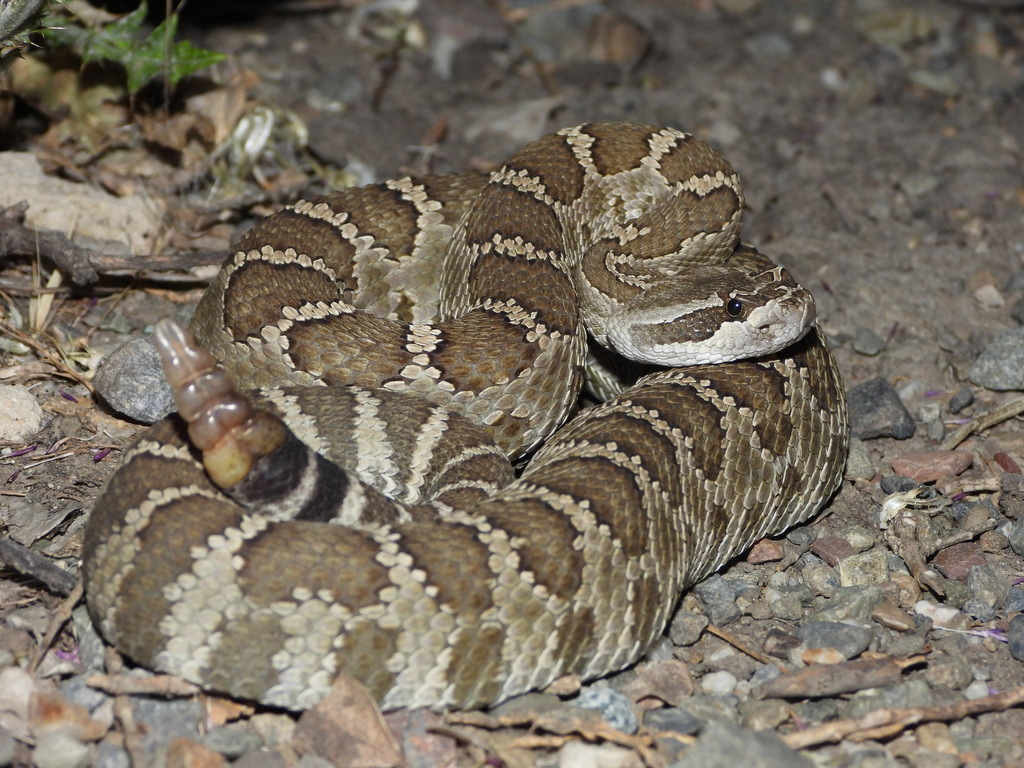
Western Rattlesnake
Crotalus oreganus
Crotalus oreganus is a venomous pit viper species found in North America in the western United States, parts of British Columbia, and northwestern Mexico. Seven subspecies are currently recognized, including the nominate subspecies described here.
From the article Crotalus oreganus on Wikipedia (CC BY-SA), quoted section by section
Description
The size of this species varies greatly, with some populations being stunted and others growing very large. Mainland specimens often reach 100 cm (39 in) in length, with the largest on record being 162.6 cm (64.0 in) (Klauber, 1956) for C. o. oreganus. The species also varies in size in relation to its migration routes as individuals with longer and more linear paths tend to have more mass. The C. oreganus is classified with 6 subspecies with 3 of them being present within the state of California. This species, in its various forms, shows considerable ontogenetic variation. Juveniles usually have more or less distinct patterns, but these fade as the animals mature. The color of the iris often matches the ground color, which may be bronze, gold, or different shades of tan, pink, or gray. The habitat and/or the substrate of the Crotalus oreganus determines their coloration. The color pattern of the typical form, C. o. oreganus, has a dark-brown, dark-gray, olive-brown, or sometimes black or pale yellowish ground color overlaid dorsally with a series of large, dark blotches with uneven white edges. These blotches are also wider than the spaces that separate them. Additionally, a lateral series of blotches, usually darker than the dorsal blotches, is clearly visible on all but the darkest specimens. …
Range & habitat
It is found in North America from southwestern Canada, through much of the western half of the United States, to the Baja California Peninsula of Mexico. In Canada, it is found in southern interior of British Columbia and is one of only three remaining rattlesnake species in the country. In the United States, it occurs in Washington, Oregon, California, western and southern Idaho, Nevada, Utah, Arizona, western Colorado, and small parts of New Mexico and Wyoming. In Mexico, it occurs in Baja California and the northern extreme of Baja California Sur.
Wikipedia: “Geographic range”
What it does
Using its heat-sensing facial pits to locate prey, C. oreganus eats birds, bird eggs, and small mammals, from mice to rabbits. It also eats small reptiles and amphibians. The juveniles eat insects. Studies show that the diet of C. oreganus can significantly impact their size. For example it was found that there was a major size difference between snakes that eat lizards and snakes that eat birds and mammals (lizard based diet snakes were much smaller). Californian C. oreganus were found to have a higher proportion of lizard in their diet which may be correlated to the large population of lizards in the state.
Wikipedia: “Diet”
Toxicity
In regards to its hunting habits, the C. oreganus utilizes its venom as its hunting strength. While quicker and stronger animals can initially escape from its grasp, the venom can induce paralysis, leading to C. oreganus being able to track down the prey. The C. oreganus venom possesses "hemotoxic" and "neurotoxic" properties leading to cardiovascular, internal bleeding, and headaches. The snakes' venom also seems to show a relationship between their diets and their resulting “venom phenotypes”. The “venom composition” of C. oreganus' venom changes "ontogenetically" with smaller snakes having more toxic venom.
Wikipedia: “Hunting habits and venom”
Where it lives
Recorded sightings
—
geo-referenced records in GBIF, from museums, herbaria and field observers.
Drag the globe to turn it. Dots are where records exist, not a range map; darker means more records.
In the stacks
Searching the stacks…
Every page naming Crotalus oreganus in the Biodiversity Heritage Library →
This page is assembled live from iNaturalist, GBIF, Wikipedia, the Source Library and the Internet Archive. It is not yet part of the hand-edited codex. iNaturalist taxon 48268.