- Animals
- ›Arthropods
- ›Hexapods
- ›Insects
- ›Winged and Once-winged Insects
- ›Butterflies and Moths
- ›Butterflies
- ›Brush-footed Butterflies
- ›Checkerspots, Anglewings, Peacocks, and Allies
- ›Buckeyes, Commodores, and Allies
- ›Hypolimnas
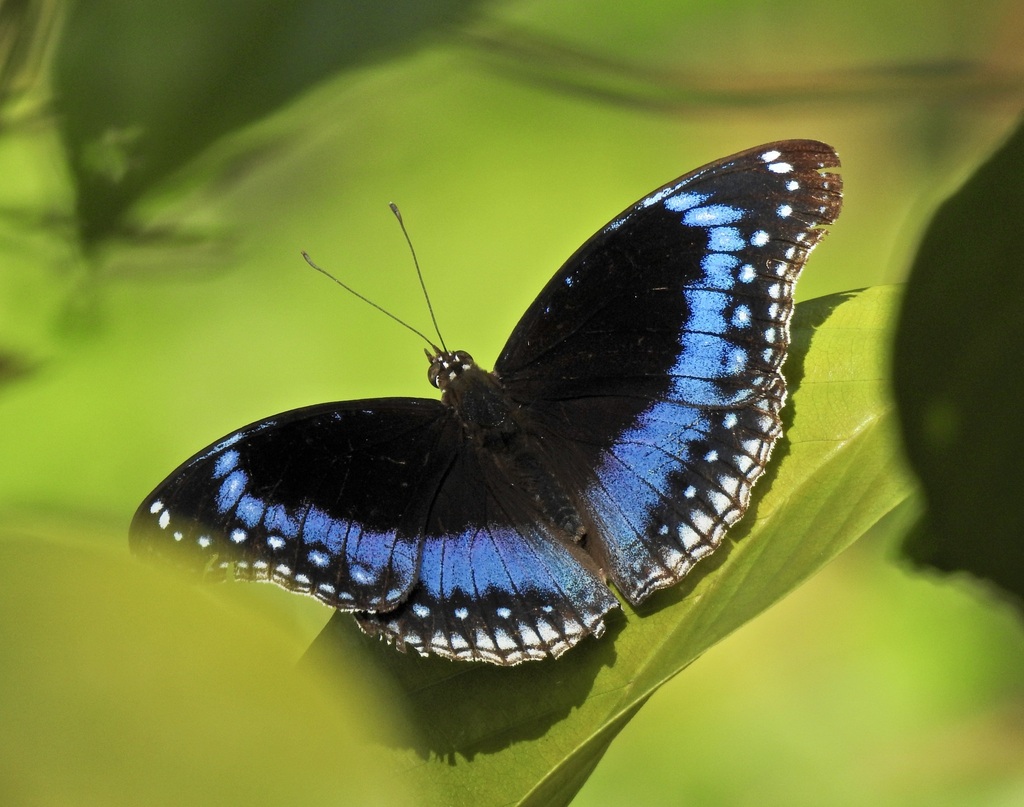
Blue-banded Eggfly
Hypolimnas alimena
Hypolimnas alimena, the blue-banded eggfly, is a species of butterfly in the family Nymphalidae. It is found in the Solomon Islands, Indonesia (Aru Islands, Irian Jaya, Kei Islands, Maluku
,Timor), New Guinea and Australia (the coast of New South Wales, the Northern Territory and Queensland).
From the article Hypolimnas alimena on Wikipedia (CC BY-SA), quoted section by section
Description
The wingspan of H. alimena is 80–90 mm. The ground colour of the wings is black with a row of white dots and a blue band. These butterflies resemble closely to related species,H. bolina.The males exhibit less visually elaborate structural coloration, as compared. The dorsal blue coloration of this butterfly has weak iridescence, and is not very bright. This is because it arises from a simpler nanoscale surface structure, unlike the more complex nanoscale multilayer-arrays structure of H. bolina, which gives it a brighter sheen and saturation.
What it does
The males of this species primarily utilize a sit-and wait-strategy for locating mates. This behavior is similar to Hypolimnas bolina. However, unlike H. bolina, these males do not engage in extended aerial disputes for the territorial defence. Both of their flight morphology is strikingly similar, and does not show any significant differences in terms of strength, as is noticeable by their similar thoracic mass. Another characteristic shared by the two species is possessing a higher relative flight musculature, lower wing loading, and a lower aspect ratio, compared to their conspecific female specimens. However these traits contribute to the sexual dimorphism observed within the species, it only suggests partial match with the typical observations of sexual selection. The females show no notable preference for males with variable dorsal blue coloration and hues, unless it is completely or mostly absent. This low drive towards exaggerated visual signals is specific to this species, unlike others in the same genus. The larvae feed on Pseuderanthemum variabile, Asystasia gangetica and Graptophyllum pictum.
Wikipedia: “Behavior”
Listen
Looking for field recordings…
Where it lives
Recorded sightings
—
geo-referenced records in GBIF, from museums, herbaria and field observers.
Drag the globe to turn it. Dots are where records exist, not a range map; darker means more records.
In the stacks
Searching the stacks…
Every page naming Hypolimnas alimena in the Biodiversity Heritage Library →
This page is assembled live from iNaturalist, GBIF, Wikipedia, the Source Library and the Internet Archive. It is not yet part of the hand-edited codex. iNaturalist taxon 447116.