On eBird ↗
Titicaca Grebe
Live sightings near you, the range map, bar charts of when it is seen, and Macaulay Library photos and recordings.
Titicaca Grebe
Rollandia microptera
The Titicaca grebe (Rollandia microptera), also known as the Titicaca flightless grebe or short-winged grebe, is a flightless species of grebe found on the altiplano of Peru and Bolivia. As its name implies, its main population occurs on Lake Titicaca. Lake Uru Uru and Poopó, the Rio Desaguadero, and small lakes that connect to Lake Titicaca in wet years, serve as "spillovers" territory. In the past, the population was larger and several of these lakes – such as Lakes Umayo and Arapa – apparently had and may still have permanent large colonies (BirdLife International 2006). It is sometimes placed in Podiceps or a monotypic genus Centropelma. Its local name is zampullín del Titicaca.
From the article Titicaca grebe on Wikipedia (CC BY-SA), quoted section by section
Description
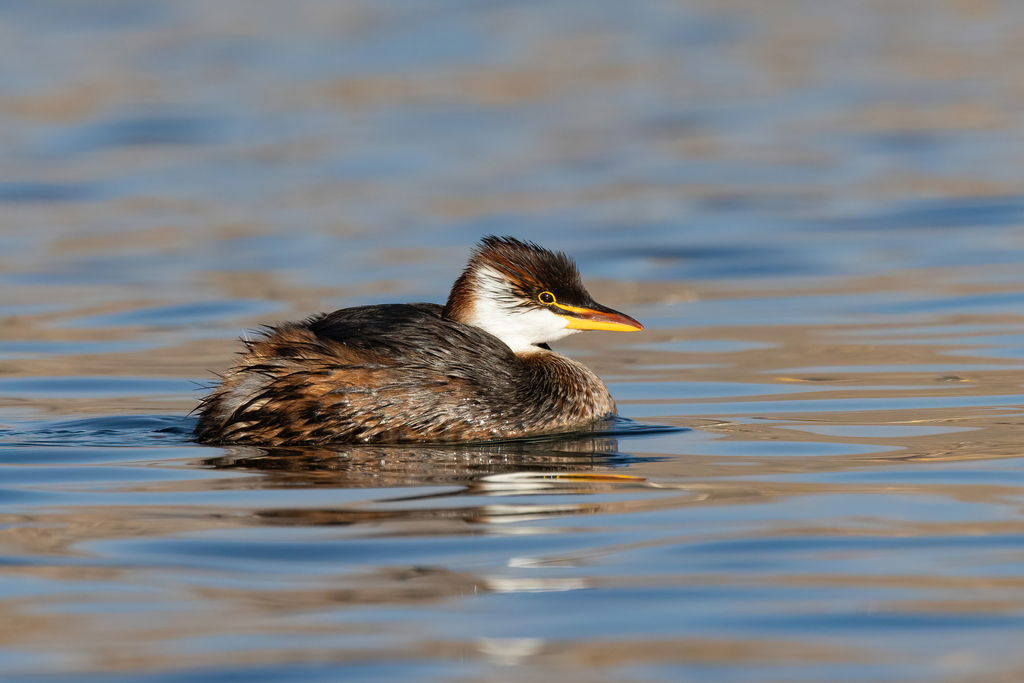
This is a mid-sized grebe, varying from 28 to 45 cm in overall length. It weighs up to 600 g. Its coloration is unmistakable. The only grebe species it somewhat resembles is the red-necked grebe, which is not found in South America. The only congener, the white-tufted grebe, does not look very similar. The color pattern of the Titicaca grebe is altogether similar to that of the red-necked grebe, but it has a darker belly, and a white (not light grey) throat patch that runs down the neck nearly to the breast. Due to the short wings, the rufous flanks can usually be seen. The ornamental plumes on the head are a vestigial version of those of the white-tufted grebe, but dark. Iris and the lower bill are yellow. Juveniles and non-breeding adults are duller, lack the ornamental plumes, and in the case of the former have rufous stripes on the sides of the head and more white on the neck, so that the rufous breast does not show in swimming birds. It is entirely flightless, but will use wing-assisted running over considerable distances. It is an excellent diver, reaching a burst speed of 3.5 km/h (2 knots).
Range & habitat
The Titicaca flightless grebe occurs in a habitat mosaic in relatively shallow waters (up to about 10 m/35 ft deep). The reed belt is found in water of up to 4 m (13 ft) deep and constitutes the breeding habitat. It is made up mainly of Totora (Schoenoplectus californicus ssp. tatora). Other plants are the underwater Myriophyllum elatinoides and Hydrocharitaceae water weeds, and the floating duckweeds and Azolla. Potamogeton constitute the dominant underwater vegetation in the deeper parts, down to 14 m (some 45 ft). In a study by O'Donnel and Fjeldsa they concluded that Grebes are strongly impacted and sensitive to environmental change.
Wikipedia: “Distribution and habitat”
What it does
This species, like all grebes, feeds mainly on fish. Nearly 95% of prey mass is made up by the Orestias pupfish of the Titicaca drainage. The introduced silversides Odontesthes bonariensis (pejerrey) is not usually taken. As the grebe eats only prey smaller than some 15 cm (6 in), the adult pejerrey which are of commercial interest are not part of its diet as they are far too large. This species has also been known to attack the Titicaca lake frog, due to positive chemical chemistry in their papillae that reacts to the touch of the frog skin.
Wikipedia: “Diet”
Listen
Looking for field recordings…
Where it lives
Recorded sightings
—
geo-referenced records in GBIF, from museums, herbaria and field observers.
Drag the globe to turn it. Dots are where records exist, not a range map; darker means more records.
In the stacks
Searching the stacks…
Every page naming Rollandia microptera in the Biodiversity Heritage Library →
This page is assembled live from iNaturalist, GBIF, Wikipedia, the Source Library and the Internet Archive. It is not yet part of the hand-edited codex. iNaturalist taxon 4250.