On eBird ↗
Great Grebe
Live sightings near you, the range map, bar charts of when it is seen, and Macaulay Library photos and recordings.
Great Grebe
Podiceps major
The great grebe (Podiceps major) is the largest species of grebe in the world. A disjunct population exists in northwestern Peru, while the main distribution is from extreme southeastern Brazil to Patagonia and central Chile. The population from southern Chile is considered a separate subspecies, P. m. navasi.
From the article Great grebe on Wikipedia (CC BY-SA), quoted section by section
Description
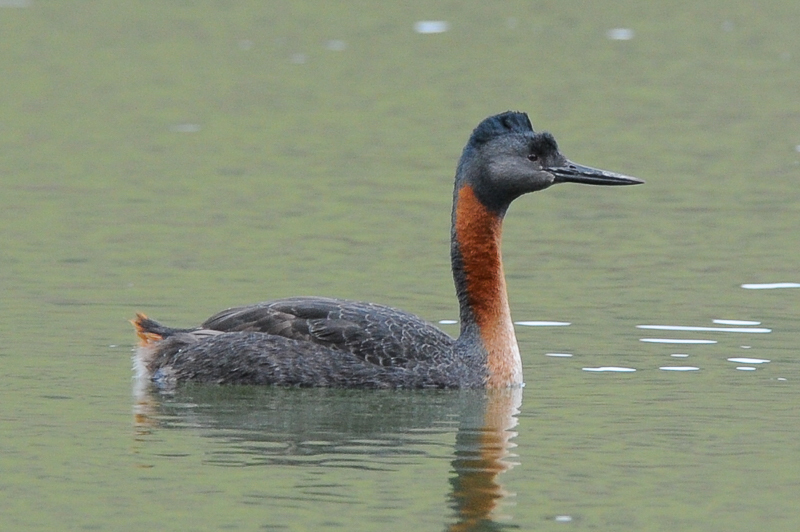
This is a very large grebe, with proportions more like a goose or a cormorant than a typical grebe. They range in length from 67 to 80 cm (26.5 to 31.5 in) and usually weigh about 1,600 grams (3.5 pounds), but can scale to at least 2 kg (4.4 lb). They are buffy-rufous on the neck and chest, blackish on the back and have a whitish belly. The head is sooty gray with a reddish-brown eye. Due to its size and unique coloration, the great grebe is unlikely to be confused with any other bird, including other grebes.
Range & habitat
This species occurs mainly in open waterways. Most birds are seen on low altitude lakes and sluggish rivers (often surrounded by forests), as well as estuarine marshes. While breeding, it frequents the heavily vegetated inlets off of large lakes. Outside of the breeding season, most birds will move to estuaries and bays, usually heavy with kelp (occasionally, they even are seen on the open sea). Non-breeding birds may live along the coasts all year. These birds are widespread and common through most of their range. Much of their native habitat has not been cleared, especially in the southern portions of their range.
Wikipedia: “Habitat”
What it does
The great grebe lives on a diet mostly of fish, sometimes over 11 cm (4.3 in) long, but usually smaller. Prey competition can occasionally occur with the neotropic cormorant over fish, but that species (in spite of smaller body size) usually takes larger fish. Also insects, crustaceans and mollusks are taken. The diet can switch to almost half crabs during the wintertime along the coasts, and these birds can also take the young of other waterbirds, especially coots.
Wikipedia: “Diet”
Listen
Looking for field recordings…
Where it lives
Recorded sightings
—
geo-referenced records in GBIF, from museums, herbaria and field observers.
Drag the globe to turn it. Dots are where records exist, not a range map; darker means more records.
In the stacks
Searching the stacks…
Every page naming Podiceps major in the Biodiversity Heritage Library →
This page is assembled live from iNaturalist, GBIF, Wikipedia, the Source Library and the Internet Archive. It is not yet part of the hand-edited codex. iNaturalist taxon 4229.