On eBird ↗
Red-necked Grebe
Live sightings near you, the range map, bar charts of when it is seen, and Macaulay Library photos and recordings.
Red-necked Grebe
Podiceps grisegena
The red-necked grebe (Podiceps grisegena) is an aquatic bird found in the temperate regions of the northern hemisphere. A migratory bird, its wintering habitat is largely restricted to calm waters just beyond the waves around ocean coasts, although some birds may winter on large lakes. Grebes prefer shallow bodies of fresh water such as lakes, marshes or fish-ponds as breeding sites.
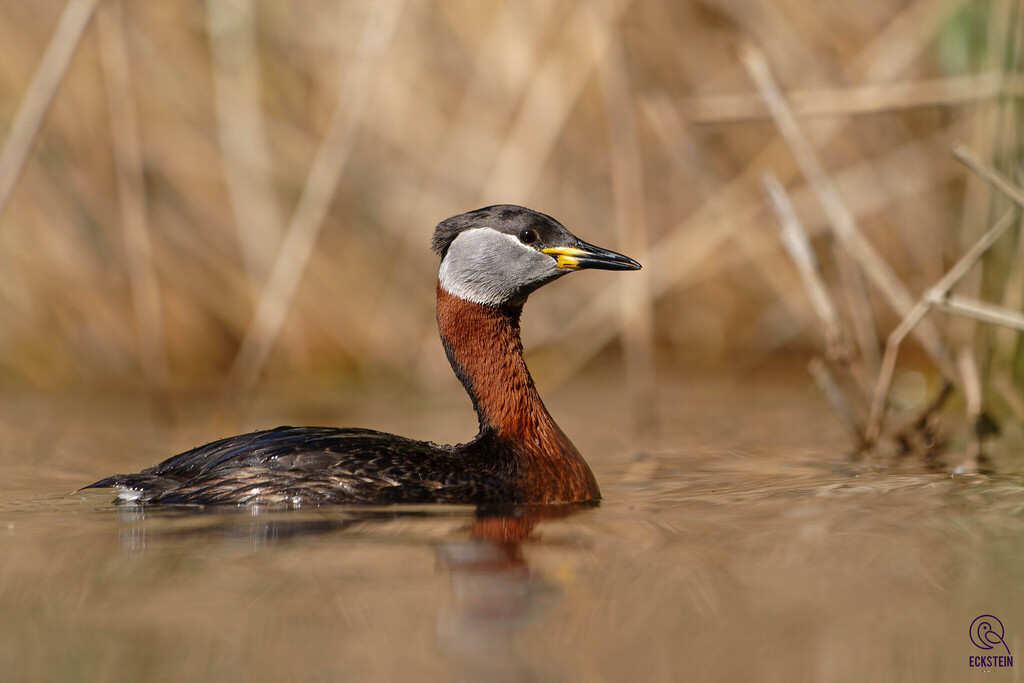
The red-necked grebe is a fairly drab dusky-grey bird in winter. During the breeding season, it acquires the distinctive red neck plumage, black cap and contrasting pale grey face from which its name was derived. It also has an elaborate courtship display and a variety of loud mating calls. Once paired, it builds a nest from water plants on top of floating vegetation in a shallow lake or bog.
From the article Red-necked grebe on Wikipedia (CC BY-SA), quoted section by section
Description
The red-necked grebe is a medium-large grebe, smaller than the great crested grebe of Eurasia, and the western and Clark's grebes of North America, but noticeably larger than other northern grebe species. In breeding plumage, it has a black cap that extends below the eye, very pale grey cheeks and throat, a rusty red neck, dark grey back and flanks, and white underparts. The eyes are dark brown and the long, pointed bill is black with a yellow base.
The winter plumage of the red-necked grebe is duskier than that of other grebes; its dark grey cap is less defined, and merges into the grey face, and a pale crescent that curves around the rear of the face contrasts with the rest of the head. The front of the neck is whitish or light grey, the hind neck is darker grey, and the yellow of the bill is less obvious than in summer. Although the red-necked grebe is unmistakable in breeding plumage, it is less distinctive in winter and can be confused with similar species. It is larger than the Slavonian (horned) grebe, with a relatively larger bill and a grey, rather than white face. It is closer in size to the Eurasian great crested grebe, but that species is longer-necked, has a more contrasting head pattern, and always shows white above the eye. The sexes are similar in appearance, although the male averages heavier than the female. …
Range & habitat
Breeding takes place in shallow freshwater lakes, bays of larger lakes, marshes, and other inland bodies of water, often less than 3 ha (7.4 acres) in extent and less than 2 m (6.6 ft) deep. The red-necked grebe shows a preference for waters in forested areas or, further north, in shrub tundra, and favours sites with abundant emergent vegetation, such as reedbeds. The best breeding habitat is fish-ponds, which have an abundance of food in addition to meeting the other requirements. The American subspecies is less tied to a high aquatic plant density, and sometimes breeds on quite open lakes. All populations are migratory and winter mainly at sea, usually in estuaries and bays, but often well offshore where fish are within diving reach near shallow banks or islands. The preferred passage and wintering habitat is water less than 15 m (49 ft) deep with a sand or gravel bottom, scattered rocks and patches of seaweed. During winter, birds typically feed alone and rarely aggregate into flocks, but on migration, concentrations of over 2000 individuals may occur at favoured staging sites. Migration is usually at night, but may occur during the day, especially when over water. This is particularly noticeable in autumn on the Great Lakes, when up to 18,000 birds may pass Whitefish Point on Lake Superior; these are thought to be Canadian breeders heading for the Atlantic Ocean to winter. …
Wikipedia: “Distribution and habitat”
What it does
On the breeding grounds, the red-necked grebe feeds mainly on invertebrates including adult and larval aquatic insects, such as water beetles and dragonfly larvae, crayfish and molluscs. Fish (such as smelt) may be important locally or seasonally, especially for the American subspecies, and crustaceans can constitute up to 20% of the grebe's diet. Birds breeding at the coast often make foraging flights to inland lakes or offshore areas to feed. Aquatic prey is obtained by diving or by swimming on surface with the head submerged, and terrestrial insects and their larvae are picked off vegetation. A line slanting downward from the eye to the tip of the opened lower mandible may be used for sighting on prey before diving or when swimming under water. The grebe probably opens its bill and looks down the eye-line toward its target. European breeders, which have to compete with the larger great crested grebe for fish, eat a greater proportion of invertebrates than the longer-billed American subspecies, although both races eat mainly fish in winter. Birds of the nominate subspecies from the northernmost breeding populations in Finland and Russia, beyond the range of great crested grebe, have a longer and more slender bill than those further south, reflecting a greater proportion of fish in the diet where their main competitor is absent. …
Wikipedia: “Feeding”
Listen
Looking for field recordings…
Where it lives
Recorded sightings
—
geo-referenced records in GBIF, from museums, herbaria and field observers.
Drag the globe to turn it. Dots are where records exist, not a range map; darker means more records.
In the stacks
Searching the stacks…
Every page naming Podiceps grisegena in the Biodiversity Heritage Library →
This page is assembled live from iNaturalist, GBIF, Wikipedia, the Source Library and the Internet Archive. It is not yet part of the hand-edited codex. iNaturalist taxon 4224.