- Animals
- ›Arthropods
- ›Hexapods
- ›Insects
- ›Winged and Once-winged Insects
- ›Beetles
- ›Water, Rove, Scarab, Long-horned, Leaf, and Snout Beetles
- ›Cucujiform Beetles
- ›Lady, Fungus, Scavenger, and Bark Beetles
- ›Lady Beetles
- ›Common Lady Beetles
- ›Black-spotted Lady Beetles
- ›Eriopis
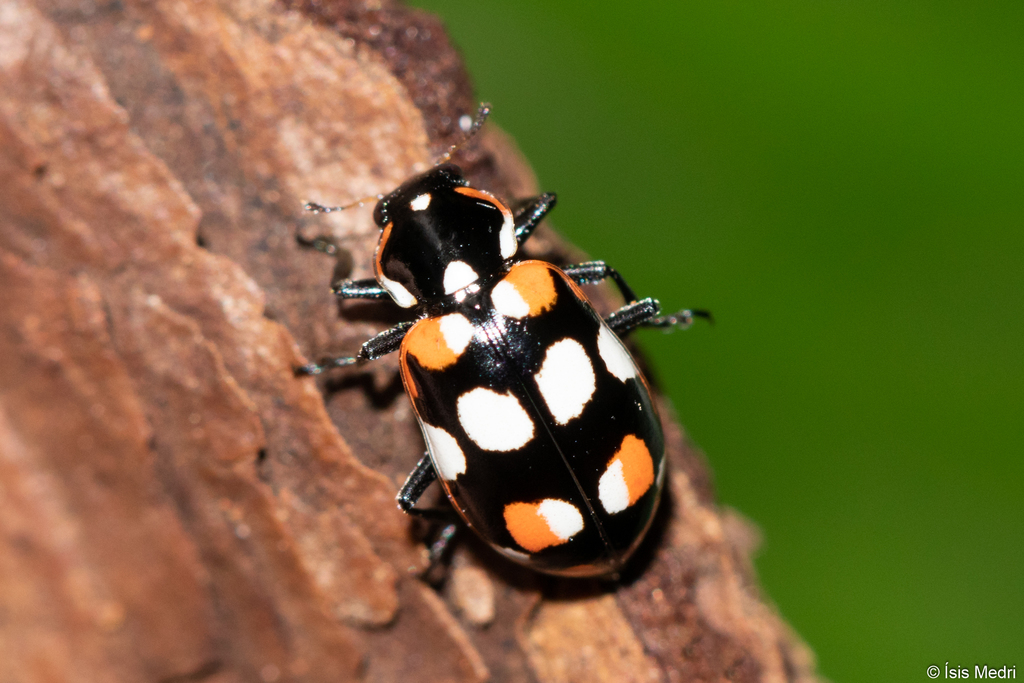
Eriopis connexa
Eriopis connexa is a species of ladybird beetle that is native to South America. Both males and females mate multiple times with different individuals of the opposite sex, like most members of the family Coccinellidae. This promiscuous behavior leads to unique reproductive adaptations, such as sperm mixing. Females lay unfertilized eggs which their offspring consume upon hatching, thereby boosting offspring nutrition and reducing sibling cannibalism, . This predatory beetle species feeds primarily on aphids and is widespread throughout many agroecosystems, such as cotton, maize, sorghum, soybean, and wheat. Due to aphids being extremely damaging agricultural pests, E. connexa has been introduced to the United States for biological pest management. Recent studies on pyrethroid insecticide resistance in E. connexa have led to research by applied entomologists on the species' potential role in integrated pest management schemes in crop fields that rely on lambda-cyhalothrin (LCT), a common pyrethroid insecticide that is ineffective against aphid population control. The potential efficacy and success of the utilization of E. connexa in these programs is widely debated and is the focus of much recent research due to the lack of understanding regarding the effects of pyrethroid resistance on the behavior of this species.
From the article Eriopis connexa on Wikipedia (CC BY-SA), quoted section by section
Description
Eriopis connexa has an oblong body shape. The base color is dark brown to black with yellowish relatively large, separated dots. The pronotum and the elytra (wing covers) have a yellowish margin. Each elytron has three separated dots and the enlargements of the margin, the pronotum two smaller dots and two enlargements of the margin. There are not always visible indications of sexual dimorphism in this beetle species, but at certain times in adulthood, females will have extended abdomens for egg production. Additionally, adult females can be distinguished from adult males by their significantly heavier weight.
Range & habitat
Eriopis connexa is a neotropical species native to South America, but has been introduced to the United States for biological pest management. They may be found in Argentina (Buenos Aires, Catamarca, Córdoba, Chaco, Chubut, Entre Ríos, Formosa, La Rioja, Mendoza, Misiones, Neuquén, Río Negro, Salta, San Juan, Santa Fe, Santiago del Estero, Tucumán), Bolivia (Cochabamba, La Paz, Oruro), Brazil (Mato Grosso, Minas Gerais, Paraná, Pernambuco, Rio Grande do Sul, Santa Catarina, São Paulo), Ecuador (Guayas), Paraguay (Alto Paraná, Caazapá, Central, Kanindeyu, Paraguarí, Pte. Hayes, San Pedro), Peru (Apurimac, Arequipa, Ayacucho, Cusco, Lima), Uruguay (Florida, Maldonado, Montevideo, San José), and Venezuela.
Wikipedia: “Geographic range”
What it does
There are five main sequential stages of development in Eriopis connexa: egg, larva, pre-pupa, pupa, and adult. The larval stage can be further broken into four instars. Laboratory studies indicate that individuals spend approximately two days in each of the first three instar stages, nearly four days in the fourth instar stage, one day in the pre-pupa stage, three to four days in the pupa stage, and the rest of their lives in the adult stage. However, duration of each stage can change based on prey offered to Eriopis connexa. Individuals usually live for around 60 days in total. Both males and females reach full sexual maturity on the fifth day of the adult stage. Individuals of both sexes are sexually receptive on the third day but are not yet at their maximum fertility and fecundity. This may be due to incomplete maturation of sexual organs.
Wikipedia: “Life cycle”
How it is grown
Because Eriopis connexa is a voracious predator of aphids, a very destructive agricultural pest, and naturally occurs in crops of high economic importance, this predatory beetle species has been used frequently for biological control of pests. It was first introduced to the United States in order to control Russian wheat aphid (Diuraphasis norxia) populations. As insecticide resistance continues to evolve in many agricultural pests, alternative pest control methods have become more desirable and necessary. There is evidence that in South America, Eriopis connexa has potential as a natural predator of corn and sorghum pests.
Wikipedia: “Agricultural use”
In human culture
In many Coccinella species, egg viability is negatively correlated with paternal sexual activity, but this trend is not present in Eriopis connexa, suggesting males in this species have adapted to more frequent matings. There is, however, a negative correlation between oviposition time and paternal sexual activity in E. connexa, suggesting that allomones in male seminal fluid stimulate faster onset of oviposition in females and virgin males have greater quantities of allomones present in their seminal fluid. Allomonal effects in seminal fluid proteins can also create subtle paternal effects, such as increased offspring size or development time, but paternal effects are not present in E. connexa, suggesting males and females of this species have similar interests in progeny phenotypes.
Wikipedia: “Male mating history”
Listen
Looking for field recordings…
Where it lives
Recorded sightings
—
geo-referenced records in GBIF, from museums, herbaria and field observers.
Drag the globe to turn it. Dots are where records exist, not a range map; darker means more records.
In the stacks
Searching the stacks…
Every page naming Eriopis connexa in the Biodiversity Heritage Library →
This page is assembled live from iNaturalist, GBIF, Wikipedia, the Source Library and the Internet Archive. It is not yet part of the hand-edited codex. iNaturalist taxon 418185.