On eBird ↗
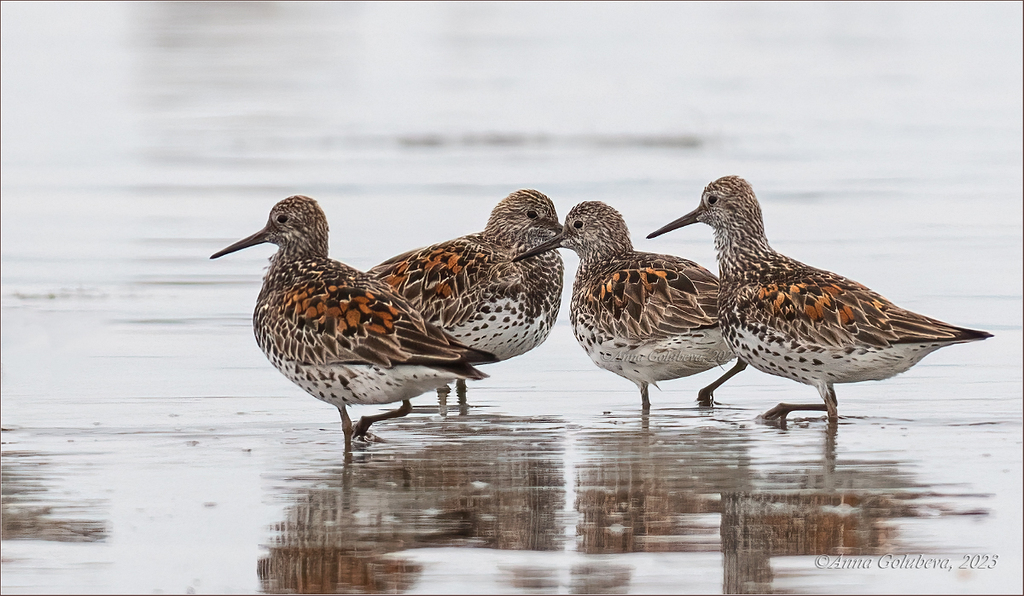
Great Knot
Live sightings near you, the range map, bar charts of when it is seen, and Macaulay Library photos and recordings.
Great Knot
Calidris tenuirostris
The great knot (Calidris tenuirostris) is a small wader. It is the largest of the calidrid species. The genus name is from Ancient Greek kalidris or skalidris, a term used by Aristotle for some grey-coloured waterside birds. The specific tenuirostris is from Latin tenuis "slender" and rostrum "bill".
From the article Great knot on Wikipedia (CC BY-SA), quoted section by section
Range & habitat
Their breeding habitat is tundra in northeast Siberia, Russia. They nest on the ground laying about four eggs in a ground scrape. They are strongly migratory wintering on coasts in southern Asia through to Australia. This species forms enormous flocks in winter. The species is also recorded in summer in low numbers in western Alaska, United States in most years, and in winter in small numbers west to Pakistan, Oman, and the United Arab Emirates. It has occurred as a vagrant in Great Britain, Morocco, New Zealand, British Columbia in Canada, and in the lower 48 states of the USA in Oregon, West Virginia, and Maine.
Wikipedia: “Distribution”
What it does
These birds forage on mudflats and beaches, probing or picking up food by sight. They mainly eat molluscs and insects.
Wikipedia: “Behaviour”
Listen
Looking for field recordings…
Where it lives
Recorded sightings
—
geo-referenced records in GBIF, from museums, herbaria and field observers.
Drag the globe to turn it. Dots are where records exist, not a range map; darker means more records.
In the stacks
Searching the stacks…
Every page naming Calidris tenuirostris in the Biodiversity Heritage Library →
This page is assembled live from iNaturalist, GBIF, Wikipedia, the Source Library and the Internet Archive. It is not yet part of the hand-edited codex. iNaturalist taxon 3852.