- Animals
- ›Chordates
- ›Vertebrates
- ›Birds
- ›Pelicans, Herons, Ibises, and Allies
- ›Ibises and Spoonbills
- ›Mesembrinibis
On eBird ↗
Green Ibis
Live sightings near you, the range map, bar charts of when it is seen, and Macaulay Library photos and recordings.
Green Ibis
Mesembrinibis cayennensis
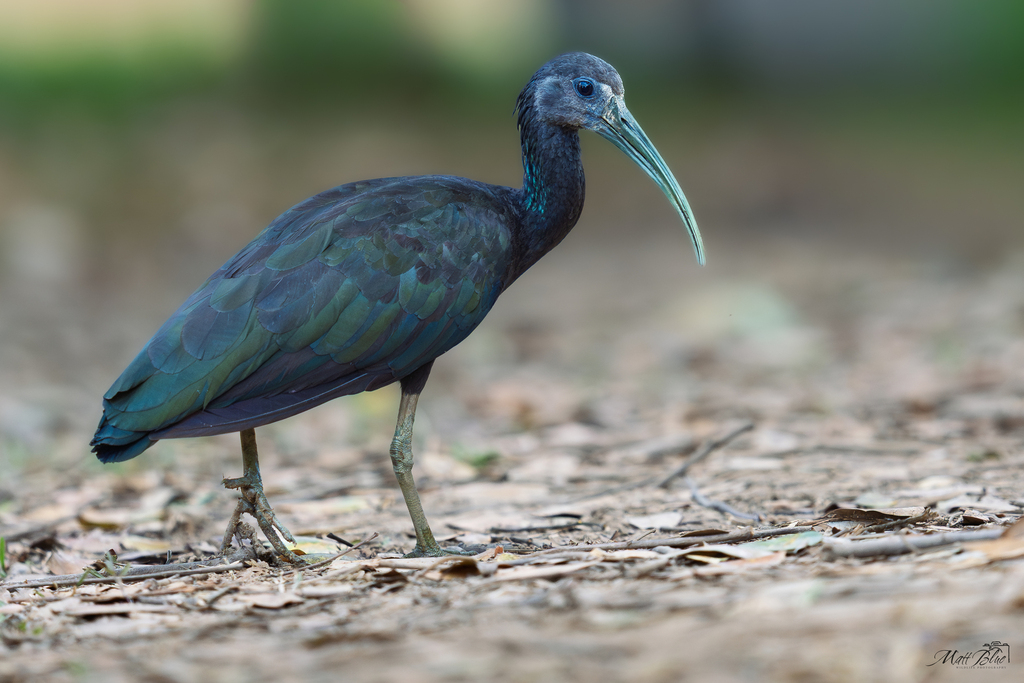
The green ibis (Mesembrinibis cayennensis), also known as the Cayenne ibis, is a wading bird in the ibis family Threskiornithidae. It is the only member of the genus Mesembrinibis.
This is a resident breeder from Honduras through Nicaragua, Costa Rica and western Panama, and South America to northern Argentina. It undertakes some local seasonal movements in the dry season.
From the article Green ibis on Wikipedia (CC BY-SA), quoted section by section
Description
The green ibis is a medium-sized ibis, with short legs and a long, slender, decurved bill. It measures 45–60 cm (18–24 in) in length and ranges from 700 to 890 g (1.5 to 2.0 lb) in mass. The sexes, which are identical in plumage, overlap somewhat in measurements, though the largest birds are male. Breeding adults have glossy greenish-black bodies, pale green legs and bill, and grey bare facial skin patches. Juveniles are much duller, but can be distinguished from the similar glossy ibis by their bulkier shape, shorter legs and broader wings. This species, like other ibises, flies with neck outstretched. Its flight is heavy, with fewer glides and jerkier wingbeats than its relatives. It has a hollow, hooting, accelerating call, most often heard at dawn and dusk. Transcribed as kro kro or koro koro, the call is described as "mellow".
Similar species. If seen in good light, the green ibis is distinctively dark, and unlikely to be confused with any other ibis. In poor light, however, it might be confused with the glossy ibis; the latter (which is bronzy-maroon in color) has longer legs and a slimmer build.
Range & habitat
The green ibis is found from Costa Rica south to northern Argentina and Paraguay. However, there have been sightings from as far north as Honduras, and fossil records show the species formerly occurred as far north as Kansas in the United States. It is found in a variety of forested wetland habitats, particularly swamps and along the edges of rivers and lakes, at altitudes up to 500 m (1,600 ft).
Wikipedia: “Distribution and habitat”
What it does
The green ibis is largely crepuscular. Less gregarious than its relatives, it is usually seen alone or in pairs. When it does forage in mixed-species flocks, it tends to remain on the fringes, usually among other green ibises. It regularly perches in trees.
Feeding. Like other ibises, it eats fish, frogs and other water creatures, as well as insects.
Breeding. Its nest is a flimsy platform of twigs built high in a tree. It has been recorded harassing sunbitterns nesting in the same tree.
Wikipedia: “Behaviour”
Listen
Looking for field recordings…
Where it lives
Recorded sightings
—
geo-referenced records in GBIF, from museums, herbaria and field observers.
Drag the globe to turn it. Dots are where records exist, not a range map; darker means more records.
In the stacks
Searching the stacks…
Every page naming Mesembrinibis cayennensis in the Biodiversity Heritage Library →
This page is assembled live from iNaturalist, GBIF, Wikipedia, the Source Library and the Internet Archive. It is not yet part of the hand-edited codex. iNaturalist taxon 3770.