- Animals
- ›Chordates
- ›Vertebrates
- ›Birds
- ›Pelicans, Herons, Ibises, and Allies
- ›Ibises and Spoonbills
- ›Theristicus
On eBird ↗
Plumbeous Ibis
Live sightings near you, the range map, bar charts of when it is seen, and Macaulay Library photos and recordings.
Plumbeous Ibis
Theristicus caerulescens
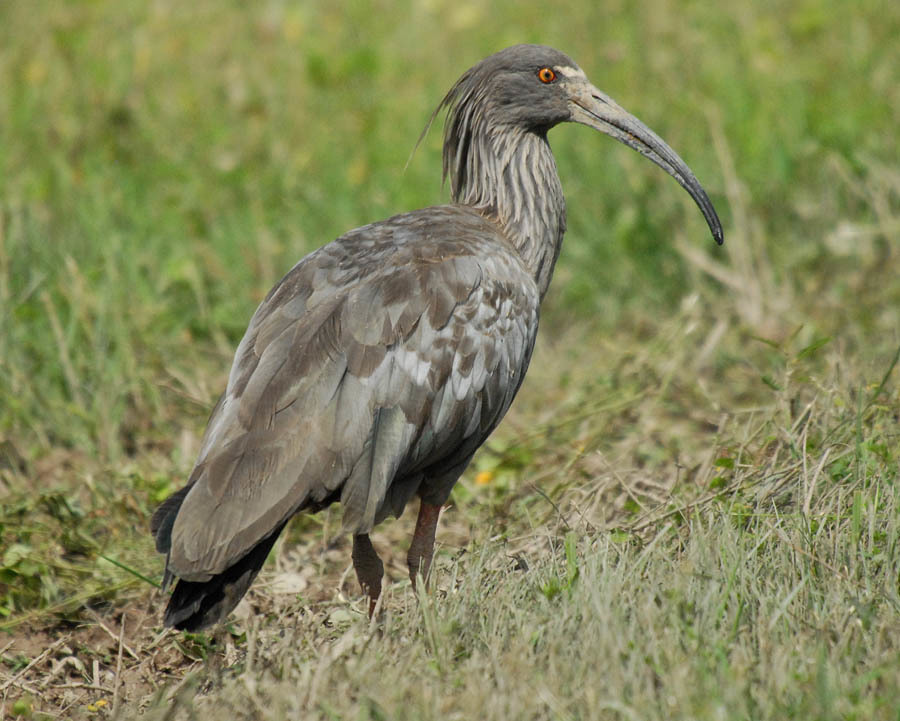
The plumbeous ibis (Theristicus caerulescens), also formerly called the blue ibis, is a large distinctive ibis species endemic to parts of central South America.
From the article Plumbeous ibis on Wikipedia (CC BY-SA), quoted section by section
Description
This large ibis measures 71–77 cm in length, with a wing length of 397-450mm in males and 360-406mm in females. The culmen length is 145-167mm in males, and 126-147mm in females. The sexes are similar in appearance, but the female is slightly smaller. The plumbeous ibis is easily recognisable through a distinctive shaggy crest comprising long grey plumes that extend from the back of head 10 cm down the nape. A prominent, narrow, white feathered band also extends around the forehead, which has earned this species the German common name Stirnbandibis (headband ibis). Overall, it is readily distinguishable in the field from other ibises by its solid colouration and thick neck. The plumbeous ibis is the most morphologically similar to the sympatric buff-necked ibis Theresticus caudatus, but differs in colouration and neck structure. The adult plumage is usually grey; but can be bluish grey, greenish grey or brownish grey. The dorsal feathers are mottled greyish-brown, so that the plumage appears lighter below than above. The flight and tail feathers are dark brown or black, superimposed with a glossy greenish bronze. It has also been reported as having various other subtle tinges on the body depending on the light. …
Wikipedia: “Appearance”
Range & habitat
The plumbeous ibis has a relatively narrow range that extends through parts of central South America. It occurs in south-western Brazil, especially in southern Mato Grosso and Rio Grande do Sul; Paraguay, especially in the Chaco and in the Paraguayan section of the Parana Basin; Uruguay; north-eastern Argentina and northern and eastern Bolivia. The northern Bolivian population is geographically isolated from the larger continuous population spanning the remaining part of this ibis's range. The westernmost part of its range extends into the Andean foothills in central Bolivia and Tucuman. In Argentina, it has been occasionally sighted as far south as the Cordoba and Buenos Aires provinces; but is non-native in these regions. Although this species appears to be relatively common, it is patchily distributed throughout its global range; being relatively abundant in some regions but less so in others. For example, it is endemic but actually uncommon in Rio Grande do Sul, but frequently occurs in the northern Lagoa dos Patos. It is relatively common in the Chaco of Paraguay, especially in the northern Chaco where large numbers of individuals occur throughout the expanses of freshwater, so that this species is considered emblematic of the wetland avifauna of this region. …
Wikipedia: “Distribution and habitat”
What it does
This ibis's diet comprises aquatic invertebrates; snails, especially apple snails of the genus Pomacea; mussels; crabs; frogs; fish and eels. It has also been reported to eat snakes, lizards, skinks and terrestrial invertebrates; which is plausible given its occasional occurrence in dry grasslands. Despite this ibis's apparently generalist diet, it is found to specialise on molluscs in the Paraguay-Parana basin. The plumbeous ibis often feeds solitarily or in pairs, but may assemble in loose flocks to forage in winter when food is scarcer. Individuals have also been found foraging together with white-faced ibises and jacanas. The plumbeous ibis's typical foraging strategy consists in walking slowly through shallow mud and water, probing fast and repeatedly with its bill in the water in search of prey. Its bill is sometimes completely submerged in the water and its aquatic foraging habits ecologically distinguishes it from the related, sympatric buff-necked ibis which preferentially forages in adjacent dry grassland; although the breeding biology of these two species is regarded to be similar. Both parents feed the young by regurgitation. Chicks induce the parent to feed them by prodding their bills into the gap between the upper and lower mandibles of the parent's bill. …
Wikipedia: “Feeding”
Listen
Looking for field recordings…
Where it lives
Recorded sightings
—
geo-referenced records in GBIF, from museums, herbaria and field observers.
Drag the globe to turn it. Dots are where records exist, not a range map; darker means more records.
In the stacks
Searching the stacks…
Every page naming Theristicus caerulescens in the Biodiversity Heritage Library →
This page is assembled live from iNaturalist, GBIF, Wikipedia, the Source Library and the Internet Archive. It is not yet part of the hand-edited codex. iNaturalist taxon 3768.