- Animals
- ›Chordates
- ›Vertebrates
- ›Birds
- ›Pelicans, Herons, Ibises, and Allies
- ›Ibises and Spoonbills
- ›Plegadis
On eBird ↗
White-faced Ibis
Live sightings near you, the range map, bar charts of when it is seen, and Macaulay Library photos and recordings.
White-faced Ibis
Plegadis chihi
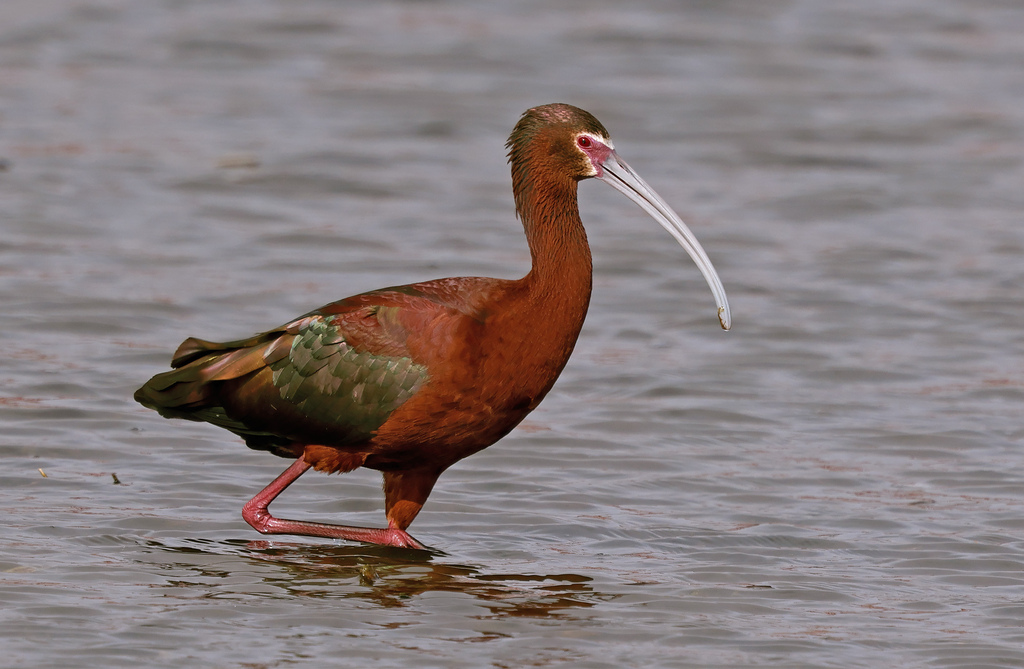
The white-faced ibis (Plegadis chihi) is a wading bird in the ibis family, Threskiornithidae native to the Americas.
This species breeds colonially in marshes, usually nesting in bushes or low trees. Its breeding range extends from southwestern Canada and the western United States south through Mexico, as well as from southeastern Brazil and southeastern Bolivia south to central Argentina, and along the coast of central Chile. Its winter range extends from southern California and Louisiana south to include the rest of its breeding range.
From the article White-faced ibis on Wikipedia (CC BY-SA), quoted section by section
Description
In its non-breeding plumage, the white-faced ibis is very similar to the glossy ibis except that it tends to be slightly smaller and its plumage has a somewhat warmer color. Breeding adults have a pink, bare face bordered with white feathers (rather than a bluish bare face with no bordering feathers), a grey bill, and brighter-colored, redder legs. Adults have red eyes year-round, whereas glossy ibises have dark eyes. Juveniles of the two species are nearly identical. Measurements:
Length: 18.1–22.1 in (46–56 cm) Weight: 15.9–18.5 oz (450–525 g) Wingspan: 35.4–36.6 in (90–93 cm)
Range & habitat
The white-faced ibis occurs in Canada, the United States, and Central America, and a second subspecies inhabits the southern half of South America, east of the Andes Mountains. In 2012, the total population size was estimated to be 1.2 million individuals, and increasing. The IUCN rates it as being of Least Concern. Migration and interchange between North and South American subspecies does not occur. Within North America, birds breeding in northern areas of the range move south to wintering areas. For example, breeders in northern California and southern Oregon move to wintering areas in southern California and México or Central America. Some birds breeding in Yellowstone in Wyoming will overwinter in areas such as Texas and coastal Gulf of Mexico regions. Birds are increasingly sighted east of the Mississippi River in the eastern United States and Canada in the summer and autumn.
Wikipedia: “Distribution”
What it does
The white-faced ibis eats a variety of organisms, including many invertebrates such as insects, leeches, snails, crayfish and earthworms. It may also eat vertebrates such as fish, newts, and frogs. Its feeding style is to use its bill to probe for prey.
Wikipedia: “Feeding”
Listen
Looking for field recordings…
Where it lives
Recorded sightings
—
geo-referenced records in GBIF, from museums, herbaria and field observers.
Drag the globe to turn it. Dots are where records exist, not a range map; darker means more records.
In the stacks
Searching the stacks…
Every page naming Plegadis chihi in the Biodiversity Heritage Library →
This page is assembled live from iNaturalist, GBIF, Wikipedia, the Source Library and the Internet Archive. It is not yet part of the hand-edited codex. iNaturalist taxon 3759.