- Animals
- ›Chordates
- ›Vertebrates
- ›Birds
- ›Pelicans, Herons, Ibises, and Allies
- ›Ibises and Spoonbills
- ›Bostrychia
On eBird ↗
Spot-breasted Ibis
Live sightings near you, the range map, bar charts of when it is seen, and Macaulay Library photos and recordings.
Spot-breasted Ibis
Bostrychia rara
The spot-breasted ibis (Bostrychia rara) is a species of bird and is a member of the order Pelecaniformes and the family Threskiornithidae. It is a wading bird which lives is swampy forested areas and is found in tropical regions. Its preference for dense rainforests in tropical Africa means that it is seldom seen and is vulnerable to deforestation.
From the article Spot-breasted ibis on Wikipedia (CC BY-SA), quoted section by section
Description
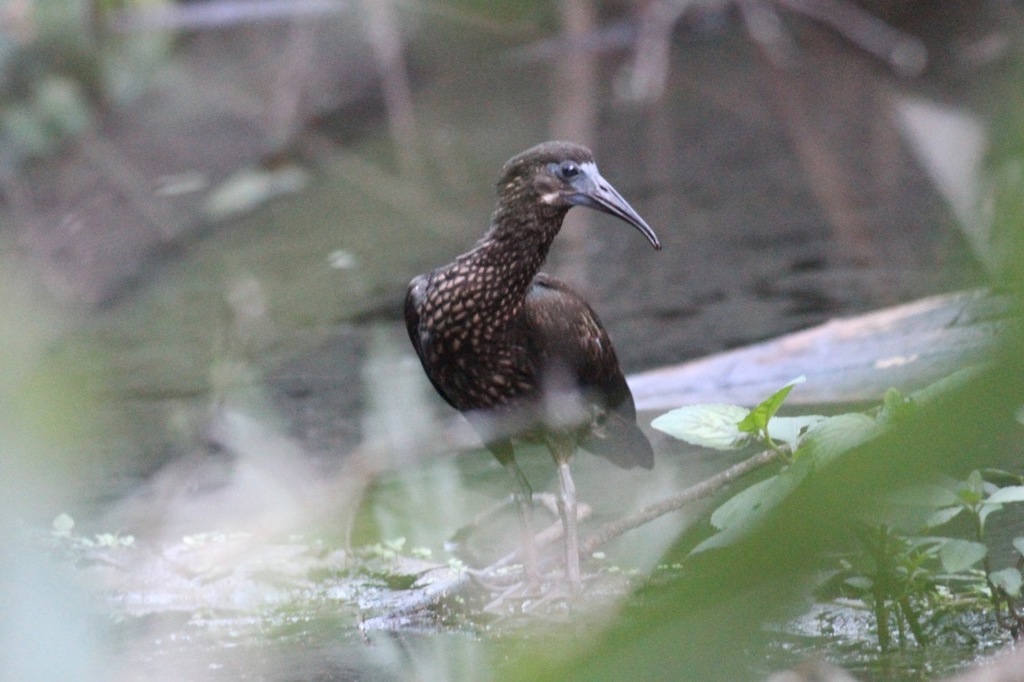
The spot-breasted ibis is a small, dark ibis (around 47 cm (19 in)), with long legs and a long red bill. The adult has a long, loose crest at the back of its head, which is dark brown to black and glossy green. Its plumage varies, but most usually tends to be brownish-blue. The mantle is brown and edged buff, but with a shiny green color. The rump and tail are blue-green, and the tail is slightly blue-green. It has blue-black wings and black underwing. The scapulars and the inner secondaries have an iridescent bronze green. The best distinguishing feature is suggested by its name: the buff-spotted neck, breast and belly that are used as a diagnostic tool to identify the species. Otherwise, the upperparts are uniformly dark, with turquoise green spots in front of and behind the eyes (smaller in females); a similar colored streak crosses the face in line with the bill. Their wing length is 270–290 mm, their bill length is 115–130 mm and their tarsus length is 56–65 mm. Flying birds can be distinguished by their broad wings and short tail. The juvenile is duller, and has a shorter crest.
Range & habitat
The spot-breasted ibis is found in Angola, Cameroon, Central African Republic, the Republic of the Congo, the Democratic Republic of the Congo, Ivory Coast, Equatorial Guinea, Gabon, Ghana, Guinea, Liberia, Nigeria, Sierra Leone, and Uganda. Although it is found across a wide range of territory is it not common and considered to be rare. In the areas where it is found it is a resident of that area, this means as a species they do not migrate and they live there all year long. Its habitat is in wooded swamps or forested areas near streams.
Wikipedia: “Habitat and distribution”
What it does
Spot-breasted ibises are difficult to observe because they are usually silent and solitary. When disturbed, they are often flushed from the ground to a nearby perch, where they remain silent. They are best located at dusk and dawn as they call in flight.
Vocalization. They are usually silent and furtive when feeding on the ground. At dawn and dusk birds call in flight, giving a loud, raucous "ha-han".
Diet. Spot-breasted ibises are omnivorous and feed on some plant material, along with various small crustaceans and insects. Invertebrates consumed include grubs, worms, aquatic snails, larvae and a variety of beetles. Usually diurnal, although they occasionally feed at night by moonlight. Away from roosting sites, most individuals feed alone or in pairs. Like other ibises, the spot-breasted ibis probes through the mud in swamps and along banks of forest rivers and streams.
Reproduction. The nests of the spot-breasted ibis are usually found about on tree branches one to six meters above ground or water. They are solitary nesters and generally lay two eggs at a time. Reproduction occurs throughout the year, except during long dry seasons when water levels are too low. For example, in Gabon birds laid in all months except July and August, with peaks in March–May and September–December. The peaks corresponded to the local rainy seasons. Incubation takes about 20 days. …
Wikipedia: “Behavior”
Listen
Looking for field recordings…
Where it lives
Recorded sightings
—
geo-referenced records in GBIF, from museums, herbaria and field observers.
Drag the globe to turn it. Dots are where records exist, not a range map; darker means more records.
In the stacks
Searching the stacks…
Every page naming Bostrychia rara in the Biodiversity Heritage Library →
This page is assembled live from iNaturalist, GBIF, Wikipedia, the Source Library and the Internet Archive. It is not yet part of the hand-edited codex. iNaturalist taxon 3745.