- Animals
- ›Chordates
- ›Vertebrates
- ›Birds
- ›Pelicans, Herons, Ibises, and Allies
- ›Ibises and Spoonbills
- ›Threskiornis
On eBird ↗
Straw-necked Ibis
Live sightings near you, the range map, bar charts of when it is seen, and Macaulay Library photos and recordings.
Straw-necked Ibis
Threskiornis spinicollis
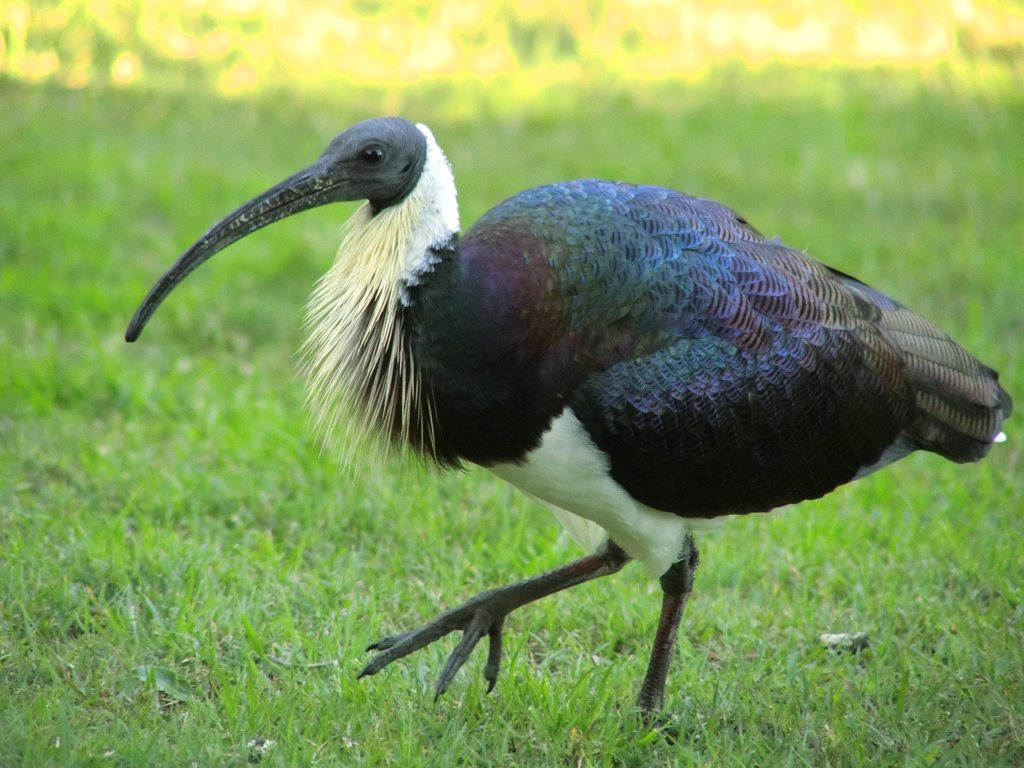
The straw-necked ibis (Threskiornis spinicollis) is a bird of the ibis and spoonbill family Threskiornithidae. It can be found throughout Australia, New Guinea, and parts of Indonesia. Adults have distinctive straw-like feathers on their necks.
From the article Straw-necked ibis on Wikipedia (CC BY-SA), quoted section by section
Description
Straw-necked ibises are large birds, around 59–76 cm (23–30 in) long, with a bare black head and a long, downcurved black bill. They have a distinctive, highly iridescent plumage, which can appear fairly uniform dirty dark brown in indifferent light; the wings are dark, with an iridescent, multicoloured sheen in sunlight. They have a shiny blue-black back, with a metallic purple, green and bronze glow, and a dark collar. The upper neck is white, as are the underparts and the undertail; their legs are usually red near the top and dark grey toward the feet. Adults have straw-colored feathers on the neck, giving the bird its common name. Their wingspan is about 100–120 cm (39.5–47 in) and weight is generally 1.1–1.5 kg (2.5–3.5 lb). Sexes are similar, although males have longer bills and females have a dark band across their upper breast. Juveniles have duller colors and shorter bills with less curvature, and lack the straw-like plumes on the neck.
Range & habitat
Straw-necked ibises are commonly found throughout Australia, nesting at least occasionally in all mainland states and territories, except in the arid interior. They are most abundant on the east coast, and are vagrant to New Zealand, Norfolk Island and Lord Howe Island. They are less frequently seen in New Guinea, Indonesia, and occasionally in Tasmania and other islands of the Bass Strait. Found around shallow freshwater wetlands, cultivated pastures, edges of swamps and lagoons, and wet or dry grasslands. They tend to avoid arid and saltwater areas, and coastal mudflats. They are extremely nomadic, and are constantly on the move searching for suitable habitats. They are frequently seen standing on high branches of bare trees, silhouetted against the sky.
Wikipedia: “Distribution and habitat”
What it does
Straw-neck ibises are partly migratory: some birds are sedentary, while others make seasonal or erratic movements when water conditions vary. Seasonal migrations are recorded from south-eastern and northern Australia, as well as from coast and inland wetlands in central Australia, and across the Torres Strait between north-eastern Australia and southern New Guinea. Non-breeding migrants arrive in western Australia and leave in autumn, the arrival dates are closely correlated with rainfall during the preceding spring. They typically fly in line or in V formation, reaching high altitudes during long-distance movements. Vocalizations are made mainly around breeding colonies; calls are composed of croaks, barks and grunts. In flight, at intervals, they may produce a hoarse grunt. They feed in flocks of up to 200 birds; they probe in soil, mud, crevices, vegetation or shallow water.
Wikipedia: “Behaviour”
Listen
Looking for field recordings…
Where it lives
Recorded sightings
—
geo-referenced records in GBIF, from museums, herbaria and field observers.
Drag the globe to turn it. Dots are where records exist, not a range map; darker means more records.
In the stacks
Searching the stacks…
Every page naming Threskiornis spinicollis in the Biodiversity Heritage Library →
This page is assembled live from iNaturalist, GBIF, Wikipedia, the Source Library and the Internet Archive. It is not yet part of the hand-edited codex. iNaturalist taxon 3741.